Category Archives: WWI
From Armistice to Aftermath: Poem for Remembrance
On this Remembrance Day, the 11th of November 2023, we reflect on the armistice that ended the First World War, a day to remember the sacrifices of so many. In 2018 – the centenary of the World War I Armistice – I wrote and posted a poem, but since then, I’ve added two stanzas and modified another. My revisions stem from viewing the two World Wars as essentially one prolonged conflict with a conclusive outcome only in 1945. The same protagonists were involved, with one side refusing to accept its initial defeat, instead preparing during the interwar period for what it considered the rightful outcome in the second.
It was a misstep for the Western Allies to agree to an “Armistice,” a term suggesting a mere truce, at a time when the German army was collapsing, the Hindenburg Line had been breached, and the Kaiser had abdicated. With no path to recovery and its Home Front in revolutionary turmoil, the Allies could have demanded unconditional surrender – and likely would have secured it.
My original poem did not touch upon the second, more devastating round of conflict, nor did it delve into the role of artillery in battlefield losses. The common belief attributes most casualties to bullets, particularly from machine guns, bayonets, poison gas, among other weapons. However, it was in fact artillery – responsible for 60% of the losses – that served as the primary agent of death and injury.
Few war poems capture this immense tragedy comprehensively. I hope my poem does so, portraying the sorrow, waste, and madness of war with poignant clarity. As we commemorate wars past on this solemn day and observe ongoing conflicts in Europe and the Middle East, let us reflect once more on the madness of war.
Echoes from the Trenches

A sea of time has passed us by, and still, we think of them,
The lives unlived, the dreams curtailed, the legions of our men.
We did not know, we could not tell, what horrors lay in store,
As year on year the mournful call went out for more and more.

A maelstrom fell upon our men of iron, steel, and fire,
And sent a piteous wail of grief through every town and shire.
"We must resist," we told ourselves, "the evil, hated Hun,
Have not our leaders deemed this war a just and noble one?"

Through mud and ice and poison gas, the order was ‘stand fast’,
This agony, like none before, it surely could not last.
For four long years, we stood our ground and bravely would not yield,
Till battlegrounds ran red with blood through every poppy field.

Nigh half a thousand miles were dug of trenches where men slept,
Exposed and wet and freezing cold, companionship they kept.
Of lice, of rats, of mice and men, over whom they scurried.
Comes the light, the lice still bite, but off the others hurried.

A wasteland scowled between the lines with not a living thing,
Where even as the dawn came up, the lark, it would not sing.
To cross through no-man’s land and live might be a lucky feat,
But barbed wire and machine-gun fire could yet that luck defeat.

How could men cause such numbing pain and suffering to all?
What thoughts of gain or equity were on their lips to call?
How could they think to justify the carnage and the blood?
What rationale endured to turn their tears into a flood?

Delusions born of hubris' ease had caused them to believe,
This war would be no different from the rest they had conceived.
But science changes everything, and chivalry was dead,
Midst strafing planes and shrapnel shards and mustard gas and lead.

Oh God above, what did man do to vent his foolish spleen,
But sacrifice the best he had on altars of the keen?
How little did he think it through and cry aloud, ‘Enough!’,
But yet preferred to stumble on with bloody blind man’s bluff.

Versailles was born with bitterness and vengeance at its heart,
And so, in barely twenty years, a fresh war would it start.
Depravity beyond belief were hallmarks of this clash,
With millions lost to racial hate, their bodies turned to ash.

Then did at last all Europe rise and vow with every breath,
To put in place a Union to end this dance with death.
A world at war must nevermore be deemed a noble thing,
Its sons and daughters join as one, this anthem now to sing.

A Lament to War
A sea of time has passed us by and still we think of them:
The lives unlived, the dreams curtailed, the legions of our men.
We did not know, we could not tell, what terror lay in store,
As year on year the butcher’s cry demanded more and more.
For full a hundred years and more our power had waxed supreme
And kept large conflagrations low and made us start to preen.
We thought we could control events and stop war in its tracks
With webs of close alliances, diplomacy and pacts.
A maelstrom poured upon our men of iron, steel and fire,
And sent a piteous wail of grief through every town and shire.
We must press on, we told ourselves what now we have begun,
Till British pluck and doggedness did triumph o’er the Hun.
Through mud and ice and poison gas the order was ‘stand fast’;
This trial of strength twixt mortal foes, it surely could not last.
For four long years we stood our ground and bravely would not yield,
Till northern France ran red with blood through every poppy field.
Delusions born of hubris ease had caused us to believe
This war could be no different from the rest we had conceived,
But science changes everything and chivalry was dead,
Midst fire and smoke and strafing planes and mustard gas and lead.
Oh God above, what did we do to vent our foolish spleen,
But sacrifice the best we had on altars of the keen?
How little did we think it through and cry aloud ‘enough’!
But yet preferred to stumble on with bloody blind man’s bluff.
What if WWI never happened?
How might the world have looked but for that cataclysmic conflict which began almost a hundred years ago? Mighty different, I can tell you. It is highly unlikely we would have a United Nations since only a catastrophe on a planet-wide scale could have caused countries to submit themselves in the future to a supra-national authority.

How might the world look today but for that cataclysmic conflict which began almost a hundred years ago?
There would be no Arab-Israeli conflict and, as a result of that, no 9/11. We would be boarding aircraft in pretty much the relaxed way we used to, with none of the demeaning scrutiny and security measures we have now. There would have been no Cold War and as a consequence of that no mad rush to be the first to land a man on the moon. Because the Second World War was the unfinished business of the first, rocketry was given priority by the Germans as a possible war-winning technology and without that impetus space technology would be way, way behind where it is today. We might not even have those satellites circling the earth which give us GPS, satellite television and so much else. Computer technology – also hastened by war – would still be in its infancy and the World Wide Web would be non-existent. The whole business of electrical miniaturization on which just about everything today depends received a major shot in the arm by the space effort. Of course we would have got there in the end but it would have been at a much more leisurely pace.
In geopolitical terms, the landscape would be just as dramatically different. There would be no European Union since it was only the trauma of the two World Wars which caused Europeans to think there had to be a better way. We would probably still rule India and most of the other European empires would be staggering on, though under rising pressure for emancipation along with us. Russia would have evolved from a tsarist autocracy into a fully fledged democratic state. All the fallen monarchies of Europe – the Hapsburgs of Austria/Hungary, the Hohenzollerns of Germany, he Tsar of Russia and even the Sultan of Turkey would still be in place along with a clutch of Balkan princlings. It is likely, though, that most of them would have had their wings clipped democratically.
But the Emperor of China would still be gone. He went three years before the Great War started, discredited by his inability to prevent China’s humiliations by the European colonial powers. But the new China would have had a Japanese experience; it would have taken the Japanese approach of if you can’t beat ’em, join ’em, and industrialised like mad. Today, most probably, it would be the top economic as well as military power in the world with Uncle Sam as No. 2. It would have avoided the trauma of the Mao experience and be like Japan, a democratic state. Britain’s colossal overseas investments – all lost to war – along with her staggering land holdings around the world would have been deployed to who knows what ends. They might even have allowed her to stay top dog.
All in all it would have been an utterly different landscape from the one we see around us today. It would not necessarily have been a better world since many of the less salubrious features of the old world would not have been swept away and there would have been umpteen disputes leading to what may be described as bush-fire wars.
As for no conflict with the Muslim world, that is because there would be no state of Israel. If there was any conflict it would be with their Ottoman overlords – it would be them, not us, taking the flak. It was Britain’s seizure of Palestine and the destruction of the Ottoman Empire along with its foreign secretary’s promise to allow a home for Jews in the Holy Land which made the creation of Israel possible. He had no idea it would lead to the dispossession of millions of Arabs from their ancestral lands. This, above all else, is what drives the Jihadists today along with Western military intervention in Muslim affairs. They take the view that it was not a kind-hearted act on the part of Britain regarding Jews – which in fact it was – but a calculated move to plant a Trojan Horse in their midst which would do the West’s bidding and help it keep control of them.
One of the consequences of the two World Wars was to so weaken and discredit the European powers that it hastened the end of their empires. Had the people of the various empires gained their freedom at a more leisurely pace – perhaps as much as a century later – there would have been more time to prepare cadres of their people and put institutions in place which could have avoided the shambles we saw following the rush to independence after the war. Africa, today, with its boundless resources, might perhaps be a well-governed and prosperous continent
But war did hasten the end of deference – à la Downton Abbey – and dispose, in the process, of autocratic monarchies. Only in the victor or neutral states did they survive. Interestingly, not a single state which abolished its monarchy has had a change of heart and reinstated it. I suppose that is our fate when something cataclysmic comes along one day to discredit our own monarchy.
Apart from the most obvious ones – the advancement of science, the UN and the EU – the other major beneficiary of war has been the emancipation of women. Oddly, it was not the dictatorships with their powers of compulsion (the USSR was an exception) which were the earliest and most successful in harnessing the abilities of the fair sex, but the elective dictatorships of the West. Albert Speer, Hitler’s armaments minister, was always bemoaning the Reich’s slowness in this crucial field to his boss.
Where does the blame lie for WWI?
No one doubts that the war against the Nazis was a necessary war – the closest thing there has ever been to a just war – but argument still rages as to responsibility for World War One.
Our prime minister wishes that all state school children should not be allowed to forget that 100-year-old conflict which took nearly a million of our brightest and best and scarred the psyche of the generations which followed, including our own. He wishes all of them to visit the battlefields of Flanders and is putting up £50 million to commemorate the tragedy.
Was this a war that could have been avoided – at least by us? In my view absolutely not.
 It all began with an assassination in distant Sarajevo, the Bosnian capital besieged in the recent Balkan wars. That pistol shot triggered a chain of events very like a line of dominoes, the first of which that assassination had pushed over. Each domino represented a Treaty which bound this country to that. All Europe was locked into a web of alliances of immense complexity. It was quite unlike the simple NATO v Warsaw Pact confrontation of the Cold War.
We alone of the great European powers had wriggle room enough not to get involved. Our sole commitment was to tiny Belgium which we had been instrumental in setting up a hundred years before, after the defeat of Napoleon. So why did we do it? Why did we risk not only our own defeat but the survival of our worldwide empire? The answer lies, I believe, in the threat which we believed militaristic Prussia posed to the entire world order. Prussian-led Germany was not like any ordinary state. Its closest historical parallel was to be found in ancient Sparta. The whole state revolved around the military.
Statehood had come late to Germany and it was militant Prussia which led the drive for unification of the patchwork of German principalities. Once this had been achieved it launched itself on tiny Denmark, then Austria and finally on France on which it inflicted a crushing defeat in the Franco Prussian war of 1870. Strange as it might now seem, Prussia’s greatest friend and ally had been Britain. She had stood with us on the field of Waterloo and had never stopped admiring us. Then she set about copying our industrial success and this she achieved brilliantly. So now you had a militarily powerful Germany allied to a mighty industrial machine and the largest, by far population and land mass in non Russian Europe. ‘Time for an empire’, thought the Germans. Trouble was that because of the lateness of Germany’s arrival on the international scene and despite her now great power status, she had missed the bus; the world had been carved up between all the other European states. Even tiny Belgium had a great empire in Africa. Germany was left with the scraps.
Huge resentment festered in the German body politic. Their deserved place in the sun had been denied them. But the Prussian military were more upbeat. If the world could not become their oyster then Europe certainly could. They reckoned that if they struck hard and early they could deliver a knock out blow. So Germany would have its empire, after all: the whole of continental Europe. France, Germany’s arch enemy, would certainly have gone down to defeat without us. Russia did. And what would Europe have looked like under a Kaiser jackboot?… an army barracks with occupying Teutons from the Atlantic to the Urals. Next in line would have been Britain and its empire.
Apart from an obsession with all things military, what other aspects of a German-dominated world should we have had to worry about? In a far off corner of Africa – a part which none of the other colonising powers were interested in (Namibia) – they were already practising genocide against the gentle, hapless Herero people. It was a grim precursor of what was to come 21 years later against European Jews. Interestingly, the German governor of the colony responsible for the genocide was none other than the father of Hermann Göring, Hitler’s No.2, and founder of the Luftwaffe and dreaded Gestapo.
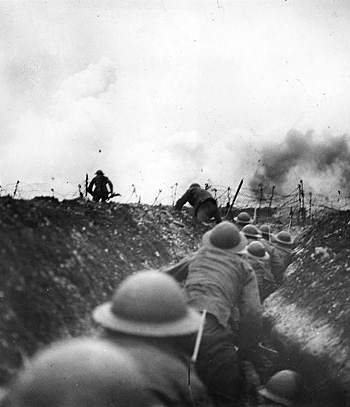
So while argument continues to rage as to who was responsible for the Great War, I personally have no doubt that it must be laid squarely at the door of militaristic Prussian-led Germany. It was gagging for a fight. None of the participants had any idea of the horrors which the first war of science was about to unleash. They all marched off with gay abandon and trumpets blaring into a maelstrom of bullets, machine guns, barbed wire, poison gas, incredibly big gunned artillery, tanks and strafing aircraft. And they dug a line of trenches 600 miles long from the English Channel to the Swiss border and hunkered down for four terrible years amidst the vermin, lice, lashing rain, mud and freezing ice. Time after time they were ordered out of those trenches into a withering fire that killed them on an industrial scale.
No one knew what they were letting themselves in for, least of all the supremely confident Brits. Their attitude could be summed up by their recently dead Queen Victoria who when questioned about the possibility of defeat by the South African Boers, replied “It does not exist”. We thought we would be in Berlin by Christmas, four months away. It took four years. Germany’s second attempt at European conquest, 21 years later, was because Hitler managed to convince it that they had not been soundly beaten, first time round, which in fact they had. A more fanatic, ideologically driven effort backed by even better weaponry, he considered, would change the verdict of WWI. He was almost right. So toxic and malign was the very idea of Prussia considered to be by the victorious Allies after WWII that, at the stroke of a pen they abolished it – the only state ever to be so dealt with.

 The Last Foundling