Blog Archives
Unmasking Russia’s WWII Narrative
A crucial aspect of history has not received the attention it deserves: responsibility for starting WWII does not rest at Germany’s door alone; Russia was a joint partner in the enterprise. We, the British, had pledged to take up arms were Poland to be attacked. Well, she was—by Germany from the west and Russia from the east. When the two attackers met at the agreed line, their soldiers shook hands, and Poland disappeared for four years.
What the world was unaware of at the time was that the two dictatorships had secretly agreed between themselves, in that stunning Non-Aggression Pact—between two former ideological enemies—that they would share Poland between them. Russia went even further, getting the Germans to turn a blind eye to their seizure of the three Baltic states. Only an understandable reluctance to engage simultaneously with two major powers prevented Britain from declaring war on Russia as well.
Three more misconceptions, I submit, still cloud our vision of those times. Russia never refers to that conflict as the Second World War for a very good reason: it prefers instead to call it The Great Patriotic War. This spin allows it to pose as an innocent victim attacked while it had a peace treaty with a treacherous fascist power. Were it to acknowledge 1939, with the invasion of Poland, as the start of WWII, then its joint invasion would put it squarely in the crosshairs of culpability.
The third myth insisted on is that their country did the lion’s share of the dying. In fact, it was their subject peoples: the Ukrainians, the Belarusians, the Caucasians, the five Muslim Stans, and the Siberians, who took an even bigger hit than the Russians themselves. The Bolsheviks, when they took power, liked to pretend that they respected the sovereignty of all the nationalities that their Tsarist predecessor had vanquished; but they were never willing to give them back their freedom. They insisted on retaining the former empire’s conquests in their entirety, and they fought a bloody civil war to do so. To camouflage the empire’s continuance, they came up with the fiction of the USSR—a Union of Soviet (read committee) Socialist Republics. This, they held, was no empire like the British or French but a heartfelt union of free-minded people.
Yet another myth that the communists cultivated is that they won the war virtually unaided. How many people know that half the tanks used to stave off defeat in the Battle for Moscow were given, free of charge, by the British? How many people know that we and the Americans provided Russia with 20,000 aircraft, 19,000 tanks, and a veritable arsenal of every kind of war material you can think of, including the boots that the Red Army marched in? And that’s another thing; they didn’t need to do much marching. Its long advance towards Berlin was almost entirely motorised—courtesy of those same allies they still insist were of next to no help. Over one hundred Royal Navy ships went down in the freezing waters of the Arctic, where survival time in the water was two minutes, in getting those supplies to Russia.
Can anyone seriously doubt that, were a quarter of Hitler’s armed forces not tied down facing us in the west and been available for the attack on Russia, it would not have been successful? It very nearly was anyway. Moreover, if these enormous supplies were taken into the equation, can anyone further doubt that Russia’s defeat would have been even more catastrophic than that of France a year earlier? Hitler had no plans to exterminate Frenchmen as he did Russians.
History will eventually catch up on Russia’s false narrative of winning the war almost single-handedly. As for the bloodletting of the non-Russian nationalities, they too will receive the just homage they deserve. Not for a minute am I saying that the Russians themselves are not to be saluted. Their bravery and steadfastness in World War II are the stuff of legend. However, it is their leaders who cannot come to terms with democracy and seek only a continuance of the authoritarian model, which is all their benighted kinsmen have ever known. Theirs is almost the saddest of histories of any nation on the planet. One day, events will draw down the curtain on this mournful history and set them on a new path. Those events may be happening before our very eyes right now in distant Ukraine. A prostrate, defeated, and humiliated Russia may see its captured nations seize their chance to gain their independence. Across a front stretching for thousands of miles, Russia will be quite unable to contain their rebellions. Japan, still technically at war with Russia, might take back the Kurile Islands stolen from it at the very end of WWII. China apart—with its occupation of Tibet and Xinjiang—we may be about to see the breakup of the world’s last empire.
As for ourselves, in that titanic struggle a full lifetime ago, we were offered a very tempting deal at the beginning by Hitler: accept his dominance of Europe, and he would accept our dominance of that quarter part of the world our empire controlled. Funnily enough, it was the same deal that Napoleon had offered 140 years earlier. We rejected Hitler’s deal as we had Napoleon’s and, against all the odds, chose to fight on alone, which we did for over a year. It is fair to say that that hugely moral and brave decision saved the entire world from a dystopian nightmare that might very well still be with us today.
Beijing is fighting the tide of history
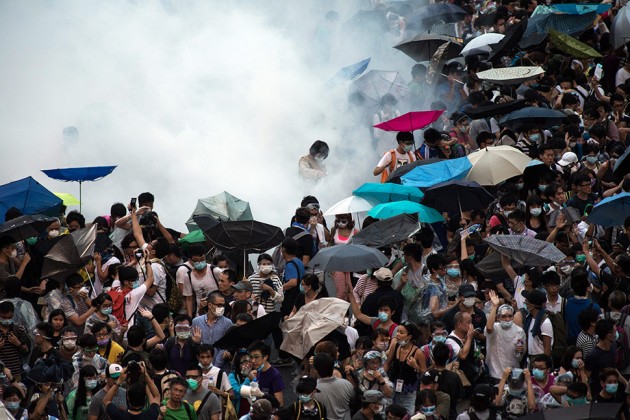
A Tiananmen Square solution is no longer an option in this media savvy world.
I sometimes think that China believes it should receive special treatment and indulgences from the rest of the world. It seems to have got it into its head that it is a case apart, and that the rest of the world has no place in offering it advice, much less in criticising it. Take what is going on in Hong Kong at the moment. The people of that former colony of ours are asking no more than that China honour the agreement standing when we departed the colony in 1997 – including the ability to choose their own administrators. That seems fair enough, doesn’t it? Yet having a list of approved candidates presented to them by the Communist authorities in Beijing, which inform them that they can chose any one of these, is not quite what the rest of us understands as free choice. It’s like when Henry Ford quipped about his Model T that you can have any colour as long as it’s black. For Beijing, read red.
But Beijing dreads any move in the direction of opening up Chinese society, even though the drumbeat for change grows louder every day. The Central Committee remains fixated on what became of the Soviet Union under Gorbachev when he recognised the inevitable and began the process of cutting the people a bit of slack. Look where that got him, Beijing says to itself. The result of the ending of the Cold War is that there are three times the number of democracies in the world today as there were at that time.
Try as the Communist authorities might to control the flow of information, they know that with the advent of the computer and, even more so, the world wide web and social media, it becomes daily more difficult to keep people in the dark. A while back I heard that years passed and there were still people in China who did not know that the Americans had landed a man on the moon. It didn’t fit with Communist orthodoxy which held that capitalist science was inferior to their own, so they kept quiet about it. There are echoes here, too, of that chap who fought on in the jungles of Southeast Asia for twenty-seven years after war’s end because he did not know that the atomic bomb had been dropped and that it was all over. Such situations are inconceivable in today’s world. Incidentally, the man was feted on his return to Japan and said only that he was awaiting orders from his commanding officer. Some wait!
Beijing and its leaders know that the tide of history is against them. No doubt their hope is that they can put off the evil day beyond their own lifetime so that they can continue to bask in the aphrodisiacs of total power. They thought they had identified Gorbachev’s mistake – that of opening up society rather than delivering the goodies that mysteriously only capitalism seemed able to produce. So they abandoned the command economy and Marxist economics and plunged, pell-mell, into capitalism. That made a nonsense of everything that Mao and the Long March stood for, but that didn’t matter so long as it enabled them to hang on to power. The worrying thing for the rest of us is that, having performed that astonishing conjuring trick, they seem unable to realise that a wealthy man – and there are a great many in China today – is not so accepting of orders as a poor man. He may have been willing to forego liberties in pursuit of getting out of the gutter, but once out he wants to breath the sweet air of liberty. That is the Politburo’s dilemma and it is an impossible one to solve in a way that allows it to keep power. Trying to square that intractable circle is further complicated by a very dangerous legacy of history.
China, I fear, has something of a contempt for the rest of humanity. For so long it considered itself the centre of not just the world, but of the Universe – and in many respects it was (at least of the world that followed, Persia, Greece and Rome). Although imperially ruled, with the usual aristocratic class, it did have advancement for the plebs by examination – the Mandarin system. So convinced was it that it had nothing to learn from the rest of the world that it did a North Korea and sealed itself off from what it considered the contaminating influences of its fellow humans, deeming them “barbarian”.
Our own Lord McCartney’s high-powered, governmental trade mission to the Celestial Kingdom in the 18th century turned out to be a very strange affair, bearing in mind that he was a “barbarian”. While the emperor’s court was in awe of McCartney, his entourage and even more so of what he had brought with him, the great man himself was nonplussed and uncomprehending. He was even disdainful. Yet here before him was a pro-consul of the mightiest power on earth, whose nation was in the process of changing the face of humanity with its Industrial Revolution. He was laden with a vast array of the products of that revolution, several of which the emperor played with like a little child.
Yet in the end, the ‘Son of Heaven’ turned his back on them (the only thing he couldn’t resist were clocks). “Go back to your master, King George,” he said, “and thank him. Tell him that we have everything we need, but he is welcome to do homage to me as do all the other rulers of the earth.” And that was that. China, in the years following, paid a terrible price for such highhandedness. Two maritime wars with the new super power laid it prostrate and humbled with the Victorians seriously considering annexing it. In the process it was forced to engage with those products it had so scornfully rejected a hundred years before. It is only now recovering and turning out those same products itself.
Until recently, China refused to believe the ‘Out of Africa’ origins of the human race. It actually believed that they had quite separate beginnings to the rest of us. For a long time we all thought that Homo sapiens shared the world with only one other kindred species: Homo neanderthalensis, or Neanderthal Man. Then on a small island called Flores in Indonesia, a new hominid was found. He was only a metre tall and was nicknamed Hobbit. Although from the east, China would have no truck with being related and, indeed, he wasn’t except in the wider Homo sense. Soon after, but this time on the mainland of Asia itself, quite close to China, was found a new but normal sized hominid which we called Denisovan Man (named after Denis, a Russian hermit who lived where the fossils were discovered in the 18th century). Still China insisted it was distinct.
Finally those illusions were shattered when a new science was brought to bear: DNA. It had no choice but to accept that ‘Out of Africa’ hypothesis – that it was just like the rest of us and was once black with frizzy hair. China has now joined the comity of nations and needs all of us just as much as we need it. But its grievances at past humiliations and present ambitions will have to be contained, and that’s not going to be easy. It never, historically, interested itself in the world beyond Asia – except for one brief period in the 15th century when it built a gigantic fleet with ships four times larger than Europe’s, stuffed with presents for the ‘ignorant savages’ who did not have benefit of his imperial rule but who could, nonetheless, submit to the overlordship of the ‘Son of Heaven’. It reached as far as the east African coast. At that point in time it could have stopped Europe in its tracks, since it preempted Magellan’s circumnavigation by seventy years and been itself the great exploring power which opened up the world. But once again its insularity when a new, less enterprising emperor came to power was its undoing. He ordered the fleet destroyed and imposed death on anyone caught building a sea going vessel.
The nations which now have to band together to resist China’s present ambitions are those of Southeast Asia, particularly those around the South China Sea where large oil deposits have been found. Meantime it is preoccupied with its standoff with Hong Kong’s dissidents who, sooner or later, will prove the catalyst for opening up the whole of China. A Tiananmen Square solution is no longer an option in this media savvy world. And besides, it knows that should it apply such a method it can whistle goodbye to the people of Taiwan ever agreeing to reunite with the motherland. For that is its most cherished territorial ambition.
China’s long history makes it a country that thinks in centuries. Thankfully it is a nation which seldom acts hastily, and once it has been persuaded to come down from that pedestal it has perched on for so long it will become a good friend and contributor to the rest of humanity.

 The Last Foundling