Blog Archives
Gods, Princes and Priests explained
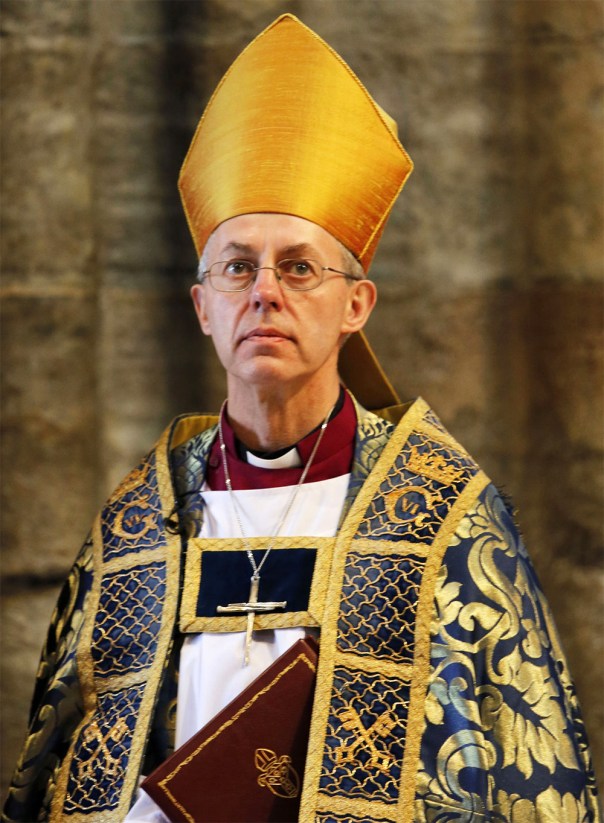
Justin Welby, a modern-day pharoah
Spain’s Seville is not considered one of the great metropolitan cities of Europe, though with almost 700,000 inhabitants it has much to fascinate and a climate you can only to dream of. But four centuries ago it was such a city and all Europe stood agog at its magnificence and, more particularly, at the stupendous wealth unloaded at its quaysides. For it was here that the treasure ships from the newly discovered Americas disgorged their plundered cargoes of gold, silver and precious gems.
To my great delight, I recently spent three days discovering the city and took a cruise down its river of former opulence, the Guadaíra. I am a man who likes his city breaks and I have visited scores of Europe’s great cathedrals, but none overwhelmed me in quite that way that Seville’s did. It was vast and held aloft by columns twice the width of mighty Karnak’s, the Egyptian temple at Luxor.
As I wandered round I was struck by the sheer quantity of gold, silver and precious stones displayed – so much more than any of the other cathedrals I had visited – and it got me thinking.
Though never a Marxist, I have long believed that that he was not so far wide of the mark when he opined that religion was the opiate of the masses. Humanity needed relief, not to say hope, against the terrible catastrophes which regularly decimated its numbers.
Almost certainly, that cathedral’s enormous structure and its accompanying wealth came courtesy of those grateful mariners and, in particular, their captains for surviving the perils of the deep and coming safely home. Ocean going in those days was enormously risky. Of the five ships that Ferdinand Magellan set out with on the first circumnavigation of the planet, only one, worm-eaten leaky vessel made it home with eighteen half-dead souls out of an original complement of 260. That number did not include its captain. Our own Francis Drake was the first commander to survive such a voyage but he, too, lost four of his five vessels. Fortuitously, among Magellan’s lucky survivors, was a man whose job it was to keep a journal of the incredible events and sufferings of that epic voyage.
So surviving mariners had much to be thankful for. They were also mindful of the appalling deeds inflicted on the indigenous peoples they encountered. Those early conquistadors would not only have been anxious to give thanks for their god’s protection, but also to seek his forgiveness for their cruelty. How better than to bestow a portion of that plundered wealth on his house, the great cathedrals. Its priests would have been only too happy to encourage such a belief and provide absolutions, along with an assurance that continuance of such largesse would secure a safe passage to the hereafter.
If the forces which play havoc with man’s safe existence – droughts, hurricanes, earthquakes, floods, lightening and tsunamis – had been absent from the early Earth and it had been a big, beautiful all-providing planet, I do not believe humans would have felt the need to come up with gods. As it was, we had no understanding of the dark forces (as we saw it) ranged against us, what created them and, more to the point, what abated them. In man’s view, those forces had to be the work of all powerful gods. When those gods vented their spleen, it had to be because they were angry with us.
It made sense, in those circumstances, to appease them. Sacrifices, even human ones, might seem the answer. An original multiplicity of gods was eventually honed down to one and, despite all of science’s unravelling of the mysteries which so terrified early man, that god is still with us.
Man’s first societies needed no rulers, but as they began organising and learned to work together cities came into existence which vied with other cities. Soon rivalry erupted into violence. The most dynamic of the citizenry thrust themselves forward to take control. The era of power politics had arrived along with kingdoms. But kingdoms had to be secured at the point of the sword. It was a case of “might made right”. If somebody came along later with more might – just like in the animal world – then the incumbent’s legitimacy was lost.
This was the point at which fresh players arrived on the scene. The Christian priesthood offered the pagan Roman emperor, Constantine, a deal: if he would take the cross and make it the official religion of the empire, they would lend their support to his regime and sanctify it. It would not henceforth be relying on brute force alone, but it would have the kingship legitimised by the god of the new faith. The priesthood would put together a service (coronation) and have the ruler anointed in God’s name. He and his heirs would then rule by divine right. Those seeking to unseat him by violence would be deemed usurpers. It was a brilliant arrangement and rulers everywhere after Constantine bought into it.
Even weak or useless rulers who, in earlier times, would have been quickly toppled, were often enabled to live out their reigns. Such was the mysticism of the coronation ceremony that the population was driven to accept the monarch as God’s anointed. And God was not to be taken lightly. Faith in the teachings of the church was all pervasive and ruled every aspect of daily life.
As for the church’s power and its own desire for riches, both of which ran counter to the founder’s tenets, its appetite grew exponentially. The mighty cathedrals, designed to overawe, represented its own rival palaces to those of the monarchs. Emulating royal pretensions, they even managed to get themselves officially declared ‘princes’ of the church. And in order to impress, and again copy the sovereigns, they designed for themselves rich vestments quite distinct from the laity. The elite – the bishops – fashioned crowns (mitres) modelled on those of the pharaohs, those most ancient and superior of all monarchs.
It was all a far cry from the open-air simplicity of their founders’ teachings, which abhorred the pursuit of wealth and needed no churches. It wasn’t long before the head of it all, the Pope, came to consider himself lord even to the sovereigns and that his authority outranked that of all the kings of Europe, whom he insisted drew their legitimacy from him.
The faith continues to attract widespread, though diminishing, support. In an age of incredible science, when we are close to revealing the Theory of Everything, kings still reign – though in fewer numbers – and priests still wave their incense and pronounce their benedictions. Though we understand now the origins of the forces which once were so inexplicable and destructive, certain of us still cannot bring ourselves to cut loose from the old superstitions – though Christendom is closer to it than Islam. In India, multiple gods still haunt the Hindu imagination.
As I walked away from the great cathedral, which housed Columbus’ tomb, I understood for the first time how this non-capital city held such riches. It was the first landfall of those treasure ships and the place where mind-blowing wealth was disgorged. My thoughts turned to those unkempt, near-naked mariners carrying armfuls of gems and bullion down the gangplanks and the overjoyed priests who would rush to greet them. Was ever a house of God better located?

 The Last Foundling