Blog Archives
NATO’s Unity and the Challenge of Article 5
All of us have felt safe in the belief that, should any one of the thirty NATO countries be attacked, it would trigger an automatic response from all members, putting them at war with the attacker. However, today, for the very first time, I read in the Sunday Times that this is not the case. For Article 5 to become a reality, unanimity is required. If a single country were to demur, then it would not happen.
Now, in any situation that requires the unanimity of so many, it is next to impossible to envisage a scenario in which such a large number would agree. It is almost certain there will be one or more who will not, especially when what they are being asked to agree to is war. Some might argue that, in a real-world scenario, Article 5 is, therefore, worthless.
In the context of the war in Ukraine, there are two countries — Hungary and Bulgaria — who we know already would not agree, and there are likely to be more recalcitrants; one that springs to mind immediately is Turkey.
The alarming situation which now presents itself is that if a desperate Russia strikes out against either of the three Baltic states, or indeed Poland, which all four now see as a real possibility, then NATO will be shown to be impotent.
The only solution that stands any chance of making Article 5 mean what it says, which is almost certainly the reason why all of its members joined in the first place, is if the European Union came to the rescue. It could make it clear that any dissenting state would forfeit its place in the Union. Such a loss would be more than likely to bring any of the foot-draggers to heel.
In providing such a guarantee of its own, the Union would be protecting its own best interests since war in Europe would likely shatter what it has lovingly accomplished over the past seventy years.
As for NATO itself, it will need to look to the future—if there is to be one for it—at this impossibly high bar of unanimity and opt for a threshold of, say, 60%. Any member who will not agree to this should be invited to leave. That way, the remaining members will have what they have long, mistakenly, believed they always had: a cast-iron guarantee.
Unmasking Russia’s WWII Narrative
A crucial aspect of history has not received the attention it deserves: responsibility for starting WWII does not rest at Germany’s door alone; Russia was a joint partner in the enterprise. We, the British, had pledged to take up arms were Poland to be attacked. Well, she was—by Germany from the west and Russia from the east. When the two attackers met at the agreed line, their soldiers shook hands, and Poland disappeared for four years.
What the world was unaware of at the time was that the two dictatorships had secretly agreed between themselves, in that stunning Non-Aggression Pact—between two former ideological enemies—that they would share Poland between them. Russia went even further, getting the Germans to turn a blind eye to their seizure of the three Baltic states. Only an understandable reluctance to engage simultaneously with two major powers prevented Britain from declaring war on Russia as well.
Three more misconceptions, I submit, still cloud our vision of those times. Russia never refers to that conflict as the Second World War for a very good reason: it prefers instead to call it The Great Patriotic War. This spin allows it to pose as an innocent victim attacked while it had a peace treaty with a treacherous fascist power. Were it to acknowledge 1939, with the invasion of Poland, as the start of WWII, then its joint invasion would put it squarely in the crosshairs of culpability.
The third myth insisted on is that their country did the lion’s share of the dying. In fact, it was their subject peoples: the Ukrainians, the Belarusians, the Caucasians, the five Muslim Stans, and the Siberians, who took an even bigger hit than the Russians themselves. The Bolsheviks, when they took power, liked to pretend that they respected the sovereignty of all the nationalities that their Tsarist predecessor had vanquished; but they were never willing to give them back their freedom. They insisted on retaining the former empire’s conquests in their entirety, and they fought a bloody civil war to do so. To camouflage the empire’s continuance, they came up with the fiction of the USSR—a Union of Soviet (read committee) Socialist Republics. This, they held, was no empire like the British or French but a heartfelt union of free-minded people.
Yet another myth that the communists cultivated is that they won the war virtually unaided. How many people know that half the tanks used to stave off defeat in the Battle for Moscow were given, free of charge, by the British? How many people know that we and the Americans provided Russia with 20,000 aircraft, 19,000 tanks, and a veritable arsenal of every kind of war material you can think of, including the boots that the Red Army marched in? And that’s another thing; they didn’t need to do much marching. Its long advance towards Berlin was almost entirely motorised—courtesy of those same allies they still insist were of next to no help. Over one hundred Royal Navy ships went down in the freezing waters of the Arctic, where survival time in the water was two minutes, in getting those supplies to Russia.
Can anyone seriously doubt that, were a quarter of Hitler’s armed forces not tied down facing us in the west and been available for the attack on Russia, it would not have been successful? It very nearly was anyway. Moreover, if these enormous supplies were taken into the equation, can anyone further doubt that Russia’s defeat would have been even more catastrophic than that of France a year earlier? Hitler had no plans to exterminate Frenchmen as he did Russians.
History will eventually catch up on Russia’s false narrative of winning the war almost single-handedly. As for the bloodletting of the non-Russian nationalities, they too will receive the just homage they deserve. Not for a minute am I saying that the Russians themselves are not to be saluted. Their bravery and steadfastness in World War II are the stuff of legend. However, it is their leaders who cannot come to terms with democracy and seek only a continuance of the authoritarian model, which is all their benighted kinsmen have ever known. Theirs is almost the saddest of histories of any nation on the planet. One day, events will draw down the curtain on this mournful history and set them on a new path. Those events may be happening before our very eyes right now in distant Ukraine. A prostrate, defeated, and humiliated Russia may see its captured nations seize their chance to gain their independence. Across a front stretching for thousands of miles, Russia will be quite unable to contain their rebellions. Japan, still technically at war with Russia, might take back the Kurile Islands stolen from it at the very end of WWII. China apart—with its occupation of Tibet and Xinjiang—we may be about to see the breakup of the world’s last empire.
As for ourselves, in that titanic struggle a full lifetime ago, we were offered a very tempting deal at the beginning by Hitler: accept his dominance of Europe, and he would accept our dominance of that quarter part of the world our empire controlled. Funnily enough, it was the same deal that Napoleon had offered 140 years earlier. We rejected Hitler’s deal as we had Napoleon’s and, against all the odds, chose to fight on alone, which we did for over a year. It is fair to say that that hugely moral and brave decision saved the entire world from a dystopian nightmare that might very well still be with us today.
Troubled waters afoot
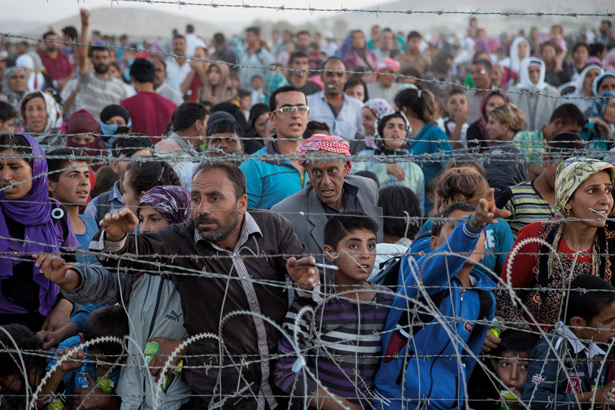
Despite a total mess surrounding us on all sides, a new opportunity presents itself in the Syrian quagmire.
What disordered times we are living though now. What a total mess surrounds us on all sides. You have Islamic terrorism stalking our cities; the European Union buckling under the weight of a tide of ‘refugees’ while at the same time grappling with bankrupt states on its periphery; our own referendum to decide whether we’re going to cut and run; an Opposition in total disarray; an America which refuses anymore to act as the world’s policeman; and failed states lapping Europe’s boundaries which have collapsed into anarchy. As if this all wasn’t enough, the world is still not through the consequences of the biggest financial crash in living memory. What are we to make of it all?
Not so long ago, we faced a foe on the other side of the Iron Curtain. He was an implacable one who had the means to destroy us all. But he didn’t. There were ground rules which we both observed, since he knew that we had the power to destroy him, too. He wore a uniform and he had client states – a great many of them – which he kept in check, as we did ours. There would be stand-offs from time to time and localised bushfire wars, but they were handled within well understood rules which worked. All that is now history and no one knows any longer where they are.
I cannot help but think that a great mistake was made when Communism collapsed. The former enemy was prostrate and needed help, but he didn’t get it. He went through ten years of hell with robber barons (oligarchs) stripping the state of assets and operating a mafia-style regime. To curb it all, but without success, authoritarianism returned to Russia in the form of Vladimir Putin. But he did not see himself to be at odds with the European Union. Indeed, he sought to reach out to it and gain acceptance as a valued partner. He even wanted an accommodation with NATO on joint exercises.
But all these overtures fell on deaf ears and now you have a troublesome bear rampaging through the undergrowth, which has had to be put into the school-equivalent of ‘special measures’ with sanctions applied.
A new opportunity, however, presents itself in the Syrian quagmire to put right some of this damage. Russia is as anxious as we are to bring that murderous conflict to an end. It is equally understanding of the need to play its part in destroying Isis, the most malignant evil since the days of Pol Pot.
Just as important, it accepts that the Syrian dictator, Assad, cannot be part of any long-term solution and that, as long as a face-saving interim arrangement can be made, Putin will go along with it. Assad has, hitherto, always enjoyed their backing; this is because Assad, and before him his father, had allowed Russia to maintain a naval base on the Syrian coast and pretend to a Mediterranean presence.
Provided its interests are protected in any eventual settlement, Russia can be expected to cooperate and play its part in ending the civil war. In so doing and acting in concert with the West, the West can begin the process of undoing the damage which its former cold-shouldering of Russia brought about. The European Union, for its part, can begin to lock Russia into its embrace and give Putin the respectability and acceptance which he originally craved.
Turning to Uncle Sam, we are going to have to accept that he will never again be prepared to shoulder the burden of world peace alone. He made a terrible mistake in withdrawing the last ten thousand troops from Iraq. Had they stayed as an emergency, fire-fighting backup, Isis would never have been able to establish itself.
What is needed now is for the European Union to step up to the plate, militarily, for the purpose of burden-sharing. Were it to do so, Uncle Sam would happily abandon any thoughts of retreating back into isolationism which was a major contributor to World War Two.
It is morally and dangerously wrong for Europe to expect any longer a free ride where security is concerned. It has the wealth and it must use it, along with others, to bolster America. I am sure the United Nations, in the interests of world peace, would welcome such a development. Of course, the European powers would have to make it clear that they seek no territorial advantage and that this is not a fresh round of empire building by the back door. Even Iran must be allowed to play its part, along with neighbouring powers.
I doubt that even if peace, by such a combination of power, can be restored to Syria that in the short term a viable government can be made to work when there is such bitterness on all sides. In that event, a United Nations mandate should be imposed on the country for It has to be accepted that, just occasionally, only the application of overwhelming force can settle the argument. This, I believe, is just such a case

 The Last Foundling