Category Archives: religion
Iran, the Straits, and the Looming Crisis for the West
A truly alarming situation is developing for the G20 advanced economies. If not handled deftly, its outcome threatens more disastrous consequences for those economies than the events following the oil crisis of the early 1970s. One of the world’s four choke points carrying 20% of its oil and gas has been shut down, and another could easily follow. Nothing like this has ever happened before.
If the religious fanatics of Iran ask their Houthi proxies in Yemen to up the tempo of their strikes in the approaches to the Suez Canal, Europe will shut down. Reserves will be exhausted in a matter of weeks — days in some cases like ours.
How, you might ask, do the mad mullahs have the power to achieve this? The Houthi insurgents of Yemen look to them for their supply of weapons, and both share a visceral hatred of Israel. Altogether, it would represent a doomsday scenario for the embattled democracies.
In such a situation, the gloves would have to come off. Any pretence at playing Mr Nice Guy would end, and the democracies, east as well as west, would feel obliged to offer their military assets to re-open these choke points to save their economies from collapse. It might well be that military occupations of the zones for a period of time would be judged necessary.
It might also be decided for future stability that if boots have to be put on the ground, the opportunity should be seized to rid the world once and for all of the theocratic regime that has brought such murder and disruption to the world. Certainly, the toppling of the regime would be welcomed by a very large majority of the population, its entire sisterhood for a start. As a result, regime change would be unlikely to be a protracted affair.
Sadly, and depressingly for future generations, recent events in Iran have demonstrated that street uprisings can no longer bring down a tyranny if that tyranny is ruthless enough to murder enough people. And that is what the ‘Holy Men’ of Iran were prepared to do — tens of thousands in this case. Only if the men with guns turn against the mullahs can change occur internally. For the moment, the promptly and well-paid 125,000 men of the Revolutionary Guard are, and are prepared to remain, loyal to their master’s dirty work.
As in Afghanistan, and sadly throughout the Muslim world, a high proportion of men quite like their faith’s legitimising male power over women. This explains why the Iranian authorities are able to mount counter-demonstrations. Look for the women among the demonstrators, and you’ll be pushed to find them. But before we get on our high horse, we should remember that our own societies were highly patriarchal only a few generations ago, though this was not mandated by scripture as it is in Islam.
With the USA and Israeli air and naval assault on Iran to neutralise its nuclear and rocketry ambitions, the aims have widened to regime change. But history has taught us that no amount of damage from the air, short of nuclear strikes, can achieve that end. Iranian cities bear no resemblance to those of Hitler’s or our own, come to that. But even so, neither of us considered surrender.
It is a great deal easier to get into things than to get out. If boots on the ground are forced on the West to secure free passage through the straits, then to quote Macbeth, ‘If it were done when ’tis done, then ’twere well it were done quickly.’ And in this case, with such majority hatred of the clerical killers of their sons and daughters, I believe it would be quick. Iranians are a clever and gifted people. There is no reason to believe that if the ghastly, evil regime that has held them in thrall for almost half a century is cast into the dustbin of history, they will not be capable of becoming a normal country and ruling themselves competently. Their civilisation, after all, was once a beacon to the world, tolerant and much admired by Alexander the Great.
The loss of the West’s confidence began with Vietnam. It continued through the fiascos of Afghanistan, Iraq, Libya and Syria. In earlier times there had been triumphs such as the Berlin Airlift, the forming of NATO, the Cuban missile crisis, and the landing on the moon. Going into countries with all guns blazing proved to be the easy bit, but putting together an exit strategy proved altogether harder. Part of the problem was a lack of understanding of the complexities of the regions they were operating in. The Middle East and Muslim world, with its Shia-Sunni divide, was made even more complex by the colonial powers’ ill-thought-out settlement of frontiers following the destruction of the Ottoman Empire. It enabled an entirely new state, Israel, to be set up, creating the thorniest issue of the lot.
Into this china shop has stormed the proverbial bull in the form of the American president. Ironically, Trump’s very unpredictability can sometimes achieve results that plodding diplomacy struggles to keep up with. If the degrading of the bestial regime in Tehran can bring about its collapse, the world and most of all Iranians should rejoice. There is everything to play for, and with luck the world’s most troublesome area may have a chance to settle down, with its remaining tyrants sleeping less easy in their beds.
Gods, Princes and Priests explained
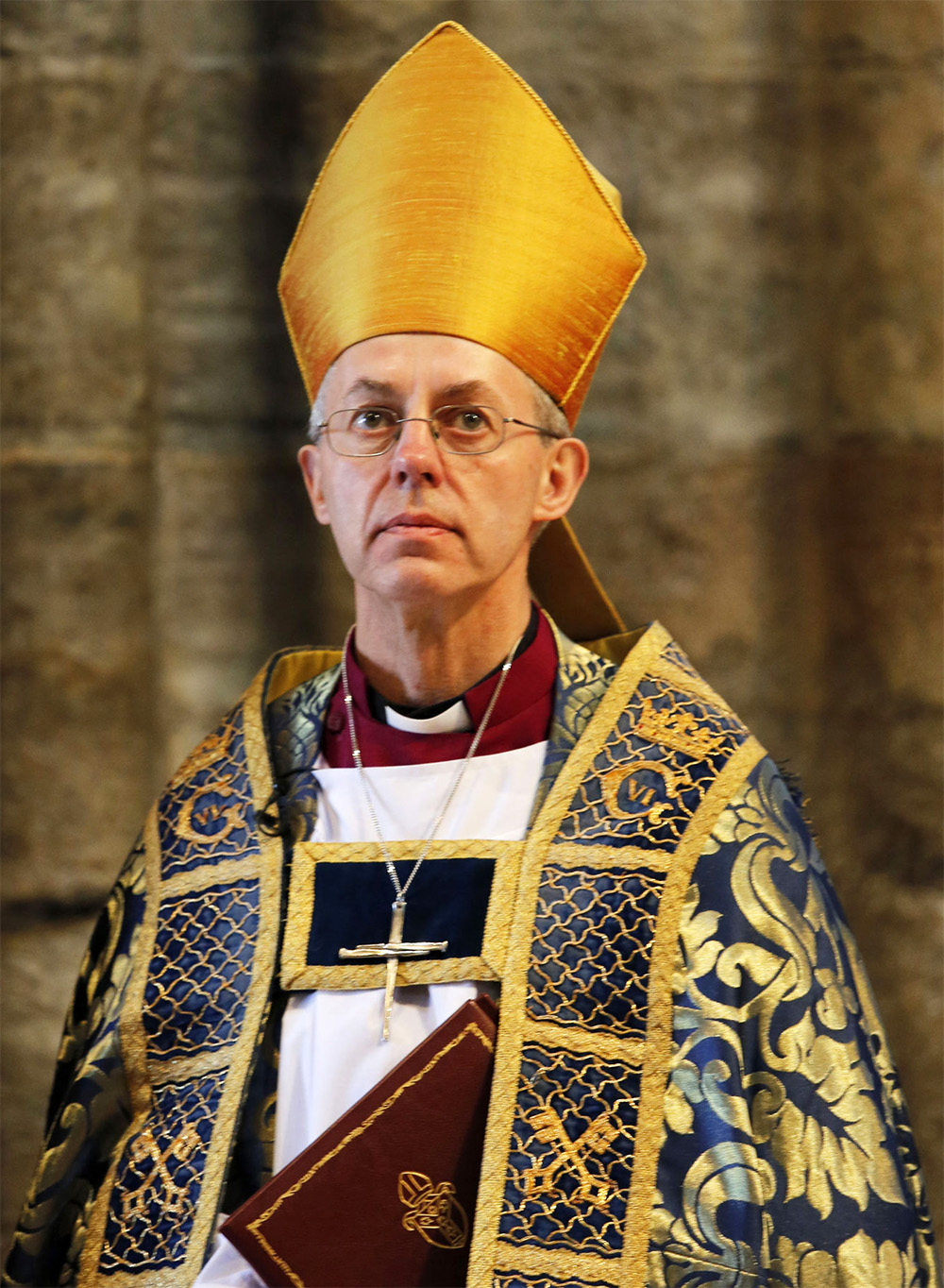
Justin Welby, a modern-day pharoah
Spain’s Seville is not considered one of the great metropolitan cities of Europe, though with almost 700,000 inhabitants it has much to fascinate and a climate you can only to dream of. But four centuries ago it was such a city and all Europe stood agog at its magnificence and, more particularly, at the stupendous wealth unloaded at its quaysides. For it was here that the treasure ships from the newly discovered Americas disgorged their plundered cargoes of gold, silver and precious gems.
To my great delight, I recently spent three days discovering the city and took a cruise down its river of former opulence, the Guadaíra. I am a man who likes his city breaks and I have visited scores of Europe’s great cathedrals, but none overwhelmed me in quite that way that Seville’s did. It was vast and held aloft by columns twice the width of mighty Karnak’s, the Egyptian temple at Luxor.
As I wandered round I was struck by the sheer quantity of gold, silver and precious stones displayed – so much more than any of the other cathedrals I had visited – and it got me thinking.
Though never a Marxist, I have long believed that that he was not so far wide of the mark when he opined that religion was the opiate of the masses. Humanity needed relief, not to say hope, against the terrible catastrophes which regularly decimated its numbers.
Almost certainly, that cathedral’s enormous structure and its accompanying wealth came courtesy of those grateful mariners and, in particular, their captains for surviving the perils of the deep and coming safely home. Ocean going in those days was enormously risky. Of the five ships that Ferdinand Magellan set out with on the first circumnavigation of the planet, only one, worm-eaten leaky vessel made it home with eighteen half-dead souls out of an original complement of 260. That number did not include its captain. Our own Francis Drake was the first commander to survive such a voyage but he, too, lost four of his five vessels. Fortuitously, among Magellan’s lucky survivors, was a man whose job it was to keep a journal of the incredible events and sufferings of that epic voyage.
So surviving mariners had much to be thankful for. They were also mindful of the appalling deeds inflicted on the indigenous peoples they encountered. Those early conquistadors would not only have been anxious to give thanks for their god’s protection, but also to seek his forgiveness for their cruelty. How better than to bestow a portion of that plundered wealth on his house, the great cathedrals. Its priests would have been only too happy to encourage such a belief and provide absolutions, along with an assurance that continuance of such largesse would secure a safe passage to the hereafter.
If the forces which play havoc with man’s safe existence – droughts, hurricanes, earthquakes, floods, lightening and tsunamis – had been absent from the early Earth and it had been a big, beautiful all-providing planet, I do not believe humans would have felt the need to come up with gods. As it was, we had no understanding of the dark forces (as we saw it) ranged against us, what created them and, more to the point, what abated them. In man’s view, those forces had to be the work of all powerful gods. When those gods vented their spleen, it had to be because they were angry with us.
It made sense, in those circumstances, to appease them. Sacrifices, even human ones, might seem the answer. An original multiplicity of gods was eventually honed down to one and, despite all of science’s unravelling of the mysteries which so terrified early man, that god is still with us.
Man’s first societies needed no rulers, but as they began organising and learned to work together cities came into existence which vied with other cities. Soon rivalry erupted into violence. The most dynamic of the citizenry thrust themselves forward to take control. The era of power politics had arrived along with kingdoms. But kingdoms had to be secured at the point of the sword. It was a case of “might made right”. If somebody came along later with more might – just like in the animal world – then the incumbent’s legitimacy was lost.
This was the point at which fresh players arrived on the scene. The Christian priesthood offered the pagan Roman emperor, Constantine, a deal: if he would take the cross and make it the official religion of the empire, they would lend their support to his regime and sanctify it. It would not henceforth be relying on brute force alone, but it would have the kingship legitimised by the god of the new faith. The priesthood would put together a service (coronation) and have the ruler anointed in God’s name. He and his heirs would then rule by divine right. Those seeking to unseat him by violence would be deemed usurpers. It was a brilliant arrangement and rulers everywhere after Constantine bought into it.
Even weak or useless rulers who, in earlier times, would have been quickly toppled, were often enabled to live out their reigns. Such was the mysticism of the coronation ceremony that the population was driven to accept the monarch as God’s anointed. And God was not to be taken lightly. Faith in the teachings of the church was all pervasive and ruled every aspect of daily life.
As for the church’s power and its own desire for riches, both of which ran counter to the founder’s tenets, its appetite grew exponentially. The mighty cathedrals, designed to overawe, represented its own rival palaces to those of the monarchs. Emulating royal pretensions, they even managed to get themselves officially declared ‘princes’ of the church. And in order to impress, and again copy the sovereigns, they designed for themselves rich vestments quite distinct from the laity. The elite – the bishops – fashioned crowns (mitres) modelled on those of the pharaohs, those most ancient and superior of all monarchs.
It was all a far cry from the open-air simplicity of their founders’ teachings, which abhorred the pursuit of wealth and needed no churches. It wasn’t long before the head of it all, the Pope, came to consider himself lord even to the sovereigns and that his authority outranked that of all the kings of Europe, whom he insisted drew their legitimacy from him.
The faith continues to attract widespread, though diminishing, support. In an age of incredible science, when we are close to revealing the Theory of Everything, kings still reign – though in fewer numbers – and priests still wave their incense and pronounce their benedictions. Though we understand now the origins of the forces which once were so inexplicable and destructive, certain of us still cannot bring ourselves to cut loose from the old superstitions – though Christendom is closer to it than Islam. In India, multiple gods still haunt the Hindu imagination.
As I walked away from the great cathedral, which housed Columbus’ tomb, I understood for the first time how this non-capital city held such riches. It was the first landfall of those treasure ships and the place where mind-blowing wealth was disgorged. My thoughts turned to those unkempt, near-naked mariners carrying armfuls of gems and bullion down the gangplanks and the overjoyed priests who would rush to greet them. Was ever a house of God better located?
 The Last Foundling