Blog Archives
Iran, the Straits, and the Looming Crisis for the West
A truly alarming situation is developing for the G20 advanced economies. If not handled deftly, its outcome threatens more disastrous consequences for those economies than the events following the oil crisis of the early 1970s. One of the world’s four choke points carrying 20% of its oil and gas has been shut down, and another could easily follow. Nothing like this has ever happened before.
If the religious fanatics of Iran ask their Houthi proxies in Yemen to up the tempo of their strikes in the approaches to the Suez Canal, Europe will shut down. Reserves will be exhausted in a matter of weeks — days in some cases like ours.
How, you might ask, do the mad mullahs have the power to achieve this? The Houthi insurgents of Yemen look to them for their supply of weapons, and both share a visceral hatred of Israel. Altogether, it would represent a doomsday scenario for the embattled democracies.
In such a situation, the gloves would have to come off. Any pretence at playing Mr Nice Guy would end, and the democracies, east as well as west, would feel obliged to offer their military assets to re-open these choke points to save their economies from collapse. It might well be that military occupations of the zones for a period of time would be judged necessary.
It might also be decided for future stability that if boots have to be put on the ground, the opportunity should be seized to rid the world once and for all of the theocratic regime that has brought such murder and disruption to the world. Certainly, the toppling of the regime would be welcomed by a very large majority of the population, its entire sisterhood for a start. As a result, regime change would be unlikely to be a protracted affair.
Sadly, and depressingly for future generations, recent events in Iran have demonstrated that street uprisings can no longer bring down a tyranny if that tyranny is ruthless enough to murder enough people. And that is what the ‘Holy Men’ of Iran were prepared to do — tens of thousands in this case. Only if the men with guns turn against the mullahs can change occur internally. For the moment, the promptly and well-paid 125,000 men of the Revolutionary Guard are, and are prepared to remain, loyal to their master’s dirty work.
As in Afghanistan, and sadly throughout the Muslim world, a high proportion of men quite like their faith’s legitimising male power over women. This explains why the Iranian authorities are able to mount counter-demonstrations. Look for the women among the demonstrators, and you’ll be pushed to find them. But before we get on our high horse, we should remember that our own societies were highly patriarchal only a few generations ago, though this was not mandated by scripture as it is in Islam.
With the USA and Israeli air and naval assault on Iran to neutralise its nuclear and rocketry ambitions, the aims have widened to regime change. But history has taught us that no amount of damage from the air, short of nuclear strikes, can achieve that end. Iranian cities bear no resemblance to those of Hitler’s or our own, come to that. But even so, neither of us considered surrender.
It is a great deal easier to get into things than to get out. If boots on the ground are forced on the West to secure free passage through the straits, then to quote Macbeth, ‘If it were done when ’tis done, then ’twere well it were done quickly.’ And in this case, with such majority hatred of the clerical killers of their sons and daughters, I believe it would be quick. Iranians are a clever and gifted people. There is no reason to believe that if the ghastly, evil regime that has held them in thrall for almost half a century is cast into the dustbin of history, they will not be capable of becoming a normal country and ruling themselves competently. Their civilisation, after all, was once a beacon to the world, tolerant and much admired by Alexander the Great.
The loss of the West’s confidence began with Vietnam. It continued through the fiascos of Afghanistan, Iraq, Libya and Syria. In earlier times there had been triumphs such as the Berlin Airlift, the forming of NATO, the Cuban missile crisis, and the landing on the moon. Going into countries with all guns blazing proved to be the easy bit, but putting together an exit strategy proved altogether harder. Part of the problem was a lack of understanding of the complexities of the regions they were operating in. The Middle East and Muslim world, with its Shia-Sunni divide, was made even more complex by the colonial powers’ ill-thought-out settlement of frontiers following the destruction of the Ottoman Empire. It enabled an entirely new state, Israel, to be set up, creating the thorniest issue of the lot.
Into this china shop has stormed the proverbial bull in the form of the American president. Ironically, Trump’s very unpredictability can sometimes achieve results that plodding diplomacy struggles to keep up with. If the degrading of the bestial regime in Tehran can bring about its collapse, the world and most of all Iranians should rejoice. There is everything to play for, and with luck the world’s most troublesome area may have a chance to settle down, with its remaining tyrants sleeping less easy in their beds.
A turbulent Islam
What is happening in Egypt and, indeed, through much of the Muslim world is sad beyond belief.
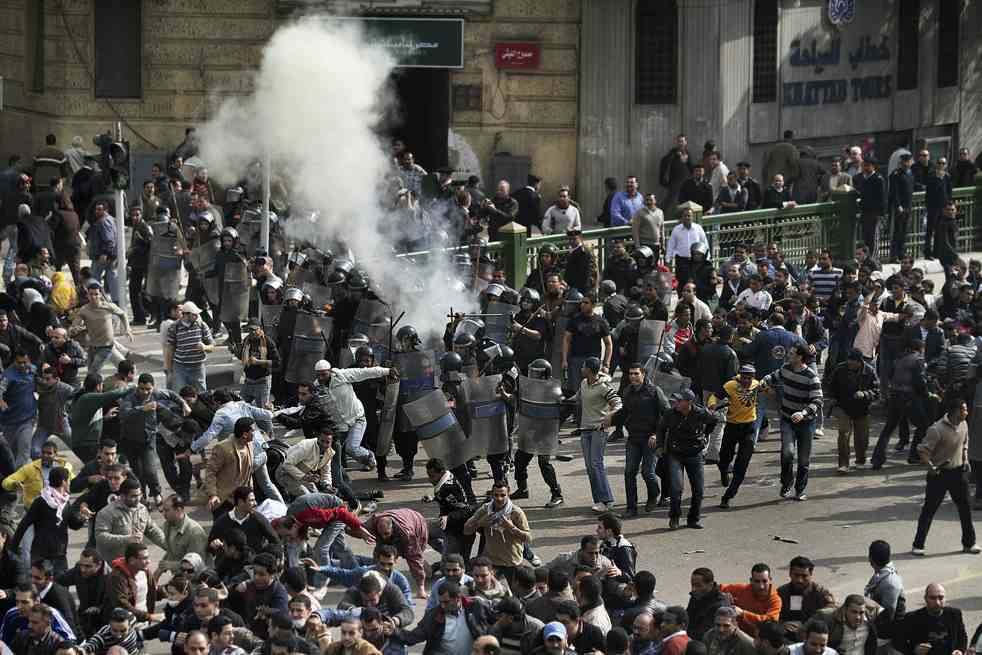
The cradle of civilisation is being reduced to barbarism with no end in sight for an equitable solution.
For two and a half years now we have seen the Syrian people tearing themselves apart. Before that it was Tunisia, then Libya, then Yemen, then Bahrain and now back again to Egypt. We even saw riots in normally peaceable Turkey. What is happening in these lands which once spawned one of the world’s most tolerant religions – lands which form Europe’s nearest abroad?
I believe it is all down to aspirations and two classes of people which live cheek by jowl with each other but yet have totally divergent views on how life should be lived. They have co-existed for many years now, but what is different today from what has gone before is the advent of the Internet, the mobile phone – which is able to tap into it – and the spread of literacy, which even the most authoritarian of regimes has proved unable to resist.
From the point of view of totalitarian regimes which find themselves unable to stop the free flow of information and the millions now able to liaise and call up street protests in an instant it is a total disaster – a truly toxic mix. It is what I call empowerment of the masses.
The two worlds of which I speak are the world of the cities and the largely unchanged world of the hinterland beyond. Across the broad expanses of the countryside – where the majority of the population still live – life goes on in much the same way as it has done for hundreds of years. Yet in the cities things are very different. The educated and young people are in revolt. Their outlook is not so very different from that of their fellow city dwellers just across the Mediterranean Sea. They want the same jobs, opportunities and freedoms as they see in the West.
In times past, their authoritarian rulers have been able to keep them ignorant of what is happening in the rest of the world, but thanks to people like Sir Tim Berners Lee, the inventor of the World Wide Web, those times are over. They are now fully aware of the venal corruption and murderous cruelty which holds them back and they are no longer prepared to put up with it. Good on them, I say.
Turkey is an interesting example to look at. Here is a not in-your-face Muslim state which has fully embraced development without compromising its Muslim faith. It has one of the highest GDP growth rates in the world.
But again the educated classes and young people were having none of it and they pulled him up sharp. This was the true reason for the recent riots.
We can take some credit for Turkey’s emergence as a secular state. It was our defeat of the old Ottoman Empire in World War One which ended the Caliphate and set Turkey on the path to modernity.
(On this note we can also take some pride too in the emergence of democracy throughout South America since it was our defeat of the Argentine military junta in the Falklands War which saw democracy restored there and umpteen other Latin American military dictatorships discredited and overthrown.)
But the great worry in Egypt and elsewhere in the troubled Muslim lands is that democracy is hijacked and used as a tool to impose Iranian-style rule by the Mullahs. At that point democracy ends.
It would be a bit like our Parliament having to seek the approval of the Arch Bishop of Canterbury before any act could pass into law.
That, effectively, is what you have got in Iran, and soon its Ayatollah hopes to have his finger on the trigger of a nuclear bomb. When the masses protested vote rigging during their 2009 election they were shot down like dogs for daring to question the Mullahs. People on the Iranian street do not like it and neither do those on the Arab street, whether it be in Cairo, Alexandria or any of the other large Egyptian cities.
The democratically elected Muslim Brotherhood – largely made up of the masses from the countryside – pressed its strict Islamic agenda too hard for the city dwellers. It did not understand that democracy only works by compromise. Morsi, the Brotherhood president, felt that it was enough that he had a democratic mandate. But urban Egypt wasn’t having it, particularly the women who saw their recent hard won liberties under threat again. The highly westernised army agreed with them.
Democracy is a fragile thing which took the West many decades to refine and make workable. It involves a great deal of give and take and a willingness to put up with the other side – in Egypt’s case the Muslim Brotherhood – but it has to learn not to push it luck too far with the opposition. Think how it sticks in the craw of right wingers in the West to put up with years of left wing policies and vice versa.
Complicating everything right now in the Muslim world is not just the stand-off between city dwellers and the countryside, but the schism between Shia and Sunni. It reminds me of the wars of religion between Catholics and Protestants, and in particular the Thirty Years War in the early 17th century which brutalised and lay waste so much of central Europe. We must hope and pray that Islam is not heading down that terrible rad.
For all its many fine qualities, Islam’s greatest failing, it seems to me, is its attitude to women. It is going to have to address that. But we must remember that it was not so very long ago that a husband in the West had the legal right to beat his wife and gain all her property on marriage. It ill behoves us to forget these things when we get on our high horse about what is happening in our neighbour’s world.
Meanwhile we must hope that things do not get out of hand in these two pivotal Arab states of Syria and Egypt so that the whole region goes up in smoke. Syria’s neighbour, Iraq is already teetering on the edge. Meantime the West must mount a monumental effort to relieve the suffering presently going on there.
Two-pronged way to lose weight
We are now into the serious business of the New Year, what we will make of it and what it will make of us.
Huge issues confront us. Will we climb out of this trough of despondency? Will we keep our jobs? Will our biggest market implode? Will America put its sub-prime market disaster behind it and start getting back to work? Will Israel bomb Iran and so plunge us into another oil crisis? Will the Arab spring end up landing us with a clutch of fanatical fundamentalist states? Will the Arab world’s most pivotal state, Syria, descend into civil war?
On not one of these issues can the most gifted political pundit give any guidance as to the likely outcome. So for myself I am going to sit tight, wait on events and try not worry too much. I suggest you do the same.
On the home front, for 25 years (particularly the later 21 in which I ran my own health club), January was the most frantic month of the year for me.
People were looking to the summer. They had been pigging out for a solid two weeks. They wanted to go into it looking better – slimmer – than they currently did. Two thirds of my entire year’s advertising budget for new members was spent in the first quarter of the year, since in that short time, if I was lucky, I could expect to enrol three quarters of my annual members.
It would cost me no less than £19,500: money spent in this very newspaper.
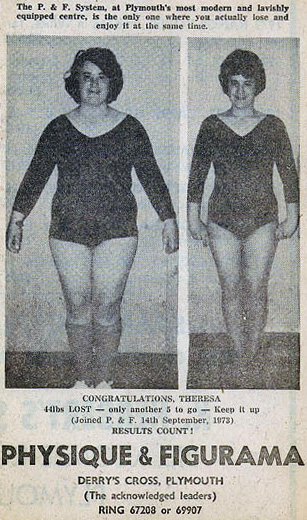
From time to time we managed to get some truly spectacular results (see inset pictures of one of our successes of 30 years ago).
The legacy of those Physique & Figurama health club days continues to endure for me.
Every Monday before I set out for work in my shop on Plympton Ridgeway, I, along with my wife, get on the scales and have a weekly weigh-in, writing it down along with the date.
Keeping our eye on the ball is the name of the game. This week, along I suspect with many of you, I had a terrible shock.
Of course, at 72, I could not run to pumping the iron, fast and furious. Instead I walk three miles a day at a brisk enough pace as to force me to breathe through my mouth. So yes, in its more modest form, exercise still continues to play a part.
I have always taken the view that three elements determine our future. One of these – our genetic inheritance – we can do nothing about (for the moment), but the other two, diet and lifestyle are entirely within our gift to control.
One of the reasons we enjoyed success over so many years in the health club was that it was never an either/or approach – dieting or exercise: it was both.
That way it did not require a superhuman effort as if you were relying on one only. Since for most people the problem was, and is, insufficient exercise and too many calories then it made perfect sense to pursue both. That way you only had to work half as hard than if you were relying on one.
So much of the success in fighting the flab is in the mind, and it does not do to ask too much of yourself. Willpower has been made extra difficult to raise in our super indulgent, lazy age and the less of that rare commodity you have to summon up the better. So the two-pronged approach was best.
You had a better chance of enjoying yourself; staying the course and seeing it though to the end.
Our great city hero, Sir Francis Drake, had it exactly right. Of course he was commenting on something entirely different, the three-year first circumnavigation of the world in which the captain survived to see it through.
But what he said still holds true for so much else. He said: “There must be a beginning of any great matter, but the continuing unto the end until it be thoroughly finished yields the true glory.”
It would be silly to equate anything we have done with Drake’s stupendous achievement, but the message is clear. It was what drove me on during the also three-year slog to complete my book, The Last Foundling. It ran to 409 pages and there were so many times I felt myself running out of steam as well as willpower, but I pressed on.
Now I must apply myself to losing a considerable amount of weight and having done that, keep it off. That last bit, keeping it off, must be the “until it be thoroughly finished” part of what Drake was referring to.
 The Last Foundling