Category Archives: Europe
NATO’s Unity and the Challenge of Article 5
All of us have felt safe in the belief that, should any one of the thirty NATO countries be attacked, it would trigger an automatic response from all members, putting them at war with the attacker. However, today, for the very first time, I read in the Sunday Times that this is not the case. For Article 5 to become a reality, unanimity is required. If a single country were to demur, then it would not happen.
Now, in any situation that requires the unanimity of so many, it is next to impossible to envisage a scenario in which such a large number would agree. It is almost certain there will be one or more who will not, especially when what they are being asked to agree to is war. Some might argue that, in a real-world scenario, Article 5 is, therefore, worthless.
In the context of the war in Ukraine, there are two countries — Hungary and Bulgaria — who we know already would not agree, and there are likely to be more recalcitrants; one that springs to mind immediately is Turkey.
The alarming situation which now presents itself is that if a desperate Russia strikes out against either of the three Baltic states, or indeed Poland, which all four now see as a real possibility, then NATO will be shown to be impotent.
The only solution that stands any chance of making Article 5 mean what it says, which is almost certainly the reason why all of its members joined in the first place, is if the European Union came to the rescue. It could make it clear that any dissenting state would forfeit its place in the Union. Such a loss would be more than likely to bring any of the foot-draggers to heel.
In providing such a guarantee of its own, the Union would be protecting its own best interests since war in Europe would likely shatter what it has lovingly accomplished over the past seventy years.
As for NATO itself, it will need to look to the future—if there is to be one for it—at this impossibly high bar of unanimity and opt for a threshold of, say, 60%. Any member who will not agree to this should be invited to leave. That way, the remaining members will have what they have long, mistakenly, believed they always had: a cast-iron guarantee.
Unmasking Russia’s WWII Narrative
A crucial aspect of history has not received the attention it deserves: responsibility for starting WWII does not rest at Germany’s door alone; Russia was a joint partner in the enterprise. We, the British, had pledged to take up arms were Poland to be attacked. Well, she was—by Germany from the west and Russia from the east. When the two attackers met at the agreed line, their soldiers shook hands, and Poland disappeared for four years.
What the world was unaware of at the time was that the two dictatorships had secretly agreed between themselves, in that stunning Non-Aggression Pact—between two former ideological enemies—that they would share Poland between them. Russia went even further, getting the Germans to turn a blind eye to their seizure of the three Baltic states. Only an understandable reluctance to engage simultaneously with two major powers prevented Britain from declaring war on Russia as well.
Three more misconceptions, I submit, still cloud our vision of those times. Russia never refers to that conflict as the Second World War for a very good reason: it prefers instead to call it The Great Patriotic War. This spin allows it to pose as an innocent victim attacked while it had a peace treaty with a treacherous fascist power. Were it to acknowledge 1939, with the invasion of Poland, as the start of WWII, then its joint invasion would put it squarely in the crosshairs of culpability.
The third myth insisted on is that their country did the lion’s share of the dying. In fact, it was their subject peoples: the Ukrainians, the Belarusians, the Caucasians, the five Muslim Stans, and the Siberians, who took an even bigger hit than the Russians themselves. The Bolsheviks, when they took power, liked to pretend that they respected the sovereignty of all the nationalities that their Tsarist predecessor had vanquished; but they were never willing to give them back their freedom. They insisted on retaining the former empire’s conquests in their entirety, and they fought a bloody civil war to do so. To camouflage the empire’s continuance, they came up with the fiction of the USSR—a Union of Soviet (read committee) Socialist Republics. This, they held, was no empire like the British or French but a heartfelt union of free-minded people.
Yet another myth that the communists cultivated is that they won the war virtually unaided. How many people know that half the tanks used to stave off defeat in the Battle for Moscow were given, free of charge, by the British? How many people know that we and the Americans provided Russia with 20,000 aircraft, 19,000 tanks, and a veritable arsenal of every kind of war material you can think of, including the boots that the Red Army marched in? And that’s another thing; they didn’t need to do much marching. Its long advance towards Berlin was almost entirely motorised—courtesy of those same allies they still insist were of next to no help. Over one hundred Royal Navy ships went down in the freezing waters of the Arctic, where survival time in the water was two minutes, in getting those supplies to Russia.
Can anyone seriously doubt that, were a quarter of Hitler’s armed forces not tied down facing us in the west and been available for the attack on Russia, it would not have been successful? It very nearly was anyway. Moreover, if these enormous supplies were taken into the equation, can anyone further doubt that Russia’s defeat would have been even more catastrophic than that of France a year earlier? Hitler had no plans to exterminate Frenchmen as he did Russians.
History will eventually catch up on Russia’s false narrative of winning the war almost single-handedly. As for the bloodletting of the non-Russian nationalities, they too will receive the just homage they deserve. Not for a minute am I saying that the Russians themselves are not to be saluted. Their bravery and steadfastness in World War II are the stuff of legend. However, it is their leaders who cannot come to terms with democracy and seek only a continuance of the authoritarian model, which is all their benighted kinsmen have ever known. Theirs is almost the saddest of histories of any nation on the planet. One day, events will draw down the curtain on this mournful history and set them on a new path. Those events may be happening before our very eyes right now in distant Ukraine. A prostrate, defeated, and humiliated Russia may see its captured nations seize their chance to gain their independence. Across a front stretching for thousands of miles, Russia will be quite unable to contain their rebellions. Japan, still technically at war with Russia, might take back the Kurile Islands stolen from it at the very end of WWII. China apart—with its occupation of Tibet and Xinjiang—we may be about to see the breakup of the world’s last empire.
As for ourselves, in that titanic struggle a full lifetime ago, we were offered a very tempting deal at the beginning by Hitler: accept his dominance of Europe, and he would accept our dominance of that quarter part of the world our empire controlled. Funnily enough, it was the same deal that Napoleon had offered 140 years earlier. We rejected Hitler’s deal as we had Napoleon’s and, against all the odds, chose to fight on alone, which we did for over a year. It is fair to say that that hugely moral and brave decision saved the entire world from a dystopian nightmare that might very well still be with us today.
Autocracy vs. Democracy: The Stakes in Ukraine
Putin, with a population three times larger than Ukraine’s, plans to expand his armed forces by 170,000. Unable to defeat Ukraine in a fair fight, he seeks to employ the infamous ‘steamroller’ approach that both Stalin and the Tsars relied on: overwhelming numbers. This tactic worked against the plucky Finns in the 1939 ‘Winter War’. They, like the Ukrainians, initially bested the autocrat of their day in spectacular fashion, until the massed ranks of Russia’s poor peasantry were thrown against them.
This time around, the vastly superior ranks of the democracies must ensure a different result. Ukraine absolutely must be supported to the end. Should Trump win the upcoming election and withhold further funding – which I very much doubt – then Europe must step up to the plate. Its resources, both industrial and financial, are twenty times greater than Russia’s, and its population is three times larger.
Should the Ukrainians find their numbers in danger of being overwhelmed – for Russia’s rulers also have historically been careless with their soldiers’ lives – then volunteers from across the continent must step into the breach. Joining the Ukrainian army would not put their respective countries at war with Russia, any more than the International Brigade supporting the Spanish government against fascist insurrectionists put their countries in the firing line. The only reason the democratically elected government lost was that the fascist regimes of Germany and Italy stepped in to aid their fellow fascists.
The Western world must realise that this struggle between autocracy and democracy is one it cannot afford to lose. The consequences of defeat are too dreadful to contemplate. Winning, which must include the recovery of Crimea, may well set in motion the breakup of present-day Russia. It will certainly bring about the fall of Putin. Restive regions with non-Russian majorities may see a once-in-a-lifetime chance to break free. The most likely regions include South Ossetia, Abkhazia, Chechnya, Belarus, Transnistria, and various Siberian Republics. In this scenario, it is entirely possible that a weakened Russia will see the Finns regain the Karelian areas seized by Stalin following ‘The Winter War’, and the Kaliningrad enclave may opt to join the European family.
Unlike at the time of the USSR’s breakup, the democracies must this time embrace the new Russia and help set it on a course that Peter the Great deeply desired for his people: to become true Europeans. Russia has much to offer once it finally turns its back on despotic rulers. The brutal war against a fellow Slav nation, which has shattered the peace of Europe, is increasingly seen by Russians for what it is: one man’s megalomaniac dream of Empire. Empires were a fact of history – if you had the power, you used it, and others, for the most part, went along with it. But they are done and will never return. We, the Portuguese, the Spanish, the Dutch, and the French have all realised this. Only Putin hasn’t.
Whatever Putin’s game plan was, it cannot have been any of this

Recent events still playing out across the distant steppes of Europe are bringing about seismic changes in the geo-political landscape.
Russia, today, stands friendless in a way it has never before. Its leader has unleashed a war that has appalled the whole world and from which there is no easy way to row back without massive loss of face.
Vladimir Putin is a man riven with hatred for what he sees as Russia’s treatment by the West. Too long now in power, he sees enemies in every quarter and has undoubtedly developed a personality disorder which prevents him from acting rationally. So out of touch with reality is he that he actually believed his forces would be greeted as liberators, with flowers tossed on his tanks and armoured carriers. He has convinced himself that a country ruled by a Jewish prime minister and a Jewish president is a fascist state and he calls them Nazis. He invites his countrymen and women to share this outlook.
Galling to him the extreme is that his plans for a quick victory are unravelling and the Western allies uniting to funnel in weapons to enable a protracted struggle to develop.
His choices are stark. Only the application of overwhelming force stands a chance of breaking the logjam. But his soldiers – mainly conscripts – are unhappy. The people they are being asked to kill are what they have always called their little brothers. Unlike in the ‘Great Patriotic War’ Putin’s soldiers are not fighting for their homeland, but to gain possession of another’s. The people they are being asked to despoil are not the brutal, merciless, sadistic Nazis, who regarded them as a lower form of humanity (Untermensch), but fellow Slavs who speak their own language and share a common history.
This time it is not the Russians who are motivated, but their invaded brother nation who, like them in 1941, face an existential struggle for national survival.
Shockwaves have swept across the entire planet which had nurtured the fond belief that a no-holds war of this kind had been consigned to the annals of history. There is a very real risk that million-plus cities will be reduced to rubble. Remembered with melancholy is the fate of Aleppo in Syria and what these same Russians did to the world’s oldest inhabited city.
The entire enterprise has become very personal. Even Hitler did not dispatch death squads to take out his implacable, eventual nemesis, Stalin, as Putin has done with the Ukrainian leader. He is well versed in taking out anyone who seriously offends him, no matter what foreign capital they may live in. The single exception to this is Washington.
Putin’s mindset is one that cannot contemplate defeat, nor tolerate a protracted struggle in which he gets bogged down, nor see his economy wreaked by Western sanctions.
Also, he has unusually sinister plans for the disposal of the dead bodies of his young conscripts. In Afghanistan, even the Soviets returned them to their loved ones which, unfortunately for them, brought home the bitter and melancholy cost of war. Putin is reported to have arranged for mobile crematoriums to be sent to the battlefield. But unlike even the Japanese in WWII, who returned the ashes of their fallen to Tokyo, Putin’s incinerators are designed to vaporise the remains. This is a truly awful man we are talking about.
Notwithstanding the fearful range of weaponry that the Russian tyrant is prepared to use – much of which is banned under international law – this may yet be a war that he cannot win. But if he does, he will need a huge army of occupation since the Western third of Ukraine is ideal partisan country, and Ukraine is Europe’s largest nation – substantially larger in land than France.
Part of Putin’s problem, after twenty-two years in power, is that he is beyond listening to anyone. But there is one power in a position to impose mediation on him and force him to the conference table. That power is China. Apart from a handful of rogue regimes which can offer him nothing, China is the only one which can mitigate, to a degree, the effects of sanctions. It comes to something that he does not even enjoy the support of the mullahs in Tehran.
Such is Putin’s isolation, and so crippling the range of sanctions now deployed against him, that only China can keep him afloat. Putin cannot do without it. As a result, that country is the only one that can twist his arm into a climbdown that may magic up some sort of fig leaf to cover the humiliation involved. It could, perhaps, involve the United Nations.
It may well be that China asserts its power, for the very first time, on the continent which, two centuries ago, began the process of humbling it and bringing it into the modern world. It may broker a conference to bring a halt to the violence presently engulfing the cities and towns of Ukraine.
The truth is that China is appalled at the situation which Putin has brought about. It has an obsession, dating back millennia, in stability. Harmony is in its DNA (providing due respect is shown to its ancient lineage). That doesn’t stop it, however, gloating over the West’s recent disarray with its armies of naval-gazing bleeding hearts bemoaning its perceived sins of the past, as well as the present, and its legions of Woke social justice warriors. These are the kind of warriors that China would like to see more of. It couldn’t believe its luck when it saw the ignominious scuttle from Afghanistan, and the European half of the Western alliance question Uncle Sam’s commitment to Europe. It has revelled even at how its own home-grown virus has laid the Western world low and plunged it into unimaginable debt.
Now, overnight, its erstwhile neighbour, Russia, has inadvertently awoken the sleeping giant of the Free World and both NATO and the European Union are re-energised with the US beathing fire and smoke, and pledging to “defend every inch of NATO territory”. Even pacific Germany has seen the light. It has thrown its mighty engine into rearmament – a terrifying prospect for the Russians – and proposes to take its nuclear plants out of mothballs, fire up its coal-fired plants and free itself from dependency on Russian oil and gas. Nord Stream 2, with its £8 billion dollars of spent investment – much of it Russian – is now for the birds. The formerly proud neutrals of Sweden and Finland are also suddenly keen to join the alliance.
Whatever Putin’s game plan was it cannot have been any of this.
All this means for the Chinese that the long-sought-for seizure of Taiwan is once again off the agenda, for China now believes that it can longer be certain that Uncle Sam will scuttle a second time. Indeed, the landscape has so changed that it seems the entire democratic world is now on the march and its growing dream of a quiescent West standing by while it advances to world domination is now just that: a dream.
Boris will face a harsh reckoning when the story of this crisis is finally written
There have been world wars, genocides, whole cities obliterated and great economic depressions. There has even been the Black Death. But we can never identify a period when the whole human race has been shut down in the face of an invisible foe with the potential to kill untold millions and perhaps wipe out half of our elderly mothers and fathers.
Had we not become a scientific species which had acquired a keen understanding of how viruses transmit, this may very well have happened. But today, in my country after three months of hiatus, the shops are permitted – under strict conditions – to resume business. This in itself is a first. There are so many of them. Never before have traders countrywide been prevented from plying their wares. But equally, never before had all human activity which involved close contact been forbidden and the entire population placed under what amounts to house arrest.
Because these constraints so obviously impinge on the ability to do business, economic activity has taken a hit greater than any since the arrival of the Black Death seven centuries ago. Billions of humans have been sent on enforced sabbaticals, and in many cases have lost the will to work. In this glorious spring and summer weather, they have actually enjoyed not having to report for work in the early morning and suffer the burden of having to constantly maintain output, work schedules and the annoyance of being bossed around by their superiors.
Society now faces the herculean task of firing up again all these beach-comers and new enjoyers of public spaces ever since they were permitted to exercise and take the air to maintain health and sanity. But just as daunting are the hitherto unheard levels of public debt incurred to keep as many businesses as possible on life support. Governments around the world knew that, despite breaking every record in the economic rulebook, millions of enterprises will never recover and untold millions will find themselves relying on the public purse to survive. This is particularly galling to those governments – including our own – which managed their affairs well and were looking to a golden future. No one knows what the consequences of so much public debt will be, but consequences there surely will be.
In handling this crisis, my own country has been found seriously wanting. While our freshly minted prime minister has won the first big test of his premiership – exiting the European Union – he has failed abysmally on the second, COVID-19. Failing to put the country in lockdown sooner cost tens of thousands of lives. Failure to test, track and trace added to the litany of woes, as did failure to provide personal protective equipment. But perhaps the most scandalous failure was that of not throwing a cordon sanitaire around the people most likely to die: those in care homes. Hospitals sending infected patients into care homes may be said to have reached the bar of criminal negligence, as was the failure to provide protection for those who look after them. But as if these failings were not enough, we must add four more: an insistence that two-metre social distancing be maintained; a mule-like refusal to accept that face masks can make it harder for the virus to jump from person to person; a tardiness in getting the least at risk back to school; and the lunacy of introducing travel quarantining after the horse has bolted.
But beyond these events, there is an important geo-political dimension. Where has the European Union been in all this? Nowhere, so far as anyone can see. Brussels has been criticised by virtually every member state for interfering in matters they say don’t concern it. But here was a life and death issue which affected all of them equally. Would any have complained were the Union to have taken the lead in protecting them? After all, health issues have always been a major concern of Brussels. It extends even to the much maligned bent or undersized banana.
It has been truly absurd that 27 member states ended up doing their own thing. This was never better illustrated than in our own small island, where devolution allowed for four different solutions to the same problem. We ended up in a Kafkaesque world where an Englishman for the first time in eight hundred years could be stopped from entering Wales, Scotland or Northern Ireland.
Various national leaders – and none more so than our own – will face a harsh reckoning when the story of this crisis is finally written up. Had the European Union taken responsibility for managing the crisis, those leaders would have avoided all the brickbats that will now come raining down on them in what many consider the great project of our time, the European Union. And had the EU, for its part, acquitted itself well, it would have provided a mighty fillip to those who have always lauded its creation and pine for a United States of Europe.
How the world has changed for Britain in the eighty years since I was born
The United Kingdom was then a world superpower with, by far, the largest navy on the planet and the largest empire known to history. Within a year of my birth, it confronted, on its own, in a Thermopylae-like last stand, the Nazi tyranny which had enslaved all Europe and which was bent on world conquest. It seemed to all to have embarked on a suicide mission.
Roosevelt cabled its war leader in that darkest hour the words of Longfellow:
Sail on, O Ship of State!
Sail on, O Union, strong and great!
Humanity with all its fears,
With all the hopes of future years,
Is hanging breathless on thy fate!
In these troubled times we do not ask our fellow Europeans to repay this debt of blood and treasure, only to remember that when they needed us most, we were there for them.
We should embrace Britain’s future with optimism
I voted to remain in the referendum of 2016. I did so because I believed that reform of the European Union would inevitably come and that, as a heavyweight insider, we would be one of its principal drivers. I believed that the world was moving towards bigger and bigger power blocks until all, in a distant future, morphed into a world government. I still consider, provided we manage not to self-destruct, that to be the likely outcome.
So why do I now believe that Brexit must be made the best of? First, it was the democratic will of the people. Second, for anyone with an understanding of history, there is no reason to believe that Brexit will be Britain’s undoing; indeed, it may very well achieve the reverse and force it to raise its game. Third, it is the one country in Europe which, because of the peculiarity of its circumstance, could take such a step with a better than reasonable chance of making a success of it. It may not seem so right now, but there is a self-confidence that exists nowhere else among its neighbours. Not one of them would dare contemplate a life beyond Mother Europe. Its perceived embrace smothers them to the extent that they will endure endless pain, à la Greece, and still cling to its coattails.
Why do I take this view? The reason is that Britain’s development has been significantly different. We are an island nation, much like Japan. While influenced hugely by what has happened on our adjacent continent – indeed, regularly interfering to prevent what we perceived as overmighty tyrants developing on our doorstep – we have insisted, nevertheless, on keeping our distance, once the business was done.
Europe’s strength, and its half-millennia dominance of the world, began when it broke the monopoly of the Silk Road’s route into and out of the continent to trade goods. It did this by acquiring maritime expertise and building ships which could withstand three-year voyages and the heaviest seas the natural world could throw against them. This allowed it to trade goods in bulk and without umpteen middlemen taking extortionate cuts along the way stations of the overland route. While this was going on, its fiercely competitive nation states benefited from an overarching and temporising religion, as well as a cultural and scientific breakout led by the city states of Italy which it called the Renaissance. Also, the creation of centres of learning in the universities along with their independence helped speed the process towards the Age of Reason. The rivalry between those city states held much in common with the rivalry that propelled the city states of classical Greece to greatness.
The race across the oceans to explore new riches and bring home old ones naturally favoured the countries with easy access to the Atlantic. That explains why the great maritime empires which came about consisted only of them: Portugal, Spain, England, Holland and France. The next race was to see which of them could become top-dog. In turn it was each. When the dust had finally settled it was England – now fortuitously called Great Britain because of its union with Scotland – which emerged triumphant.
With a revolution in both industry and commerce, a population explosion, vast trading networks and a navy which could see off all others, it is not surprising that Britons came to see themselves as a case apart. Because of their island protection, they had escaped the continental upheavals of rampaging armies and had become quite distinctive – again, much like Japan.
One of Britain’s great strengths is that it was always a pragmatic country. If it worked, adopt it; if it didn’t, ditch it. It was never much interested in dogma or political theorising. That is why it returned to monarchical government after the eleven miserable years of the Cromwell republic. But it made sure that the royal power knew, as a condition of its return, it could never again step out of line in the way the previously executed king had. The lesson was well learned.
Britain’s relative isolation, which fostered evolutionary rather than revolutionary progress – allied to its Protestant work ethic – was one of the reasons its efforts at establishing new countries was so much more successful than its Latin rivals. Compare, for instance, the outcomes for Spain and Portugal’s South American colonies to those of North America, Australia and New Zealand. Even when Britain went to work on existing countries, the institutions and infrastructure it left behind outclassed anything the Latins left in place, and that includes France.
Above all, Britain’s language had become ubiquitous, as had its ‘Beautiful Game’. That game, however, struggled in the heat of the Indian plains so another British game, cricket, is now played in many hotspots instead. Its playtime activities proved almost as alluring as the rest.
All of these and many more are reasons why we Britons should embrace our new future with optimism. Our forebears have sown an amazing legacy. Now is the time to harvest it.
What are the prospects for Britain outside the European Union?
The UK joined the Common Market, the predecessor of the European Union, from a position of weakness in the early seventies – the sick man of Europe, so the country was called at the time. The package sold to Britain was that of a trading arrangement. Beyond the inner circle of continental Europe’s political elites, there was little to no talk of the true direction of travel, which has always been a United States of Europe.
The first signs of where the so-called European Project was really headed was the Maastricht Treaty in British prime minister John Major’s premiership. The final curtain raiser, during that of Gordon Brown’s, was the Lisbon Treaty. (Who can forget the unedifying way he waited to be the last to sign and went through the back door so as not to be photographed signing away his nation’s rights?)
Since the Maastricht Treaty, Brits increasingly formed the opinion that they were losing control of their country. As a once trickle of Brussels directives – which took precedence over British law – turned into a flood, Brits began to question the whole concept of EU membership. It was the erosion of sovereignty which I believe formed the bedrock of the opposition which finally stunned the world last year with their decision to quit.
High among the concerns of the Brexiteers, as those seeking to leave the project have come to be known, was their inability to determine who should come to live among them and how many. It was like saying that you had a house but no say in who could pitch up to stay in it and in what numbers. Just like that flood of pettifogging Brussels directives came a new flood, but one that took jobs from the least skilled and most disadvantaged in society. Cheap, plentiful labour was great for the professional and governing classes and, of course, the bosses, but not so great for those struggling to make ends meet.
Then there was the concept that a group of jurists in the European Court of Justice – many with apparent questionable legal experience – could impose their foreign, codified set of laws on the UK’s English common law legal system. English common law, built up assiduously over a thousand years, has become the most common legal system in the world and today covers 30% of the world’s population in 27% of its 320 legal jurisdictions. It should be no surprise then that Brits, with no little justification, were proud of their legal system and took offence at the idea that the European Court of Justice knows best.
This, I believe, was at the heart of concerns over Europe. For sovereignty covers almost everything, including who comes to live among us and who makes our laws.
Much as the British feel free to criticise their own parliament, they still find it objectionable that others from outside their borders can order them around – especially when those others have never subjected themselves to a British ballot box. Where democratic, sovereign nations are concerned, citizens should have the chance to turf their politicians out if there is a failure to perform or if they wish to try something different. There must be accountability.
So can the UK prosper outside the European Union? Although I voted to remain because I believed we could better influence reform of the EU from the inside, I have taken the view nevertheless that we can prosper outside. If there is any nation whose DNA shrieks global trade, it is Britain. The world’s first multinational company was founded by the British in India, growing so prosperous that it had to create its own army to protect its interests. Even the great Napoleon acknowledged that we were a nation of traders (he used the word shopkeepers, but in essence it’s the same).
I can understand why the countries of mainland Europe cleave together with none daring to contemplate a future outside the bloc. Theirs has been a distinct experience from that of the British. All have suffered the horrors of defeat and occupation down the centuries. We have not.
Brits may not bestride the world with hard power in the way they did a hundred years ago. But hard power in today’s world, as our American cousins have come to realise, does not work in quite the way it used to. Soft power is a different matter, however, and Britain has oodles of that. It reaches into every corner of the globe and the widespread adoption of English in official business helps to grease the wheels. The Commonwealth, which represents 31% of the world’s population – united by language, history, culture and their shared values of democracy, free speech, human rights and the rule of law – never wanted Britain to join the European Union in the first place. So, yes, it is entirely possible that we can thrive outside.
The same bracing winds which once filled the sails of Britain’s ocean-going merchant fleets may be just the winds needed to force us to raise our already decent game to new levels. We must fervently hope that is the case, for Britain is the one country in Europe whose situation has allowed it to stick two fingers up to the oppressive EU elites with any hope of getting away with it.
Turkey should be embraced, not scorned
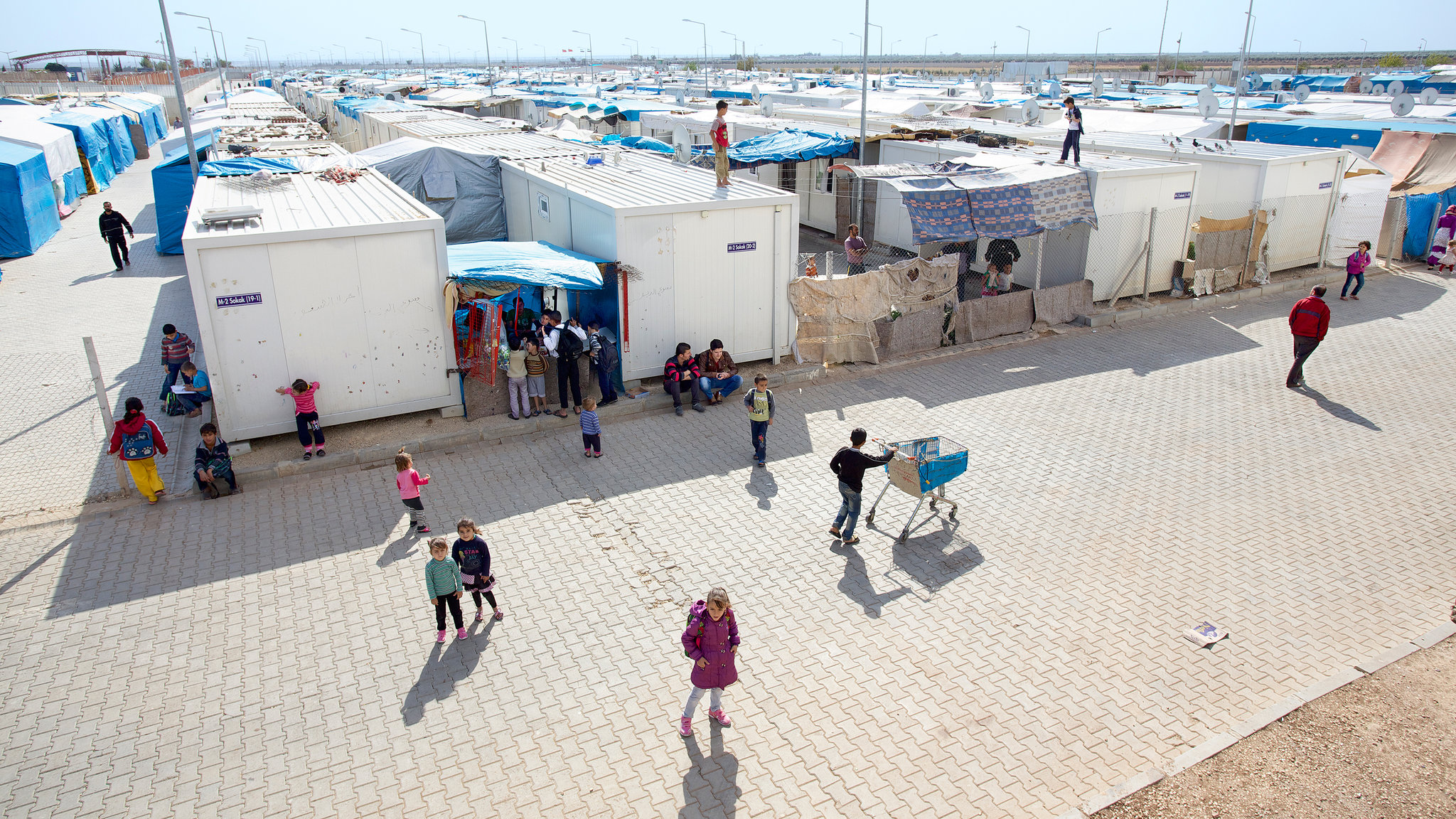
Kilis, a refugee camp in Turkey near the Syrian border.
I wrote some time ago that the EU was making a big mistake by playing hardball with Turkey’s application to become a member. They fear that the entry of a major Muslim country will have a destabilising effect.
They fear a possible Trojan Horse whose admission could immerse our continent in many of the horrors currently being visited on Turkey’s neighbours, Syria and Iraq. They couldn’t be more wrong.
Turkey is the obvious Muslim country which stands any chance of enabling Europe to gain acceptance throughout the Muslim world as a friend. As a member of the EU, it would send a signal to all Muslims that Europe is not irredeemably prejudiced and could happily work with them to build a better and more secure future. Once a member, you could be sure that Turkey would go after the nihilist maniacs with a sure-footedness that is not open to the rest of us.
Remember that Turkey single-handedly kept order throughout the Near East and North Africa for 500 years right up to modern times. Millions of Turks headed for Germany by invitation during the post-war years of the economic miracle to help rebuild that country’s shattered industries and infrastructure. They were known as ‘Guest Workers’ and the understanding was that, in due course, they would return to their homeland. They were not meant to stay.
So little did they offend their German hosts, however, that they were never asked to leave. Theirs proved to be the face of Islam that Europe never needed to fear. Even with the recent controversial admission of the huge refugee influx triggered by Chancellor Merkel’s off the cuff offer, there is not in Germany the festering resentment among Muslims and, indeed, Germans that exists in France. Two reasons account for this. In Germany, there is not the ghettoisation and lack of jobs as in France. Also, France’s Muslims are, for the most part, of Algerian origin and are the legacy of a bitterly savage colonial war of independence. Neither side fully forgave the other.
All of us can agree that Europe is at a crossroad in its relationship with the Muslim world. An implacable death cult has cast a shadow over all the continent’s urban conurbations and the crowd-gathering events which are staged there. Messaging each other in the new Wild West of the internet in an encryption form harder than Enigma to crack, they can operate in cells or as ‘lone wolves’ with manuals provided to allow them online to acquire and assemble deadly bombs. How the zealots of the IRA must regret that they never had such tools.
The result of it all is that people increasingly live in a fear they have never known before. They know the authorities have no answer, and never can, to the lone operator who can drive a truck or buy a knife across a supermarket counter. Even if we succeed, as we very well might, in taking back the land which Isis has claimed for its new Caliphate, its fighters will disperse throughout Muslim lands and perhaps our own and reappear hydra-headed to continue the mayhem. It is a depressing prospect and one to which we can envisage no end.
My own regular visits to London, its museums and places of interest, have lost their appeal. On a recent visit, I found that the dear old British Museum, an endless source of wonderment to me, had a half-hour long queue for semi airport-like security checks. I took one look and went on my way. In a long life, I had hitherto been able to wander up unmolested and pass through its hallowed portals unchallenged. That soon will become a distant memory. Security everywhere has become the order of the day.
We must resist. Turkey can help us for only it, as a Muslim nation closely allied to the West with NATO’s second largest army, can help us confront the threat ideologically. And that is the only way this death cult can be beaten.
Followers of their own faith must turn on them en masse. Their communities and their own families must place them beyond the pale.
The cowardly recruiters and dissemblers who encourage disaffected youngsters whose lives have gone off the rails to make an end of themselves and carry as many as they can into oblivion with them must be taken out of circulation and denied any platform to propagate their poison. Theirs should be a special place in perdition.
Turkey has already won the hearts, as well as plaudits, from the millions driven from their homes in Syria. Their efforts to provide a refuge from Assad’s killing machine dwarf those of any other nation, including Germany. The camps they have set up are a model of humanitarianism; they provide every conceivable facility and resemble more villages more than camps. Turkey receives scant recognition for her huge efforts and, needless to say, massive expense. And this from a nation which, unlike those in the West, cannot be described as rich.
For all the frequently ill-informed criticisms of Turkey’s president, he has proved himself a man with a heart which is more than can be said of many of the rest who weep crocodile tears. With 14 years of enlightened economic policies, he has also achieved growth rates the envy of all but China and India. In short, until these terrible troubles on his border, Turkey was booming.
My own message is clear: Turkey should be embraced, not scorned. If we continue to reject her overtures she will turn her back on us, and rightly so, with dire consequences for any last hope of getting back to normal and putting terrorism back in the malign box where it belongs.

Brexit was a brave act by a brave nation
Stunned, gobsmacked, incredulous, horrified. All of these adjectives have been expressed around the world at Britain’s decision to quit the European Union. If Britons doubted that theirs was still a nation of consequence, they need only consider the world’s reaction to the referendum result last Friday.
I have to say that I can think of no braver an act of the working man since 1940 when, faced with what seemed like the overwhelmingly successful Nazi juggernaut, he chose to stand and fight rather than accept what many of his leaders considered to be an honourable and generous peace.
This time it was not military might that he defied, but the massed ranks of the political, business, banking and academic classes who told him that he would be committing economic suicide to quit the EU. Though he did not put his person at risk, he certainly – if they were to be believed – put his job and his family’s finances on the line.
But he is a stubborn creature, the British working man, and he is not easily cowed. Over the years he has developed an increasing distrust and deep antipathy to those who consider themselves his better. And as the fanciful figures were daily trotted out to warn of the doom which awaited him, he did not harken to their warnings but instead dug in his heels even further and effectively defied them to do their worst. Magnificent, I call it, even though I voted to remain. It reminds me of Churchill’s snorted response when he was invited to deplore a well-known military man’s alleged act of buggery: “In this weather! Good God, man, it makes you proud to be British!”
Not in over a hundred years has British politics been in such a state of turmoil. Civil war rages in the Labour Party while the Conservatives are in disarray with their leader, the prime minister, forced to quit fourteen months after winning a stunning electoral victory. In the other party, the leader has had two thirds of his shadow cabinet walk out and 170 of his MPs back a ‘No Confidence’ motion with him retaining the loyalty of a mere 40. A hundred-plus-year-old party is, as a result, on the brink of oblivion.
All this is taking place at a time when, like in 1940, it is us now against the world as a result of Brexit casting us adrift into uncharted waters. As if this isn’t enough mighty England has been ignominiously put out of the UEFA European Championship by the minnow, Iceland, playing for the very first time in the tournament.
What are we to do? What has become of us? First, let us remind ourselves of those many centuries when we operated as an independent, sovereign nation. Did we make a decent fist of it? I’ll say we did! We became the richest nation on the planet. We pioneered free trade, set up the first factory systems, launched the Industrial Revolution, carried our products to the far corners of the earth and along the way saved Europe from tyranny in two world wars which we could have stayed out of. It ill behoves, therefore, those ingrates across the water to forget this.
So it can fairly be said, in answer to my question, that we did pretty well for ourselves as Britain plc and we can do so again. My own feeling is that what we have done will encourage others to champion their rights, which are in danger of being subsumed in a Brussels despotism. Meantime, the shadow of an ever more assertive Germany hangs over Europe. Nothing, it now seems, can be done without first clearing it with Berlin.
I have no doubt that other nations will, as a result of Brexit, be encouraged to call for their own referendums. This will be the point at which Brussels will take a long hard look at itself. What it fails to recognise is the incredible pride and patriotism which exists in each of its member states. You only have to look at the flag waving at Eurovision and other such gatherings to catch a glimpse of this. Being subsumed and having their national identities eroded is not what they want.
When a new Europe emerges we may be prepared to look again at re-joining. There is no objection to Europe punching its weight in this emerging world of giants, but it must do so in a less intrusive, respectful and democratic way.
Whatever is decided on 23rd June, the show will go on

Referendums may seem like a good idea and, doubtless, they have their place in a working democracy, but they have a way of polarising society in a manner that general elections do not.
On both sides of the Atlantic there is a dangerous disconnect between the rulers and the ruled. That is why, I suspect, such unlikely characters as Jeremy Corbyn and Donald Trump have confounded all expectations and caused us to believe that, in the current febrile atmosphere, virtually anything in politics can happen. The same disconnect can be said of the unelected and unaccountable gnomes of Brussels. At the moment we are cynically digesting the latest piece of hyperbole concerning the coming EU referendum and await with trepidation the next shocking apocalyptic revelation.
Genocide and war, they tell us, is a possible consequence if we make the wrong decision, as is a five-million rush to these crowded shores to swell our already ballooning numbers. The ten plagues of Egypt must surely be in the pipeline as the next possible item on the agenda. Which side will jump in with its own 21st century version of these horrors to scare the living daylights out of us is anybody’s guess. Is the public buying any of this nonsense? I suspect not.
Forecasts are notoriously unreliable. We spend billions worldwide trying to predict the weather and still we get it wrong. In the seventies, National Geographic featured scientists forecasting another ice age. In the 1920s, economists were convinced that a return to the gold standard would cure our economic woes. It made them worse. When Mrs Thatcher proposed her remedies, 364 leading economists signed a letter to say they would not work. They did. When the three party leaders, the entirety of the establishment and almost all the chattering classes said we should join the European Exchange Rate Mechanism in the early 1990s, the ERM, they were wrong again. Many of the same group of know-alls also wanted us sign up to the euro and predicted doom if we did not. How lucky for us that we declined to listen to them. “We would be able to do our business in Afghanistan without loss of life,” said the defence minister. Nearly 500 died. 13,000 would come to us from Eastern Europe, said Labour. Over 1,000,000 did. When George Osborne proposed austerity, Christine Lagarde, the head of the IMF, rushed in saying he was “playing with fire.” We ended up with the highest growth rate in the western world and over 2 million new jobs created. The governor of the Bank of England said it would be necessary to put up interest rates when employment fell below 7%. It was not.
So much for the “experts” knowing what will happen. Why should we take any of their forecast seriously?
Referendums may seem like a good idea and, doubtless, they have their place in a working democracy, but they have a way of polarising society in a manner that general elections do not. Perhaps it is because they concern huge and generational issues, the results of which cannot be unpicked five years down the line when you realise you got it wrong. Whatever the reason, they seem to generate a level of bitterness unique to themselves. Remember the nastiness of some of the SNP zealots in 2014? Had I been a unionist at that time, I certainly would have thought it prudent to keep my head down and definitely not put a poster in my Glasgow flat window.
The truth is that whatever is decided on 23rd June, the show will go on and the good ship Great Britain Plc. will plough on much as it did throughout all those centuries before the European Union was even heard of.
At this moment in history it cannot be denied that the EU is going through a rough patch. The euro may yet implode; even moneybags Germany has not enough to save beleaguered Spain, never mind troubled Italy if the markets call time on them. The single currency was certainly ill-conceived and has massive problems which have yet to be addressed. As for the Schengen Zone – that great leap of idealism – it poses a huge security risk in this volatile, post-9/11 world and it could be dynamite, literally. The EU’s policies are driving extremism in Europe leading to the rise of neo-Fascist parties. In terms of job creation, the EU is currently a disaster area and its growth rates is abysmal (on both of these counts we are an exception). A good case, you might argue for the Brexit. Why cling to a loser?
At the same time, you might equally argue that to cut ourselves loose might be to put ourselves on the wrong side of history. As well as staying at peace, a continent united is obviously going to be able to make its voice heard loudly in the world and its trade deals carry enormous clout.
Europe’s whole history since Rome fell apart has been to find a way of getting back together again. Various of its more powerful states have sought to do it under their own hegemony, but that has been unacceptable to the rest. Europe’s glory, and you have to say achievement, today is that it has found a way of doing so largely by consent rather than by coercion. Yet unfortunately in many important areas it has messed up and its democratic credentials are seriously flawed.
Perhaps a vote to leave might provide the system with the jolt it needs to make it acceptable, not just to us but to others who do not wish to see their identity subsumed in a monolithic super state which wishes to homogenise them all into a blandness and make all Europe seem the same. If Europe is to succeed a way must be found to preserve its charming idiosyncrasies as well as a meaningful level of sovereignty for its nation states.

To Brexit or not to Brexit?
The Europe which we put our signature to almost two generations ago is not the Europe we are being asked to vote on in a few weeks’ time. Then it was all about trade, except that is wasn’t.
The European Common Market began its life as something of a confidence trick. The political classes knew from the very beginning that it was a political project designed to relegate the nation states of Europe to a subservient role. They had concluded that they were nothing but trouble and were the biggest single cause of its terrible wars.
Just the same they knew that the peoples of Europe were, almost without exception, lovers of the lands which bore them and felt a deep attachment to the cultures which had developed within their borders. Talk at that stage of a European Union might have frightened the horses and run the risk of it being still-born. So they had to tread carefully. A mighty trading bloc though? Well, who could object to that? We all want to improve our standard of living.
Thus was born the Common Market. Europe had always been strong on markets and the use of that word was perfectly designed to allay suspicions. They were content to play the long game. Stage one was to lock the lot in lucrative trade arrangements, recognising that nations doing the bulk of their business with each other could not, thereafter, easily break free.
Actually, the whole business had begun even before the Treaty of Rome with the creation of the Iron and Steel Community of France, Germany and the Benelux countries. The idea there was that you couldn’t go charging off with a secret re-armament programme, as Hitlerite Germany had done, if all your iron and steel came from a common source.
Europe had had enough of war and a system, so they reasoned, had to be created whereby future outbreaks would be next to impossible. Although there was nothing wrong about that, hadn’t the setting up of NATO nine years earlier achieved that? As Europe grew richer – helped in no small part by the generosity of Uncle Sam with his Marshall Aid programme – it became safe to move on to stage two of the project and chuck overboard that boring old, and grudgingly conceded title, Common Market. Now it became the European Community.
Still no feathers were ruffled, but the more discerning of us could see where the project was headed. Not long afterwards came the great European Union and all was plain to see. With that came the burgundy coloured passports that let us all know – in case naively, a few of us nursed any continuing illusions of national independence – that we were now part of a burgeoning superstate. The Euro was meant to be the final brick in the wall.
The reason all the member states, with the exception of Britain, had been so accepting of the project was that they believed that the nation state, through its inability to protect them from the ravages of war, had been discredited. Only Britain’s island status had saved it from occupation. It therefore had no reason to lose faith in the nation. It stood proud of its institutions and the fact that its Industrial Revolution had changed the face of humanity. Also its exalted former position as the world’s greatest empire made it harder for it to become just another brick in the wall.
But now we must decide: do we cut loose and regain that independence which has been lost, or do we stick with it and with the confidence of a major player work within the system to bring it to the democratic accountability which we Anglo Saxons insist on? We are far from being alone in wishing this.
The world is increasingly moving in favour of what may be called the Anglosphere with our language and business models reigning supreme. I do not doubt that Britain PLC could cut a swathe in the world, but do we want a mighty power on our doorstep which we are unable to influence?
Nevertheless, worries abound concerning immigration, which apart from putting all our public services under strain, has the power to change the character of our country forever. Much of the fury and distrust of the political class which drives the Trump presidential campaign in America is at work here in Britain. They never asked us, say the doubters, about immigration and they never asked us if we were willing to cede sovereignty. They seem only interested in looking after themselves. And as to what Europe was really all about that, well that too, was founded on a lie.
Although the EU was a work of the utmost deceit, we are where we are and we should not necessarily quit because of that. Perhaps the best reason to stay is a geopolitical one. Out of the EU, however brilliantly we handle our affairs, with a population of 64 million ours might end up being a forlorn voice crying in the wilderness.
It is not an easy choice to make. But then who ever said life was easy?
Troubled waters afoot
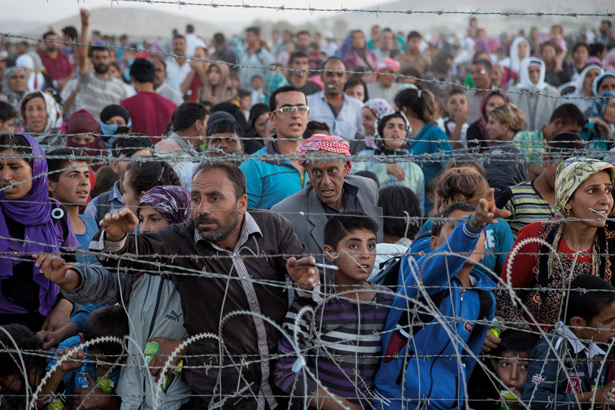
Despite a total mess surrounding us on all sides, a new opportunity presents itself in the Syrian quagmire.
What disordered times we are living though now. What a total mess surrounds us on all sides. You have Islamic terrorism stalking our cities; the European Union buckling under the weight of a tide of ‘refugees’ while at the same time grappling with bankrupt states on its periphery; our own referendum to decide whether we’re going to cut and run; an Opposition in total disarray; an America which refuses anymore to act as the world’s policeman; and failed states lapping Europe’s boundaries which have collapsed into anarchy. As if this all wasn’t enough, the world is still not through the consequences of the biggest financial crash in living memory. What are we to make of it all?
Not so long ago, we faced a foe on the other side of the Iron Curtain. He was an implacable one who had the means to destroy us all. But he didn’t. There were ground rules which we both observed, since he knew that we had the power to destroy him, too. He wore a uniform and he had client states – a great many of them – which he kept in check, as we did ours. There would be stand-offs from time to time and localised bushfire wars, but they were handled within well understood rules which worked. All that is now history and no one knows any longer where they are.
I cannot help but think that a great mistake was made when Communism collapsed. The former enemy was prostrate and needed help, but he didn’t get it. He went through ten years of hell with robber barons (oligarchs) stripping the state of assets and operating a mafia-style regime. To curb it all, but without success, authoritarianism returned to Russia in the form of Vladimir Putin. But he did not see himself to be at odds with the European Union. Indeed, he sought to reach out to it and gain acceptance as a valued partner. He even wanted an accommodation with NATO on joint exercises.
But all these overtures fell on deaf ears and now you have a troublesome bear rampaging through the undergrowth, which has had to be put into the school-equivalent of ‘special measures’ with sanctions applied.
A new opportunity, however, presents itself in the Syrian quagmire to put right some of this damage. Russia is as anxious as we are to bring that murderous conflict to an end. It is equally understanding of the need to play its part in destroying Isis, the most malignant evil since the days of Pol Pot.
Just as important, it accepts that the Syrian dictator, Assad, cannot be part of any long-term solution and that, as long as a face-saving interim arrangement can be made, Putin will go along with it. Assad has, hitherto, always enjoyed their backing; this is because Assad, and before him his father, had allowed Russia to maintain a naval base on the Syrian coast and pretend to a Mediterranean presence.
Provided its interests are protected in any eventual settlement, Russia can be expected to cooperate and play its part in ending the civil war. In so doing and acting in concert with the West, the West can begin the process of undoing the damage which its former cold-shouldering of Russia brought about. The European Union, for its part, can begin to lock Russia into its embrace and give Putin the respectability and acceptance which he originally craved.
Turning to Uncle Sam, we are going to have to accept that he will never again be prepared to shoulder the burden of world peace alone. He made a terrible mistake in withdrawing the last ten thousand troops from Iraq. Had they stayed as an emergency, fire-fighting backup, Isis would never have been able to establish itself.
What is needed now is for the European Union to step up to the plate, militarily, for the purpose of burden-sharing. Were it to do so, Uncle Sam would happily abandon any thoughts of retreating back into isolationism which was a major contributor to World War Two.
It is morally and dangerously wrong for Europe to expect any longer a free ride where security is concerned. It has the wealth and it must use it, along with others, to bolster America. I am sure the United Nations, in the interests of world peace, would welcome such a development. Of course, the European powers would have to make it clear that they seek no territorial advantage and that this is not a fresh round of empire building by the back door. Even Iran must be allowed to play its part, along with neighbouring powers.
I doubt that even if peace, by such a combination of power, can be restored to Syria that in the short term a viable government can be made to work when there is such bitterness on all sides. In that event, a United Nations mandate should be imposed on the country for It has to be accepted that, just occasionally, only the application of overwhelming force can settle the argument. This, I believe, is just such a case
Schäuble needs a history lesson
Poor, benighted Greece. Yes, it lived beyond its means, encouraged by greedy bankers all too willing to see it mortgage its future. And, yes, the Greek way of doing things seems decidedly un-Germanic.
What an unedifying carry-on that scrambled, weekend marathon was, called to decide Greece’s fate and preserve the integrity of the euro. A two days’ notice summons went out to the nine heads of government not in the euro who were told to attend that Sunday. Then they were told to stand down. They didn’t need a grand council of all twenty-eight EU members after all. Talk about an omnishambles and the Grand Old Duke of York.
It was always meant to be that, once enrolled, you were as locked in as all fifty states of the American union are to the dollar. But it turns out that that this is not the case. Former Foreign Secretary William Hague once made the mistake of saying that belonging to the euro was like being in a burning building in which all the exit doors are locked. Really! Wolfgang Schäuble, the hard-line German finance minister, had actually drawn up a plan to show Greece the exit door if it did not comply with EU terms.
There are many truths to this latter day Greek tragedy. Ironic it is that it should happen to Greece of all countries, which wrote the scripts of the very first tragedies concerning the foibles of human nature. Just as it was beginning to make progress under austerity – though there remained much to do, as the latest Brussels proposals made clear – a crazy, economically illiterate cabal of schoolboy lefties gained power. (They once believed that Communism was the answer.) Their silly promises of an end to austerity were seized on by a weary electorate. But how could they work that particular piece of economic sophistry? It was like asking someone to turn base metal into gold.
We are today in a situation in which a mere eleven million Greeks labour under a mountain of debt equal to what our sixty-four million people spend on the NHS in a year and a half. It was, and is, insupportable.
Once again the banks have a case to answer. It is a truism that a lender has as much of a responsibility as the borrower. What is abundantly clear is that the lenders did not exercise due diligence. They knew the Greek character and that once they enjoyed the security of the euro with its low borrowing costs would, likely as not, go on a spending spree and end up living high on the hog, enjoying a standard of living way beyond what their productivity justified.
But while the good times rolled the banks looked the other way and that fatally flawed conception – a currency (monetary) union without a fiscal and banking one was able to bumble along… just. But it was never going to avoid the attention of the speculators on the world’s money markets when the good times ended, as they always do. And boy, did they end! When the banks were exposed as having lent to millions of mainly Americans (but, yes, us too) on mortgages that they knew were likely to go belly-up, they then artfully – and I believe criminally – wrapped up those toxic, sub-prime debts in packages mixed in with sound debts and unloaded them to unsuspecting other banks all around the world. The consequence was that every bank viewed every other bank with suspicion and would not lend to them (an absolutely necessary requirement under the capitalist system) for fear that the other bank had saddled itself with lashings of toxic debt and may actually be insolvent.
When the giant Lehman Brothers bank went down and the Federal Reserve refused to save it, shock waves went round the world. It was a seismic event in that cloistered world of banking which everywhere shut down on lending. It sent the system into a tail spin. Thus we became familiar with a new term: the credit crunch.
Returning to Greece, the bailiffs of the big boys, (the Troika’s IMF, ECB (European Central Bank) and the European Commission) have effectively moved in. Proud, humiliated Greece is being told it must provide collateral for the monies advanced. It must sell off all it can of its public sector along with whatever else can raise hard cash. The next thing we’ll be hearing is that they’ve slapped a ‘For Sale’ notice on the Parthenon. What has been needed throughout, but which has been totally lacking, is a generosity of spirit. If the 520 million people of Europe cannot handle 11 million, admittedly errant, citizens, then something is seriously wrong.
The fact is it is perfectly possible to be a member of the European family (i.e. the EU) – after all, there are nine of us who are not using the euro – without being beholden and tied to that flawed currency. It is equally possible that if one day that currency proves itself by correcting its inbuilt defects and then goes on to become the world’s reserve currency, replacing the dollar, we may ourselves rethink our position and apply to join. But that day is a long way off.
Meantime what of Greece and its mountain of unrepayable debt? 92% of the monies advanced to Greece do not go to helping that country get back on its feet, but to servicing its debts. As a deadline for repayment looms, Greece is handed monies which it must immediately pay back. Thus, while for book-keeping purposes, the situation seems under control it is anything but. It is an altogether hopeless situation. In essence it’s no different from that of a person taking up ever more credit cards to pay off a loan from his bank.
Europe, and in particular Germany, should remember that when the Americans put together that incredibly generous Marshall Aid programme to rescue them from an even more dire situation than present day Greece’s at the end of World War II, there was a total forgiveness of debt. Without that there would have been no recovery of Europe for decades. It remains my hope where little Greece is concerned that our great continent will show a generosity of spirit similar to what the Americans showed with their Marshall Aid programme and declare a forgiveness of debt. Without it Greece has no hope.
A tragic consequence of the present situation which few have thought about is that we are in danger of losing, through neglect and vandalism, much of that peerless heritage we so like to visit and wonder at. The treasures of European antiquity, of which the Greeks are custodians, are already suffering terribly from thefts and shocking neglect. What with the destruction going on in Aleppo, the oldest inhabited city on earth, at Palmyra, Babylon and indeed throughout the Middle East – the very cradle of civilisation – the world will wake up one day and realise that it wasn’t just present day humans who paid the price, but the surviving evidence of what its distant ancestors achieved down the ages.
The latter day Greek tragedy continues

If the Greeks vote no, they face not just potential mayhem but a complete national shutdown. Yet the majority of economists actually believe this course would serve the country best.
What are we to make of the tragedy which is unfolding across the beautiful waters of the Aegean? Here in high summer when they should be enjoying the fruits of their glorious holiday season they are locked in a battle for their very survival with the giants of north Europe and their banking systems.
Let’s be clear about one thing: Greece has already paid a terrible price for its profligacy and easy living on the back of a strong currency of which it was never qualified to be part. Their economy has had been bludgeoned by the money men into shrinking by a horrendous 25% and their youth unemployment exceeds 60%.
Right at the beginning, the books appealing for entry into the euro were cooked, helped in no small part by that ‘Great Vampire Squid’, Goldman Sachs. But while the Germans and the rest knew very well how the Greeks went about their business and that they were not a suitable candidate, political Europe had to take precedence over economic Europe and they let them in.
With other weaker economies such those of the Spanish, Portuguese, Irish and Italians allowed to join the party, the Germans ended up with a currency much less strong than their old Deutschmark would have been and that made it much easier for them to flog their BMWs and the like. Borrowing rates for these weaker economies became much lower than ever they would have been had they been using their own currencies so, of course, they were happy to buy north Europe’s products as well as treat themselves to a much higher standard of living than their economic performances warranted.
All was well throughout the goods times that preceded the financial crash of 2008. That ill-conceived monetary union – which lacked the also essential fiscal union – of the euro could bumble along so long as there were no headwinds. But, boy, it wasn’t so much headwinds that arrived but rather a hurricane. The Credit Crunch brought the Western world’s economies to the brink of meltdown.
Today the weakest of the dominoes stands in imminent danger of falling, with the risk that others will follow. And the country that benefited most during the good times, Germany, insists on playing hardball. It needs to show a bit of humility – as well as compassion – and realise that it must take its share of the blame for the plight that Greece finds itself in today.
Despite its own banks, along with French and others, being exposed to a possible Greek default of alarming proportions, it knows that a Greek economy that cannot grow because of acute austerity will never ever be able to pay off its debts. It needs relief and restructuring. Long before this present crisis broke they acknowledged this fact. But what now are the Troika’s proposals? Even deeper austerity. Can we be surprised that a government that was elected on a mandate to end austerity has thrown up its hands and said enough?
If Greece on Sunday, in its touching desire to remain at the heart of the European family – but also out of sheer terror at the thought of the consequences of being cast adrift – votes to accept the Troika’s diktats, it faces never-ending recession. If the Greek people vote no on Sunday, they will stay in the EU and possibly even the single currency, but mayhem could follow with a complete national shutdown. Could Brussels stand by and see this happen?
Actually the majority of economists believe that this seemingly bonkers course would serve it best (Argentina went down a similar road). Economists say there would be six months of hell, or possibly longer, but then a future would open up for Greece. With holiday costs cut to half their present level, we would cast aside that old warning to ‘beware of Greeks bearing gifts’. Greece would become the continent’s playground as never before. Poor, suffering Hellas, the first of all Europe’s civilisations, would start to smile again.
Gay schools aren’t the answer

If you remove certain sections of society from the mainstream you risk encouraging the majority to believe that they really don’t want to belong to the mainstream.
I was taken aback recently to learn of a serious proposal to set up a school for Gays. While a firm supporter of not stigmatising minorities – as a child of an unmarried mother at a time such things were scandalous, I know just what that means – I felt that this was simply a bridge too far. In fact I believe it could be counter-productive, harming the very people it was designed to protect; a classic case of the law of unintended consequences. Humans across the world belong to a single family. If you remove certain sections of society from the mainstream and create an environment in which they circulate for substantial and formative periods only among people of their own preferences you risk encouraging the majority to believe that they really don’t want to belong to the mainstream. We know the aims of Gays in making this proposal are laudable; they wish to experience and benefit from an education free from the slings and arrows of a taunting minority. But the answer, I fear, is not to remove them from the orbit of the bullies but to bear down and educate bullies into accepting that it is they – the bully – not their victim, who is the problem. It was never more clear to me than during my army service in Northern Ireland that if people are ghettoed from their fellows they will not relate to them and, as a consequence, would be capable of doing terrible things. And there, job discrimination was total – in schools, churches, policing, pubs, town halls, housing and just about anything else you could think of. The first question that any employer asked of you was, “are you Catholic or Protestant?” We saw in blood where that led.
Social attitudes can be turned full circle. We know this from things we have already achieved. Do you remember that ‘Carry On’ film in which a partying group of young medics came out and piled into an open-topped sports car and roared off? The noisy, raucous group were all the worse for drink. We thought, at the time, it very funny and so did the producer. Neither he nor we would think that now. In fact we are appalled that we ever thought it so. In similar vein was the ubiquitous glamorising of smoking on the silver screen. Also, look at our previous indifference to the disabled; we never bothered to put wheelchair access into anything. Then, just let a landlord – as happened when I first lived and worked in London – try putting in his window a sign reading ‘No Blacks, Irish or Dogs’. All hell would break loose. Women’s prospects have improved immeasurably from what they were and so have peoples’ of other races. I could go on. Indeed, some might argue that in today’s Britain your life chances might be improved if you were not of Caucasian stock. Racial, religious, gender and disabled abuse have all joined the bonfire of the unacceptable, as has hate language. Also that pernicious culture of being able to touch women up and, worse, and get away with it is thankfully at an end, though I do wonder if we are right in pursuing old men to the grave. But I acknowledge that justice must trump everything and you could argue that they were lucky to have got away with it for as long as they did before justice finally caught up with them. Finally, while we’re at it, let’s remember that poor unmarried mother whose family once turfed her out. That was not a million miles removed from stoning her.
My point in highlighting all this is to show that Europe in times past – often with us as flag-bearer – has had very backward attitudes. In addition to this we have been exceptionally cruel, physically as well as emotionally. It therefore ill behoves us, as we make progress, to lambast the Muslim world for its tardiness. The whole world hardly needs to take lessons from us in this area. There was a time, which lasted for seven hundred years, when Muslim Spain led the world in virtually all the sciences. While it was rescuing and translating almost all the Greek classics, we were transporting ourselves across the Mediterranean Sea and despoiling their prosperous, peaceable lands in Palestine. Our ‘great’ King Richard (The Lionheart) – who spoke no English and spent only a few months out of his eleven-year reign in England, bankrupting it in the process – wrought such cruelty on Crusade that even today Muslim mothers will quieten their little ones by saying “shhh… King Richard is coming”. He once decapitated 5,000 prisoners on the beach at Acre. Strange it is then that of all our many illustrious monarchs he is the only one honoured with a statue outside Parliament. An unfathomable people we are for making such a judgement. And in terms of cruelty, no Muslim country that I am aware of ever matched our grisly hanging, drawing and quartering routine, nor Bloody Mary’s 300+ burnings at the stake in a five year period, nor Vlad the Impailer’s bestial cruelties, nor the horrors of the 30 Years’ War.
It is very true that we have today a terrible problem – to put it mildly – with certain crazy Muslim men, but we have had our share of crazy men, even if they have not specialised in running wild on the streets with butchers’ knives and Kalashnikovs. The sheer magnitude and level of depraved brutality which our own continent has exhibited throughout the recent century should humble us considerably in our dealings with the rest of humanity. It certainly does not qualify us to hand out advice as though it is coming from on high, and as though we approach the world’s problems with clean hands. However, it is my belief that it is this very barbarism which has made Europe determined to do things differently in the future.
It may not seem so but we are moving into a kinder, more caring world. Not only have we such institutions now as the International Criminal Court, whereby previously unchecked rulers can be held to account, but we show concern and provide help when manmade or natural catastrophe overwhelms one of our brother countries. This is new. Every country now acknowledges that it has a duty to work towards some sort of a welfare state for its people. This, too, is new. Making war without United Nations authorisation is an option becoming increasingly difficult for sovereign states.
Social networking, Skype, emails and the instant availability of facts and information – as well as the next day delivery of goods on eBay and Amazon – makes ours a more joined-up world than it has ever been. And we are only at the beginning. Within three generations, virtually the entire human race will be able to communicate with each other in a universal language. What incredible good fortune that it happens to be our own which will be that medium – and what business opportunities that should present us with if we have the wit to seize them!
Meantime we must hold our nerve as we navigate through what undoubtedly will be treacherous waters, finding ways of containing and then rolling back the bone-headed fanatics who seek excitement on foreign battlefields as well as at home in the misplaced belief that their warped vision is the future. Yet we must do so without compromising our essential liberties and bring our Muslim brothers and sisters on board. Their thinking, young people, in particular, want all the same things we have, including democracy. We must find ways of getting them to prevail over their rogue elements and bring them on board too.

Europe must act as a much-needed adrenalin shot to a weary Uncle Sam
While we all luxuriate in the afterglow of a fabulous summer and await the outcome of the Scottish independence referendum – as well ponder the rise of Ukip and how it will all pan out at the coming General Election – a much more terrible set of conundrums lap at Europe’s borders. Far to its east, the post-war settlement is under threat.
Already an annexation has taken place. On Europe’s southern flank a militia banditry reigns in the land we helped free from Gadhafi. Across the desert sands of the Sahara the black flag of Muslim extremism makes many of the states there close to ungovernable. Sweep east and the heroes of Tahir Square have seen a military dictatorship annul all their efforts and seize power in Egypt to stop that pivotal Arab state falling to the excesses of the Muslim Brotherhood. Go south into the land of the former Queen of Sheba (Yemen) and more turmoil reigns. Across the narrow straits from our former colony of Aden and into Somalia more of the same flourishes, not just on land but at sea, where a scourge which our navy had long ago cleansed the world of has broken out again: piracy. Travel north into the desert fastnesses which Lawrence once traversed and you are upon Gaza and Syria. Again, more chaos. Go east and you have reached Iraq where the most bestial activities of all are currently taking place. Further east and you are upon the hapless land of Afghanistan where we await the outcome of our ten-year effort when we leave next year. The signs are not good. If a new Iraq breaks out there it may very well take down a nuclear armed Pakistan with it.
While all this is going on, we in the West fret about our petty goings on – though certain goings on, such as splitting our country apart and leaving the EU are not, admittedly, petty – and we worry about what our responses should be to these ugly canvasses which are unfolding all around us. It is my concerned belief that we are about to see years, if not decades, of strife before an exhausted Islam settles down to enjoy the sort of order which descended over Europe with the 17th century ‘Peace of Westphalia’ following the terrible bloodletting of the Thirty Years War. That, too, was about religion – the Protestant/Catholic schism which has echoes of the present Sunni/Shia split.
But things could have been different if the US had had a partner as militarily powerful as itself with whom it could have shared the burden. It would have made it possible for us to save our Muslim brothers from themselves and spare them the miseries we endured in that long-ago conflict. That partner should have been us, the Europeans. We have no longer any interest in colonising anybody, but we do have an interest in maintaining stability, especially when it is on our doorstep.
Just as the victorious Western Allies were able to work the miracle of creating and sustaining a democratic and peaceable West Germany after the horrors of Nazism, so we could have rendered the same service to the fractious Muslim world if we in Europe had pulled our weight in world affairs and not left it all to an ever more fed up and weary Uncle Sam.
But even now it is not perhaps too late. First of all we must stop distracting ourselves by fragmentation – starting with ourselves. If Scotland separates, it will send Spain into paroxysms of worry as its most prosperous region, Catalonia, ups the ante for independence. Then the Basques, another – prosperous area – will do the same. Belgium, itself – the heart of the European Union – may very well split in two, with the French-speaking south and Dutch-speaking north going their own ways. There is plenty more potential for further fragmentation in the always volatile Balkans. And who’s to say that Wales and Northern Ireland might not catch the contagion.
Cameron’s job – in which, as far as I can see, he has done mighty little that is visible and hence Douglas Carswell’s defection to Ukip – is to get busy on those re-negotiations with Europe and make them meaningful. Europe needs reform, and most of its members know it. If he can get it into their thick heads that they really are in danger of losing one of their biggest players then I think there is a chance that he may come home with a package that most of us can accept. Meantime, he should go public and tell them (and the country) that unless this is so he will have to recommend our departure.
If Europe can weather this British-made storm which lies ahead and stop attempting to reduce its nation states to regional entities, then it can forge ahead and exert the kind of muscle on the world stage – both diplomatically and militarily – as will act as an adrenalin shot to Uncle Sam. No longer will he feel alone. He and his new partner will dispose of such power as will make all others think twice, including Putin with his old-world adventures in the east. Europe will have come into its own and will have demonstrated to the world that its interests lie not only in enriching itself but in helping an increasingly impotent United Nations maintain a stable and just world.
Putin is no a fool
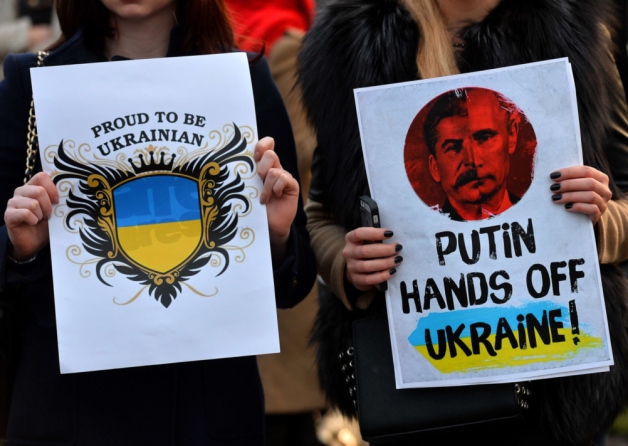
A great opportunity was thrown away by the West when Putin first came to power.
What are we to make of developments in Eastern Europe? It is one thing to have a squabbling clutch of Balkan countries at each others’ throats, as we saw in the breakup of the former Yugoslavia, but quite another to have the Russian bear stomping around with what looks like a very sore head. Europe, historically, never expected anything sensible coming out of the powder keg of the Balkans. After all – at its worst – it gave us the First World War, but since then Europe has never had to worry too much about that region disturbing the peace of the continent as a whole – only its own.
The chief reason for its instability were those many hundreds of years that it lay under the yoke of the Turkish sultan who did his best to turn as many of them as he could into Muslims. So in that corner of Europe you have not just a religious divide, such as we still have between Protestants and Catholics in Northern Ireland, or Sunni and Shia in Syria, but a divide of Faiths itself: Islam and Christianity.
But none of this exists where the bear is concerned. He belongs to the Christian community of the West. His trouble is that, unlike us, he has not yet come to terms with the loss of empire. It is, after all, only twenty years since the Soviet republics – there were thirteen of them – gained their independence. Russia still believes, deep down, that those countries rightfully should belong to it or at the very least should be under its sway.
Putin, the Russian leader, knows that the warm water ports of the three Baltic republics will never be his again; they are too close to the West and with long historical ties to it. But, more to the point, they now enjoy the protection of NATO – the best life insurance policy they could have taken out. Even now NATO planes, including our own, are sweeping Baltic skies daily. The message there is ‘thus far and no further’.
A great opportunity was thrown away when Putin first came to power. He wanted desperately to gain acceptance from the West, but foolishly his overtures were spurned. Even as late as his second presidency he offered to open up his vast country into a free trade area which would extend from Lisbon in the extreme west to Vladivostok in the far east. Instead of looking seriously at this, what did the West do? It pooh, poohed the notion and even provocatively poked the bear by offering deals to Russia’s former vassal states, Moldova, Armenia and Georgia – the latter two far from Europe’s heartland.
Undoubtedly, down the ages, Russia has been Europe’s perennial headache – and I’m not just talking about the seventy years of the Communist era. For almost all of its history it has been a delinquent state and now resembles something of a corrupt gangster state. But it needn’t have been this way. An understanding tutelage by the West after the failed experiment of Communism would almost certainly have worked wonders.
When Russia lost the Crimean war in the middle of the 19th century and the Russo/Japanese war in 1905 it came to a full appreciation of how backward it was, politically and economically. It set about changing this at a fast and furious pace and, by the outbreak, a hundred years ago, of the First World War, it had very largely succeeded. Only the curtailing of the Tzar’s autocratic powers remained.
It was the foolish mobilisation by Tzar Nicholas II of his army – much like what Putin is doing today on Ukraine’s border – which brought the whole process of modernisation to a halt. It gave Germany the excuse she sought to smash her militarily before she became too powerful for even the Prussian-led German army to defeat easily. But for the Tzar’s crazy action in plunging Russia into WWI and losing it there would never have been a Bolshevik revolution and no wasted seventy years pursuing the fantasy of a workers’ paradise under Communism.
The Duma – Russia’s parliament – would have long since clipped the Tzar’s powers and turned him into a constitutional monarch, much like our own. She would by now have genuine democratic institutions and, probably, with all her vast natural resources, be the world’s leading economic power instead of running an economy smaller than Italy’s.
Putin, although a bully, is not a fool. He is in fact an intelligent man. He knows that in the long-term his 145 million people cannot hope to get the better of the European Union’s 485 million. He also knows that his armed forces are miniscule compared to NATO’s.
It must be made plain to him that the postwar borders of Europe are sacrosanct and if he insists on challenging them there will be consequences – damaging and unpleasant ones. Chancellor Merkel of Germany is the one best placed to talk turkey to him. He learned fluent German during his years as a KGB operative (a colonel) in East Germany.
Then, when he quietens down, she must tell him that his gifted people – great in the sciences, literature, sport and music – will not be spurned and belittled anymore but will be embraced by the West and led into the comity of nations, so completing the mission which Peter the Great began all those years ago.
The Germany-UK axis and the long-awaited rescue of Europe
The long awaited rescue of Europe, along with its badly put together single currency, gets under way now that the German chancellor no longer has the distraction of an election to worry about.
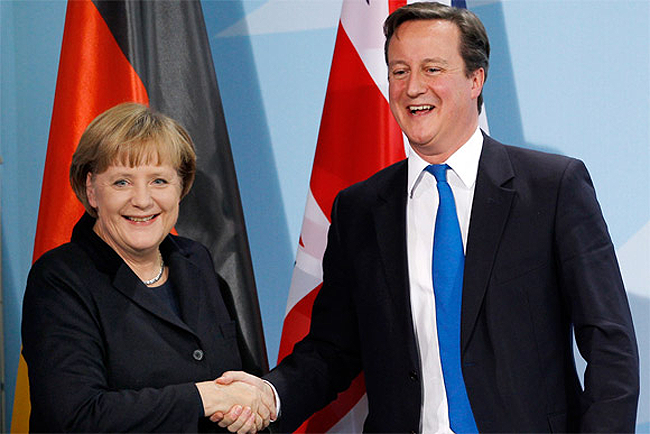
Angela Merkel aspires to a business-minded Europe
Angela Merkel, the pastor’s daughter from the former Communist east, will get down to a lot of serious business. Her mission, no less, is to save the continent from imploding. In doing this she will seek help from her new best friend, David Cameron. Many of us here at home have gone off him, particularly the women, but he makes a good impression abroad. Even neo socialist Barack Obama gets on well with the ‘posh boy’ from Chipping Norton. He is mannerly, brimming with self-confidence and knows how to talk the talk. What else would one expect from an Old Etonian, that breed of Brits who once believed that they were born to rule. Incredibly, it seems that even in 21st century Britain they still have grounds to believe this.
Angela Merkel aspires to a business-minded Europe: caring but frugal; hard working, but at ease with itself. The last thing she wants is a Europe in tatters. Whether or not it was wise to create the euro in the form they did, we have to accept it is a fact of life. It certainly has benefitted German exporters, whose massive sales to the rest of Europe is part of the reason they are in such debt. If Germany were to go back to the deutschmark its exports would be so incredibly expensive that their export dependent economy would be in danger of crashing. So save the euro they must. But they must also save it for another reason: if it collapses, or even fragments, the whole European Project will as likely as not come off the rails and Germany will take the blame. For the third time in a century, people will say Germany has left Europe in ruins.
The simple truth is that the political and financial establishment have too much at stake to allow their dream project to collapse. The consequences would be seismic and coming at this time, when recovery seems underway, it would be unthinkable. Only Germany has the financial clout to save the Euro.
But Fritz does not want to open up his coffers – especially to what he perceives as lazy and corrupt southerners – but neither does he want to become Europe’s baddy all over again. He will drive a hard bargain which will involve some pretty nasty medicine when he takes responsibility for all that toxic debt and he will seek a powerful, respectable ally to share the howls of protest with. France is no longer willing to be that ally. She seems not to understand the scale of the problem. Perhaps that’s because she is herself part of the problem. That leaves only one ally available to Germany and it is not even in the euro. That ally is us.
Germany views Britain as a business-minded country, like herself, and it makes sense, in her view, to get Britain onside in her chancellor’s drive for reform because Cameron wants reform too. But his reform is not just in monetary matters. As it happens, Germany, as well as others, doesn’t much like a lot of what is coming out of Brussels so he could find himself pushing at an open door.
I am convinced Germany will do all that it can, within reason, to give Cameron what he needs from Europe rather than lose a necessary and valued ally. Merkel is said to be ready to discuss anything, so long as Cameron does not ask her to chose between Britain and Europe. She knows that if he cannot repatriate powers then Britain is a goner from the EU. That would be a body blow to the whole European Project and it would set a most unwelcome precedent. It would send shock waves throughout Europe and indeed the world.
Even before her re-election, when she had to be careful, she began her courtship of David Cameron. That weekend soiree to her country home in which Samantha and the kids were invited, was in my view, extraordinary. It spoke volumes. She has never asked any other political leader to visit her at home, never mind bringing the whole family. So even if the women on Dave’s home patch have abandoned him in droves, Angela most certainly has not. She thinks he’s lovely – ‘My naughty nephew’, she calls him, and can’t wait to team up with him in sorting out Europe. In all the photo shoots of recent times she makes a point of standing next to him, and the body language is very telling.
All in all, it causes me to think that we are in the early stages of seeing a new, powerful axis being formed… a resurgent Britain alongside its fellow Teutonic power Germany. That axis will be an outward-looking one keen to harness the enormous potential of half a billion Europeans, but moving to direct their energies to the world beyond Europe. Britain, for its part, is already travelling very successfully down that road and with its vast connections worldwide, its goodwill from its former empire and its universal language, it is peculiarly well placed to profit from it all.
Uncle Sam worries about the threat posed by the emergent Eastern economies – we all do – but he does not worry about Europe. Rather he wants to team up with it in a North Atlantic trade partnership. Such a partnership is a very real prospect; it will hugely benefit all of us and give the whole world a tremendous fillip.
I do not subscribe to the view that this century will necessarily be the Asian century. Yes, it will do well, but all the countries concerned have tremendous structural and political problems which the West overcame long ago. Endemic corruption and a lack of trustworthy institutions will also act as a break. Human Rights issues will plague them because justice, as we know it, does not exist. They have got a lot of work to do and are not in a position to give their undivided attention to coining a buck, as the West is. For a start, they are going to have to take better care of their people and that means creating something of a welfare state – and we know how ruinously expensive that will be.
As for Cameron, he has a great opportunity, but if he does not put forward some female friendly policies and quickly, he won’t be there after the election to take advantage.
A shift of power in EU corridors
It seems clear to me that a major link-up between the two top Teutonic powers of Europe – Britain and Germany – along with lesser like-minded powers to the north and east is taking place. The tectonic plates of Europe are on the move in a way that may prove irreversible. This will certainly be viewed with horror in Paris.
Merkel’s whole philosophy of life gels with that of the foreign leader she is said to have once described as her “naughty, but charming, nephew”.
That invitation from Angela Merkel for David Cameron to come and visit her at her home north of Berlin a few weeks ago and to bring his wife and children has, I believe, great implications. She even wheeled out her hermit husband for the weekend soiree.
It had all the characteristics of a love-in. No other European leader has had such an invitation or been accorded such warmth and hospitality. It is known that the pastor’s daughter holds Cameron in the highest esteem – perhaps that Eton grooming helps – and it will have been reinforced, I’m sure, by the shy, but charming, Sam Cam – and her equally delightful children. Such personal chemistry and bonhomie really does matter. The invite, in my opinion, speaks volumes.
But equally importantly her whole philosophy of life gels with that of the foreign leader she is said to have once described as her “naughty, but charming, nephew”. Naughty because, at a time of huge difficulty for her beloved Euro Project, he has rocked the boat by demanding fundamental changes to the way the EU goes about its business.
It is not as if she disagrees with much of what he committed to put before the British people in a 2017 Referendum, should he retain power, but because it’s complicated and will take a lot of what she does not have: time. As it happens, most of her fellow countrymen agree with David Cameron. They, too, dislike much of what is coming out of Brussels and would like to see things done differently. But she wants to keep her eye on the Euro ball, whose solution – if there is one – is also complicated. She feels she cannot afford the distraction of a major renegotiation of EU treaties at this time. There is also the added factor that she is up for re-election in September and has all that circus ballyhoo to worry about. Cool and detached, as Angela famously is, she is in danger of becoming stressed and Davy boy, right now, isn’t helping.
What with France’s weak and hopelessly left-leaning ‘leader’ – distracted as he is with woman problems and who cannot see the necessity for tough measures in France – she is at her wits’ end. The Franco-German axis, which has been the engine of the EU since its beginning, is unravelling.
France, under Hollande, seems destined to be the flag-bearer of a southern rim of EU countries which will put up with no more belt-tightening. Merkel admires little Ireland’s heroic acceptance of the need to pay off its debts, but she is fast losing patience with the other PIGS (Portugal, Greece and Spain, that is). She is full of praise for Cameron’s recognition that sound money and balancing the books is central to everything. Also his open trading outlook and market philosophy equates exactly with her own. She has no truck with spending your way out of debt. She sees David Cameron as an economic soul mate.
Germany herself has still not shaken off the terrible legacy of WWII and she is unwilling to take the lead in Europe on her own for fear of cries of a Fourth Reich being hurled about. She feels she has to have a partner who is ‘respectable’ and can front up everything diplomatically while she can make the running economically. France, for fifty years, has been that partner. Yet now the dice have rolled in another direction and an alignment of Teutonic powers seems in the offing. Is this a good thing? It certainly will not seem so in Paris, which will be outraged at its relegation and see the hand of perfidious Albion at work all over again. As virtually the creator of the EU, which she saw primarily as a means of controlling German ambitions, she has seen her dominance slide inexorably. That is why, originally, she was so keen to keep ‘interfering’ Britain out. But this proved impossible in the end, especially when you had a British leader, in Edward Heath, who was prepared to sell the pass and demean himself as a wretched supplicant, to get in.
Now, more and more countries have been allowed to join the original Club of Six – chiefly at the instigation of Britain – and France’s position has weakened with each new entrant. Most infuriating of all, they seem to want to use English in preference to French in the corridors of Brussels power! Once you could not get a job anywhere – even a lowly one – if you were not fluent in French, but now the point had been reached in which the Brussels power brokers actually had the audacity to appoint a Union foreign minister who spoke no other language but English. That was the ultimate insult.
I have no doubt that Europe has the capability to become the dominant power in the world if only it can get its act together. Its GDP is already way ahead of Uncle Sam’s and it will only widen. In terms of any numbers you care to look at, it is perfectly within its reach to see off competition from the east for the rest of this century. I look to the day when Russia itself comes knocking at the EU door. It is essentially a European country.
Europe’s cultural dominance is already unassailable: its music; its art; its literature; its universities; its history; its multiplicity of matchless ancient cities. Even its science is on a par with the US. I see no reason for us to be downcast. All things come to an end, including this wretched recession.
So will David Cameron get his deal, which will persuade enough Britons to back him in the referendum? I think he will. Angela will see to that, one way or another, and she will be assisted by Britain’s many other friends in Europe. France will be incandescent. Germany does not wish to lose a country which she sees as pivotal to Europe’s future; one that has played so crucial a role in its past. America will be delighted, for she will feel that in the coming difficult world, where after 500 years a resurgent east threatens to displace a weary west, a half a billion people, all speaking its own language – as a back up – and mentored by his closest ally and friend, will be there to stiffen its own resolve. And that same Europe may well be a Europe fashioned after the Anglo Saxon model – one very much to the US liking. Rest assured, too, that Uncle Sam himself is far from finished. He will come bouncing back, I am sure, with all that energy we are so familiar with. Together with Europe, it will be a bloc more than capable of looking after itself in a fast-changing world.
Cypriot Euro raid proves banks cannot be trusted
Banks are not to be trusted. That is the shocking message the Troika of the European Central Bank, the EU and the IMF have sent out when they seized up to 60 per cent of the deposits of their wealthier customers in tiny Cyprus.

The actions of Cyprus’ powerful masters to curb the country’s excesses has sent shock waves not just across Europe, but the entire world.
Governments have attempted to get themselves out of holes in years past by raising money in all sorts of unlikely places, some of them truly bizarre. But never, until now, had they felt themselves entitled to raid peoples’ bank accounts and plunder them. That island state of 1.2m people may only represent 0.02% of Euroland’s GDP, but the action of its powerful masters to curb Cypriot excesses has sent shock waves not just across Europe, but the entire world. The reason is simple: if you can’t lodge your money in a bank account without feeling that it is safe, where on earth can you put it? Under the bed, perhaps, or in a biscuit tin? For all the derisory interest savings have attracted in recent years, that might not seem such a bad idea. The trouble is that almost no one has a pay packet anymore – it has to go straight into the bank – and we have allowed ourselves to be seduced by the convenience of the hole in the wall that we can no longer contemplate anything else.
What has happened to Cyprus, however, should make all of us take stock. It has breached what hitherto has been held as a sacred principal: that you cannot help yourself to something which has been placed in your safekeeping.
People have believed that in an uncertain world their humble bank deposit was at least safe from predators. Just the same, what is to be done with a bank which has got itself into a mess? Is it fair that people – i.e. taxpayers – who did not even sign up to that bank should be compelled to ride to its rescue? Those taxpayers are even more innocent (if you want to use that emotive term) than the lowly deposit holders who did sign up.
What is clear is that we can never again allow ourselves to be held to ransom as we were with the 2008 rescue of British Banks. We have suffered as a result of that rescue for coming on five years now and there is no end in sight to the misery that it has inflicted. High Street banks – the ones we need most to trust implicitly – must be ring fenced against the sometimes crazy risk takers in their investment arms.
In view of the banking industry’s unique capacity to bring the whole system down – even discrediting capitalism itself – they must all be closely monitored. Had this been done it is arguable the catastrophe which has overwhelmed us could have been avoided, or at least mitigated. In addition to all this we must enact laws that permit us to send bankers to jail, where reckless conduct and dodgy practices puts all our livelihoods at risk. Amazingly, there was no law in place that could hold ‘Fred the Shred’, to account: he broke no laws. This must change.
What really sticks in the public craw is that not a single banker is behind bars. Even members of the political class including peers, have ended up sporting prison blue. Their crimes, by comparison with the enormity of what the bankers did and are still doing, is of no consequence. Soon, no doubt, those numbers will be swelled by overzealous newspaper hacks and policemen who have had the temerity to keep them in the picture, even where no money has changed hands. Everybody – ministers included – it seems, can be jailed except ‘fat cat’ bankers. But even before consideration is given to criminalising certain banking activities, the Libor manipulation was an actionable crime. Why then is there no move to bring those fraudsters to justice? Their scams involved tens of billions of pounds worldwide. That question is doubtless answered by recently released figures which showed that access to Downing Street by bankers was of an order of ten times greater than that of anyone else – captains of industry and their like. Meantime the bonus culture continues on its lucrative way rubbing salt into our wounds and insulting us. These ‘gentlemen’ really are laughing all the way to the bank.
It has to be said that the Germans were unfairly treated by the hot-headed Greek Cypriots when they lampooned them as Nazis. The Germans had not wished for deposits to be seized from small depositors: that was a decision by their own Cypriot ruling class. They were fearful of upsetting all that hot money – much of it illegally acquired in Russia and stashed in Cypriot banks. It now seems that a benchmark has been set that only big investors and that, regrettably – since not all are crooks – is how it should be. If you have big holdings you should have the sense to see that when banks are offering returns out of kilter with banks generally there is likely to be a catch somewhere. If still you are prepared to take that risk, then so be it. You cannot look to others to save you from your own folly. Also you should not expect careful Fritz, who does pay his taxes and beavers away in a cold climate, along with other diligent north Europeans, to bail you out. At least the so called PIGS (Portugal, Italy, Greece and Spain) have the inestimable luxury and consolation of making a living under the Mediterranean sun. It tells you everything you need to know – that whereas Germans over the last two decades have voted themselves a 20% pay rise, the French have voted 90%.
Apart from anything else it was an affront to north European taxpayers that they should be expected to protect the ill-gotten gains of Russian oligarchs and the like and that a Euro country was being used to launder money. But you could say much the same about Luxembourg except that with more rigorous stewardship its banks have not gone belly up.
As for the future of the Euro itself, on which our own recovery is so heavily dependent, the storm clouds refuse to go away. This is because of the disparities between the economies of the north and south and the huge differences in competitiveness between them. It is so great that it has built up debt levels in the Club Med countries that are unsustainable. My belief is that the Euro will survive, but the weaker members, which never qualified for entry in the first place, will be let go. If only those rules of entry had been applied, so much of the pain currently being felt could have been avoided. But, as is so often the case, politics triumphed over sound money and we are all left with the consequences.
Don’t be a Little Englander
It is likely that I’m going to ruffle a few feathers here, but before I do I would like to say sincerely that I hope my readers have enjoyed their Christmas. The good news is that there is more celebration to come as New Year looms.
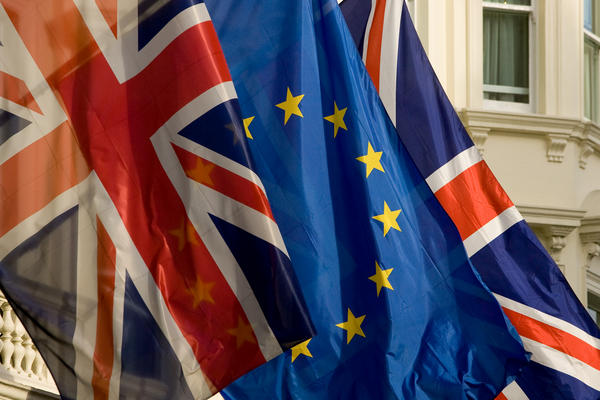
We cannot hope to control which direction the Union moves in from the sidelines.
None of us can say whether there will be more good news as the year progresses, however. We know there is unpleasant belt-tightening up ahead. But will our sacrifices start to pay off? I believe they will. We, unlike Uncle Sam, are pressing most of the right buttons, though more on growth is necessary. What we have to do is hold our nerve on shrinking the state’s share of GDP.
An economy cannot take off if the state grabs too much. The great imponderable, apart from said Uncle Sam’s actions – or inactions, which might push him over the fiscal cliff with who knows what consequences for us all – is Europe. Will its terrible economic travails rain seriously on our, hopefully, improving parade? Again, no one can say.
Europe has been sticking its nose in our affairs for a very long time now. It started with the Romans; then it was the Angles, Saxons and Jutes; then the Vikings; and then the Normans (who weren’t actually French at all, but a gang of settled down Vikings). It ended there – at least where foreign occupation was concerned. After that it was our turn; the boot was on the other foot. Indeed, we have been sticking our nose in their affairs now for almost a thousand years – much strengthened, I have to admit, by this mongrel-mixing that we had to endure – and most effective our interference has been.
It has been our cardinal aim never to allow a single dominant country to conquer and overawe the rest, and so present us with an accumulation of power to which, notwithstanding our island status, we would have no answer. Many times we came close to disaster. Philip of Spain – with his Armada – almost overwhelmed us. Louis XIV, the ‘Sun King’, nearly pulled it off but Churchill’s famous ancestor, the Duke of Marlborough, did for the Sun King and smashed his hopes at Blenheim in Austria. Then came the terrible Napoleon; but Herculean efforts – aided by our burgeoning Industrial Revolution – spread over twenty years, which almost bankrupted us, finally brought him to ruin at Waterloo.
For a hundred years after no power on earth could threaten our supremacy and we went on to build the greatest empire known to man. But nothing lasts forever. A powerful rival in the form of the Kaiser’s Germany came up on us and the accumulated wealth of two hundred years and a bloodletting on a scale never before experienced had to be deployed to frustrate his hopes. Twenty-one years later, what was left of that once incredible wealth, plus more blood, was expended to crush Germany’s revanchist ambitions once and for all. And that is where we are today. We have no more treasure to deploy and we will not send our young men to their doom anymore in such numbers. Luckily, neither will any of the others. All of us have had enough; hence the European Union.
We all wish to prosper in a continent of harmony. We wish to concentrate our energies on getting richer as well as fairer and more compassionate. And as with Japan, the appetite for large-scale war has been successfully eradicated. So far so good.
We on this island, with some understandable difficulty, have come to accept that we cannot any longer play the world’s diva. We are, as a consequence, prepared to join forces with our European neighbours to resurrect Europe’s power and prosperity in the world which it foolishly threw away. But this is conditional on this great union being fully democratic, truly accountable and non intrusive in sensitive areas best handled at home. That is not what we see. This octopus which operates out of Brussels seeks to spread it tentacles into every nook and cranny of our national life. Its servants run a gravy train of quite stupendous generosity and corruption seems to be endemic. For eighteen years its auditors have refused to sign off its accounts. And the worst of it all is that we seem unable to control it. A reckoning is overdue.
Proud nations cannot be dictated to in matters which properly should be decided at national level. In this take on the Union’s shortcomings, we are not alone. We have natural allies in Scandinavia, the Netherlands and, most of all, moneybags Germany. They are desperate for us to stay. Our problem is that with our frustration we allow ourselves to flounce off, with all the terrible risks attendant on being out of the loop.
Outside of the Union, we cannot hope to control which direction it moves in. With such an accumulation of population, wealth and power, its development could be inimical to our interests; and it could even end up threatening us. As the most successful, internationally, of all the European powers, we must have confidence to know that our voice will be heard. Things cannot go on as they are. We have, for instance, finally brought sense to the Common Fisheries Policy which was decimating our fish stocks. Forward now to the Common Agricultural Policy which so harms the poor nations of the world and keeps food prices at home higher than they need be. Forward also with repatriating those many powers which should never have left these shores.
I glory in the diversity of our continent and am confident it will never go away. Italy will always be Italy and France, France. If I mix with the boisterous crowd wearing lederhosen at the Munich Beer Festival, they look (lederhosen excepted) just like me. Our church-driven culture down the centuries has made us – despite our fascinating differences – one civilisation with a single European culture and we cannot, indeed must not, marginalise ourselves and walk away into the sunset. And how gratifying it should be to us that the multilingual family of nations we are fashioning our future with have looked to our language to be their language of choice in order to make our latter day tower of Babel function smoothly. What an advantage that gives us.
So my plea is this: have confidence and believe in yourself. Just as through your earth-shattering Industrial Revolution you touched the face of humanity and left an indelible mark, go out and do the same in Europe. Only please, please don’t be a ‘Little Englander’. It doesn’t become you.

A train crash in slow motion
The euro crisis rolls on like a train crash in slow motion.
The fact is, you cannot bend economics to your will. The forces which say you cannot do this are almost as immutable as the laws of gravity. Yet that is what the founding fathers of the euro set out to do.
They sought to bind nations with wildly disparate national traits, and equally disparate levels of competitiveness, into one whole. But they did it for political reasons not economic.
It might have worked if all involved had applied the original, sensible rules of entry and submitted their annual budgets to a Brussels power of veto, but they did not.
A monetary union not backed by a fiscal one is actually a no brainer. It cannot work. Even those American founding fathers of nearly 250 years ago understood this.
The success of the American union had a lot to do with the template drawn from a single gene pool with a single historical experience, put in place by the original thirteen colonies who decreed a single language for all.
Now ‘cruel necessity’ – as Cromwell is said to have described the decision to cut off the king’s head – is pushing Europe to cut off the head of the errant Greek state and force it back to the Drachma, Europe’s oldest currency. It is also going to force those who remain within the single currency to give up forever sole control of their countries’ spending policies.
Having done that, then you might at last have a system which actually worked. Within that system would undoubtedly develop a super strong currency with the potential to displace the dollar as the world’s reserve currency.
It all hangs on what the Greeks vote for at the forthcoming election. Despite all the serious pain they are going through a surprising number of them (over 70%) still want to stay in the euro. But, being the hot-headed Greeks that they are, they cannot help but wear their pain on their sleeves.
If this shows itself by a massive protest vote for the party which promises to bucket a lot of austerity promises – as seems likely – then Greece’s days as a euro member are numbered.
The young and inexperienced party leader in question has convinced himself that the Germans, right now, need Greece more than the Greeks need the Germans. The logic of his argument is that the loss of Greece will begin the unravelling of the euro and quite possibly the whole ‘European Project’. He will simply refuse to implement austerity and defy the Germans and north Europeans to do their worst. He’s convinced they will blink first. I fear he and his nation are in for a terrible shock.
It has to be said that no one has benefited more from the euro than the Germans.
If they have huge reserves of savings that is because for a decade they have been marketing their products in a hugely (for them) undervalued currency. Their former chancellor, Helmut Kohl, has admitted – albeit belatedly – that at the time the political elite dared not ask the German people if they would surrender their beloved deutschmark in favour of the new currency because they knew that they would get a big fat nein.
Yet if the euro were to break up, their deutschmark would be back again – only this time with a vengeance; it would become so expensive that few could afford to buy their products. Exports would plummet.
So yes, the Germans are terrified that a Greek exit will set off an unstoppable chain reaction causing the weaker southern economies to drop out, threatening to destroy the whole single currency. But the Germans are equally terrified at seeing their hard earned savings and pensions going down a bottomless ‘Club Med’ plughole and an endless future of propping up lame duck economies.
So now the previously unthinkable is being touted in Berlin and the other chancelleries of Europe: Greece can go if it will not comply with its undertakings. It will serve as a salutary lesson to other possible backsliders, say some. Provided they do not show similar defiance as Greece, then I believe that Fritz will give the European Central Bank the powers it needs to act as the lender of last resort like the American Federal Reserve or the Bank of England.
Both for narrow self-interest and deep psychological reasons Germany does not wish the European Project to fail, much less be blamed for its failure. It wants desperately to be seen as a good European and lay forever the ghosts of its troubled past. So my own belief is that Germany will do all in it power to hold the eurozone together.
IIf the markets go on to attack the other weaker economies once Greece has gone, who knows where it will all end. Even German savings may not be enough to save the euro, so big are the debts of Italy and Spain, the 7th and 9th largest economies in the world.
George Soros, the man who bet against Britain staying in the ERM in 1992 and won a billion pounds in the process, says the euro train has three months before it hits the buffers. While he is not always right, we should worry. He is 60% of the time.
It is my firm belief, however, that the euro, in one form or another, will survive. And as strange – even weird – as it may seem, given present circumstances, there are still many countries waiting in the wings to join such as Poland, the Baltic states, Czech, Slovakia, Slovenia and even perhaps Sweden and Denmark.
Had the original rules of entry been adhered to then none of the present PIIGS would have qualified to join in the first place and this nightmare would never have happened. For that, Germany must take its share of the blame; it does no good for it to get on its high horse over-much.
But a reformed euro, even if it has shed a whole swath of weaker members, may yet be something to behold. It’s been a long time in Europe since anyone has been able to boast of sound money. If it did not entail so great a loss of sovereignty, it might be a door that we ourselves might one day find ourselves greatly tempted to knock on.

A Marshall Plan for PIGS
I recently watched a BBC interview with Angela Merkel, the German Chancellor – a very rare event since she has only once before given an interview to the foreign media.
 The interview represented a considerable feather in the cap of the BBC, further confirming its status as the world’s premier broadcaster.
The interviewer, Newsnight’s Gavin Esler, wanted to get inside the head of the person who will largely determine the future of the eurozone and, to some degree, the rest of the world.
The visual aspect of TV makes it very difficult for an interviewee to ‘fake it’; to pass himself off as someone else. His body language and emotions are often plain to see; and when his face occupies most of a 42″ screen in your living room, you feel you can almost look into his soul. TV greatly assists in our quest to sort out the wheat from the chav.
Merkel came over as a pleasant, but no-nonsense, woman – interested more in getting the job done than in sound bites. Astute as she was with thoughtful responses, she seemed genuine.
And there was more than a little guile there too (but you don’t get to lead the most powerful economy in Europe without a level of that).
It was not difficult to understand why she had taken a shine to our own prime minister – the polished, well-mannered product of England’s leading public school. She may even have fancied the younger man a little, or perhaps felt a tad motherly, seeing him as the archetypal English gentleman as opposed to the coarse, bling-loving French president who wants to smother her at every opportunity with Gallic kisses. The contrast is stark.
Cameron is a most courtly emissary from a fellow Teutonic power which, from early childhood, she had come to respect. Yet despite its bombing of large areas of her beloved homeland almost back to the Stone Age only a generation or two before, it is apparent that – in economic terms at least – Merkel regards Britain as a natural ally and one she is most unwilling either to offend or marginalise.
The BBC was right in picking Gavin Esler as the interviewer, since Paxo might have been too adversarial by adopting his characteristic ‘master inquisitor’ approach.
But what I really gleaned from the interview is an appreciation of the lengths to which Germany will go to save the single currency.
Up to now, Angela Merkel has, understandably, played hardball. The German taxpayer is not going to throw his money at profligate nations which show an unsatisfactory willingness to change their ways.
The Germans want a new economic order in Europe so that nations act responsibly in the future; and to this end they want robust systems in place in the form of a fiscal union.
Germany is not interested in imposing a German jackboot, but wants the whole exercise to be seen as a pan-European affair – even though a fiscal union would result in all 17 eurozone nations’ budgets being overseen by EU officials: a fact masked by a Byzantium-level of cunningness or ingenuity (call it what you will).
I came away from that interview convinced that the German political elite do not want a single member – not even Greece – to drop out of the eurozone. And when push comes to shove, they will do everything in their power to see that this does not happen. They see the loss of a single country as the trigger that will begin the unravelling of the entire single currency and, more than that, of the whole ‘European Project’ to which it is so utterly and irredeemably committed.
So now, it would seem, it is down to the individual eurozone member states to do what is necessary. Only time will tell whether the eurozone’s peripheral countries’ impoverished citizens will – or even can – stay the course.
Pain levels in Greece – and now, more alarmingly, Spain – are at breaking point. A pistol shot to the head outside the Greek Parliament of a 77-year-old retired pharmacist has a terrible resonance with that pistol shot long ago at Sarajevo which set in motion the chain of events which led to the First World War.
Germany has to understand that PIGS’ (Portugal, Italy, Greece and Spain) citizens can take little more pain. While it was necessary to start the austerity drive and change PIGS’ spending habits, it is clear that austerity alone is fast becoming counter-productive.
If Germany wishes them to hold on, she must give them hope – and this can only mean a plan not just for cuts, but for growth. She must put together and spearhead a new Marshall Plan of aid – such as saved Europe in the aftermath of the Second World War.
Germany does not wish to be cast as the villain all over again; the one who did wrong by Europe for a third time, only now by economic, rather than military, might.
Now that we have all come to understand that we must stop living beyond our means, and that the social model we have developed is unsustainable, we are in a position to go forward.
Only by means of growth and a smaller state sector have we a chance of paying down our debt.
Fearful and envious as we may be of the developing countries – and that includes the oil producers – they are as one in wanting us to succeed; for if we go down the pan, we are as likely as not to drag them down with us – and they know this.
They might even feel that it is in their interest to involve themselves in such a rescue plan. But they will not do so if they see north Europe, and in particular the Germans, sitting on a pot of gold but refusing to use it to kick start their own salvation.
God, as they say, helps those who help themselves.
Germany: hero of the hour?
It used to be said that when America sneezed, Europe caught a cold. Now it’s the other way round, except that Europe has done a great deal more than sneezed; it’s almost taken to its bed. The reason for this is that Europe today is, despite appearances – the world’s economic powerhouse. It has on the way to twice America’s population and accounts for well over 40% of the world’s trade. But it has mismanaged its affairs to the point where the markets have had enough.
We must not blame the markets; they are only a reflection of how the guardians of our pension funds and insurance companies view future prospects. It is their job to identify risk and so protect people’s savings. They do not worry about the Scandinavians, Swiss, Dutch, Germans, or even us (now that we are in the process of balancing our budget and bringing our deficit under control). What they look for are not fine words and good intent – welcome as they are – but action.
They have seen it from us, but they have not been getting it in any meaningful way from Europe. From bestriding the world like a colossus in the lifetime of people still alive (not many, admittedly), Europe has seen its position twice destroyed by the two German wars.
The European Project was designed to ensure that this never happened again. For 50 years, Europe has painstakingly climbed back on its feet. Its people realised that old style nationalism was not the way forward, and today it is a beacon of cooperation and prosperity admired around the world. But all this is now threatened. Ruin, recrimination and bad – if not spilt – blood faces the continent unless it acts fast and decisively
It is to Europe’s great good fortune that it has one economy big enough and strong enough to silence the markets. But the leaders of that economy must step up to the plate. While we all understand why Germany is so paranoiac about printing money, no extra notes are actually printed – it’s just an electronic exercise in today’s world. And that is the point.
Today’s world is very different from the financial circumstances which brought Hitler to power. First, we now know that beggar thy neighbour, protectionist policies are counterproductive. Second, we are a much more joined up, globalised world, with powerful computers assisting our fragile brain capacities. Third, there are the great institutions such as the World Bank, the IMF, the World Trade Organisation, G20, and many, many more which were not in place when Germany’s Weimar Republic wrestled with its horrendous problems. (Not the least of these were the foolish and ruinous Reparations imposed by the victorious Allies in the Versailles Treaty). So Germany can take a more relaxed view today.
While it is important to learn the lessons of history, it is equally important not to be spooked by them. Germany has an historic opportunity to save Europe which its previous militarism helped to destroy. Germany must realise that if its fears and parsimoniousness allow the Euro to collapse, it will be among the greatest losers; its export-dependent economy would reel under the weight of a super valued Deutschmark. Nobody would be able to afford its goods. And that’s another thing! Nobody has benefited more from the reasonably priced Euro than have the Germans.
Poor, benighted Greece, (along, I might add, with the rest of us) has indulged itself on German products and that’s part of the reason it owes so much. There’s an irony in there somewhere, surely. Another irony is that this crisis has ended a British foreign policy which has been central to it for 500 years – even propelling it into any number of pre-emptive wars – never to allow a continental power bloc to develop which would overshadow us.
When our Prime Minister and Chancellor of the Exchequer urge Germany forward into a fiscal union, of which we will not be part, they are doing just that: putting the final building blocks in place which will lead to a united Europe.
It is a measure of the extraordinary trust which has built up that they feel safe to do so. So Fritz now has his chance to be the hero of the hour. Let him look at the big picture and rise to the challenge. Europe will be forever in his debt (literally). The European Central Bank must be the vehicle of his largess. It must be beefed up to the point where it can act like the Federal Reserve or the Bank of England – the lender of last resort.
The consequence of Germany opening up the coffers on all its hard earned dosh will not be without benefit in other ways. Systems will be put in place to ensure that such a drama never happens again; the feckless will be compelled into good housekeeping; corruption will be rooted out; Spanish practices in the workplace will be curtailed and Europe will have the fiscal union which, but for the crisis, it would never have had.
South Europe, despite all these measures, will always need a little forbearance, much like the poorer regions of Britain. We northerners will have to accept that with all that heat you will never get the Club Med countries to beaver away quite like us. But if they are unable to implement the austerity requirements – and they should not be too draconian (remember Versailles) – then they should be let go.
One thing, though, is certain. Either we all do our best to all hang together or we will surely all hang separately.
Taming Brussels
For a brief moment we thought we had got on top of the financial woes of the Credit Crunch and our personal and governmental debts which put all our livelihoods at risk.
At incredible potential cost, we had recapitalised our banks and put them on a sound footing. And then we began the painful long haul task of bringing our deficit under firm control. So far so good; the markets were impressed. The heat was off Britain.
But then the markets turned their gaze on the warring Europeans and their troubled, ill conceived euro.
The sovereign debt levels of the periphery countries quite spooked them. A slanging match had developed between the thrifty north and the spendthrift south. The Germans, in particular, were furious at the feckless and economically illiterate way the south Europeans had behaved, and the talk was that they had had enough of the haemorrhaging of their hard earned dosh. The whole future of the euro – and with it the European Union – hung in the balance.
Greece was the domino likely to go down first and very likely to carry a string of others with them. It was never an easy country to govern, and lovely people though they are, one of their irredeemable failings is that they make almost a national sport of not paying their taxes.
Yet at the same time, because they were part of the wonderful European Union, they expected to enjoy all the social benefits of the conscientious taxpaying north. How do you square a circle like that? After all, the north only got all those benefits because it was willing to cough up.
Greece’s public sector is bloated to the extent that it makes our own flawed product look like a sleekly toned race horse. What’s more, it only turns up for work when it feels like it and its appalling levels of absenteeism pass with just the Greek equivalent of a Gallic shrug. Then, after a semi-detached life of half work they insist on retiring ten years before the rest of us. No wonder the boys in their lederhosen are hacked off.
Yet despite what he and his other diligent north European comrades feel, he will not get his pride and joy deutschmark back. The ruling elite will see to that! The political classes have invested too much political and other capital in the so called ‘European project’ to let it founder. But after terrible dithering and lack of leadership which has propelled them to the wire, they have drawn back from what they see as the abyss of a collapsed Europe.
They are now determined, at last, to get ahead of the curve. They are putting together a package of such breathtaking proportions – three trillion (or 3,000,000,000,000) euros, no less – that even the money markets will recognise that they are putting their money where their mouth is and back off.
Yet the package will need approval of all 17 members of the eurozone and all 27 members of the Union for treaty amendments. Part of the deal, I’m sure, is that the people who underwrite the deal – principally the Germans – will insist on a future level of fiscal rectitude which will make it nigh on impossible for such a situation to arise again. There will be an oversight of all 17 member states’ budgets with a majority power of veto.
It will be, effectively, the final part of the jigsaw towards a united Europe: for all intents and purposes a fiscal union, which along with the existing monitory union will finally give the European single currency credibility. Politically, it couldn’t have happened at the beginning or at any point along the way, but dire necessity has forced the issue. It’s an ill wind that blows no good. The new Europe will not be such a bad place to belong so long as all that nonsense of an interfering Brussels is dealt with.
This is a heaven sent opportunity which will not come again. And because they need our signature on the treaty, we can insist on repatriation of those matters we all know to be flawed, such as the Working Times Directive, border controls, fisheries protection, and even that horney old chestnut: the Common Agricultural Policy.
Way back when we were haggling over the Maarstricht Treaty, they came up with that amazing word “subsidiarity”. What ever happened to it? It was adopted by the Union and was specifically designed to constrain Brussels.
If we seize the moment, we can then settle down to becoming the good Europeans we were always willing to be, instead of the perpetual awkward squad.
The world of tomorrow is going to be one of the big battalions, and Europe is a very big battalion indeed; one more than capable of stopping itself being pushed around by a resurgent China or anyone else.
The Perfect Storm
It is alarming that the markets have given a thumbs down to the Obama/Congress deal. And now we hear that they are seriously doubtful of Italy’s ability to grow its way out of the enormous debt it holds.
What with Spain teetering on the brink, and Greece, Portugal and Ireland considered lost causes, we have what amounts to ‘the perfect storm’. Yet we British have retained the market’s confidence; our willingness to bite the bullet allows us to borrow at the same rate as the Germans. But sadly that won’t save us. We absolutely have to sell our goods and services to the New World as well as the old.
43% alone of our output goes to the European Union, and another huge chunk to North America. The US Republicans – led by the Tea Party – refuse to aid a deficit cutting programme by including tax increases, even though the Federal Government’s tax take is barely half the European average. What right-minded system in today’s world allows Western drivers to fill up at not much more than half of the EU average?
Alas, Americans (and to be fair we) have been living high on the hog for too long. We in the West – especially the Americans with their consumption-driven economy – have been sating ourselves on China’s cheap goods, fueling its mind-blowing year-on-year 10% growth at the expence of increasing their own competetiveness. Industries have gone down like ninepins and jobs exported; they have allowed China to get away with a grossly undervalued currency and not to conform to World Trade Organisation rules. Perhaps most alarming of all, China stands accused of commercial and military espionage on a industrial scale by hacking into the West’s computer systems. This amounts to war by other means. So either the US treats balancing its budget almost as though it were a wartime priority, or it can say goodbye to being the world’s leading economy. Hello, China. Hello, India.
We may have been sold the idea that somethings are too big to fail, but believe me: a whole nation can fail – even the US if it hasn’t the stomach to put its house in order. The wars in Afghanistan and Iraq have done for the United States what the Kaiser and Hitler wars did for us… nigh bankrupted it. The difference is that in our case it was a noble struggle that simply had to be faced; a militaristic Germany bent on world conquest was a cause worth sacrificing even the British Empire for.
As far as the Euro is concerned, no matter how many sticking plasters they try to put over the crisis, nothing can hide the fact that the patient neeeds surgery. Greece and the others – the so called PIIGS – can’t service the debts they already have and provide for growth. And how does it help to foist more loans on them and push their service charges even higher? It’s the economics of the madhouse. They must all be cut loose; free to set their interest rates at the appropriate level; free to make a mess of things if they can’t get their act together without dragging everyone else down with them and also free to rejoin if they get their house in order and meet the strict criteria of membership, which they were meant to meet in the first place but never did.
The only alternative is for the sound economies of the north to take fiscal control of the hopeless cases in the south. In other words, a Fiscal Union to add to the unworkable existing Monetary Union. In the long run the PIIGS would all be better off. But would they stand for it? Proud, broken Greece would find it exceedingly hard to take the teutonic medicine that Frankfurt would insist they swallow.
As for poor old Britain, we are left dangling in the wind, waiting on events over which we have no control, but which are certain to turn all our lives upside down. I would hazard a guess, however, that if the Euro is reformed so that only successful economies can belong, then perhaps a very good case could then be made for us to join
There are huge advantages to be had in belonging to a truly powerful currancy bloc that might well take over as the world’s Reserve Currency. I fear the dollar’s day may be done, but I wouldn’t underestimate Uncle Sam’s recuperative powers and his legendary can-do approach when fired up. But please, please don’t let the Reserve Currency be the Yuan if Uncle Sam can’t make it.
Norwegian killings
The recent shocking events in Norway have affected us in a particularly unusual way, as we have long come to view the Scandinavian family in a special light. Although they may once have been among the most violent people ever to walk the earth, that was a very long time ago; like so many others whose characteristics have changed beyond all recognition – think Romans, Germans, Japanese – we now regard the Norsemen as paragons of virtuous and peaceful living. If such an event can occur in such a region then it can occur anywhere. But perhaps I miss a vital factor here; perhaps I should restrict my comments to the developed world. Why do I say this? I say it because we have not yet heard of an outrage of this sort in Africa, Latin America or the East. And we have not heard of it in the countries of the Mediterranean basin.
A common feature of all the perpertrators of these crimes is that they are loners. They do not come from integrated and loving families; they have chips on their shoulders because they feel themselves neglected and unwanted. Their parents, in pursuit of notions of equality and a right to continue the hedonistic lifestyle of youth, even after they have ‘committed’ and produced children, do not want to be burdened with the sacrifices of parenthood. Forget the cover which hatred of the outsider provides – in this case Muslims. If they didn’t exist it would be the Jews, Gypsies, homosexuals, or other such minority groups. The loner has to have something to hang his grievances on.
One factor which distinguishes this atrocity from the others is that the killer had no wish to kill himself. For a start – with his warped thinking – he believes he is acting in a righteous cause and need have no bad conscience. To him, the end justifies the means or, as Stalin put it: ‘A single death is a tragedy, but a million is a statistic.’ And in that respect he is no different from the Jehadists. What’s more, he is young and will, due to Norway’s 21-year maximum jail term, be walking the streets again in his early fifties (during this time he will be enjoying some of the cushiest prison conditions in the entire world). Also what is different is that he has left us a veritable mountain of his private thoughts via the internet. He has spent years cataloguing everything. His ‘manifesto’ alone runs to an astonishing 1,430 pages, the majority of which will no doubt be rambling nonsense. We shall further have a chance to analyse his twisted logic in minute detail in one-to-ones during the months and years ahead.
What this sad and tragic tale seems to say to me is that government policies throughout the developed world must be skewed to resurrect the values associated with strong and stable families. Parents must be brought to understand that if they produce children they must stand by them; that they must make sacrifices to ensure that they have happy memories of their childhood to draw on and to know that they were loved and cherished. It is a bitter harvest indeed that we are reaping as a result of the decades following the fifties, when adults were free to be as promiscuous as they pleased – thank you, pill – and to pursue a ‘me, me lifestyle’. And don’t tell these people about duties; they only want to hear about rights.
The euro
How could Greece’s economy, which makes up only 2% of the Eurozone, potentially bring the whole house of cards crashing down? It is down to what the jittery markets make of it all. If they believe that the new bailout’s austerity demands (the second tranche) are unenforceable on a people who are now close to ungovernable, then they will panic, and a panicking bond market cannot be resisted. Indeed, we British had firsthand experience of this on ‘Black Wednesday’. And besides, the Greeks don’t have the stomach for more austerity: they would rather default on their debts and tell north Europe to get stuffed; they see only a future of unending misery as things stand.
As for the still fragile and barely recovering banks, there would inevitably be huge shockwaves all over again. But it’s the thought of a domino eftect on the other tottering economies of south Europe (Britain in extremis will save Ireland from going under) which is the stuff of sleepless nights. No body (neither the ECB nor IMF) can raise the sort of money needed to save the likes of Spain or Italy: it is truly a doomsday scenario which, amazingly, has got even China and India thinking they might have to step in.
The Euro is going to have to go back to the format which it originally drafted; that’s to say that only economies which can meet the five strict criteria laid down can be members. Alas, it was the failure to adhere to these requirements and the mad rush to admit anybody and everybody – and all the fudging that took place besides – which has led to the present situation. In that sense, north Europe has only itself to blame for not insisting on admission rules being sacrosanct. It is perfectly understandable that the hardworking, tax-paying, late-retiring North resents the happy-go-lucky, tax-avoiding and lets-play-the-Euro-system-with-its-cheap-loans South, which told a string of porkies about its indebtedness and then, to cap it all, wants to put its feet up early. But the South did only what most would do in the circumstances, given half a chance. Any thinking person could have seen it coming.
Watch this space!

 The Last Foundling