Blog Archives
CANZUK: A Marriage Made in Heaven
There are few political outcomes about which any of us can be certain. However, the coming together of the Anglosphere seems almost assured. I am certain that when it happens, it will be a great boost for liberal democracy, becoming at a stroke the third pillar of the Free World after the US and the EU. It will also, at one leap, become one of the largest economic and military entities on the planet.
I speak, of course, of the settler communities of Canada, Australia, and New Zealand reuniting with their founder. A bipartisan poll has shown massive support in all four countries. While keeping their own parliaments, they propose to operate in unison in such areas as freedom of movement, job opportunities, recognition of each other’s qualifications, free trade, common currency; defence and intelligence, along with a joint defence policy. All will enjoy a high level of autonomy, much like the four countries of the UK.
This profound development could not have happened before this time. But a growing chorus argues that its time has come. Each of the now established nations needed to break free from the coattails of their founder, mature in their own right, shaking off any feelings of inferiority to their ancient motherland, and establish their own identity. This, over long years of autonomy, they have successfully achieved. All three punch well above their weight and are a credit to both themselves and their founder. The same could be said of the mighty United States, though its weight can never be in doubt.
Although the four nations of the proposed new union have been free for well over a hundred years to set their own policies, they have remained in remarkable lockstep with each other. So much so that if any of their citizens were to uproot themselves to another of the quartet, they would not feel themselves to be in a foreign land. So similar are all their institutions and the way they go about their daily lives, and so similar are the things they hold dear, that it is not surprising that such massive majorities for a reunion were achieved.
However, the world in which all four now operate has changed beyond all recognition. Who could have imagined that backward, dirt-poor China that occupied Australia’s backyard when it gained its independence would now be a digital, financial, and military colossus that casts a menacing shadow over its empty spaces, rich with rare earth materials and everything you can think of? How could Canada have known, when it achieved its independence 158 years ago, that its kindred neighbour to the south would grow so big as to make any dealings with it, trade or otherwise, totally unequal? Dangers and challenges surround these fledgling nations, as indeed they do their own mother-country since it left the EU. It is glaringly apparent that only their combined muscle can provide an answer.
Quietly and without fanfare, as is their preferred method, the nations of the Anglosphere are already reuniting. Britain’s exit from the EU has now got us back to where we were before that fateful sign-up decision that so upset our natural family. It has no option but to fashion a new future. In truth, it was never a proper fit with the EU, the successors of Charlemagne, wonderful as the concept of the EU was and is. It only joined because it was economically weak, while at the same time, Europe appeared prosperous. Britain’s horizons have always been global, notably marked by its history with the thirteen colonies. But that particular colossus, although it truly belongs in the proposed new union, cannot ever be a part. Ex-officio, maybe, but never a part. It is just too damned big. It couldn’t help itself from bossing the others around. Nevertheless, the emergence of a mighty new ally, fashioned in so many ways in its own image, could only but bring a smile to its face. The US would feel immense relief at no longer having to bear the burden of maintaining the post-war settlement alone. The creation of CANZUK (an acronym for Canada, Australia, New Zealand, and the UK) would also be a boost to the Commonwealth, various members of which, with closely aligned values, might well aspire to join. Singapore springs to mind, as it already shares a great many of these and is an economic fit.
Few would argue that the world would not be a better, happier, and more secure place, were CANZUK to become a reality. As we move into the New Year, I am hopeful that 2025 will see some truly positive developments, even if CANZUK is not one of them. 53 years of Syrian misery is at an end, and I believe that the present leadership means what it says about a Syria for all factions. Ukraine, too, I believe, will see an end to the war, though it cannot be that Putin can claim any sort of a victory. Also, I am sure that there will be a resumption of the Abraham Accords, once the guns fall silent in Palestine. Peace may, at last, come to that benighted region, which we — I am sorry to say, as the arbiters of the time — messed up on and which our progenitor nation, the US, will, hopefully, after a hundred years, make good on.
With all these things in mind, and many more, I would like to wish my own small family of readers a very happy and contented New Year.
Brexit and Beyond: Uniting the Old Commonwealth
On the seventh anniversary of Brexit, it is both disheartening and exasperating that the project remains shrouded in negativity, with scant attention paid to the opportunities it presents. A dazzling prospect lies in wait for the British government. By overwhelming majorities, the citizens of our erstwhile Commonwealth allies – Canada, Australia, and New Zealand – have signalled their wish for a revival of the kinship that united us at the dawn of the 20th century.
While steadfastly maintaining their sovereign parliaments, these nations envision sharing with us a common defence, security, and foreign policy. They also aspire to enable freedom of movement, commerce, recognition of qualifications, and much more. This collective interest embodies a potential union that could function exceptionally well. Our levels of employment and standard of living are broadly comparable, and almost all aspects of our societal framework; our values, culture, history, parliamentary system, law and language, are remarkably similar. If realised, this would form the largest union globally, and provide a sturdy pillar of support to a beleaguered Uncle Sam.
Objectively, such an endeavour could be considered a straightforward decision and one that should draw cross-party backing. So, why does Westminster hesitate to seize this momentous opportunity? Could Brexit yield a more significant dividend than to reunite our familial ties in such a monumental development? The renewal of this close relationship, now known as CANZUK, holds a promising future.
The emerging power of the CANZUK union
Democracy and our Western way of life are currently in crisis. The rise of a militarised China, a crazed and delinquent Russia, and increasing numbers of authoritarian states pose what some see as an existential threat to our Western values. Yet, a powerful development could potentially reverse this situation.
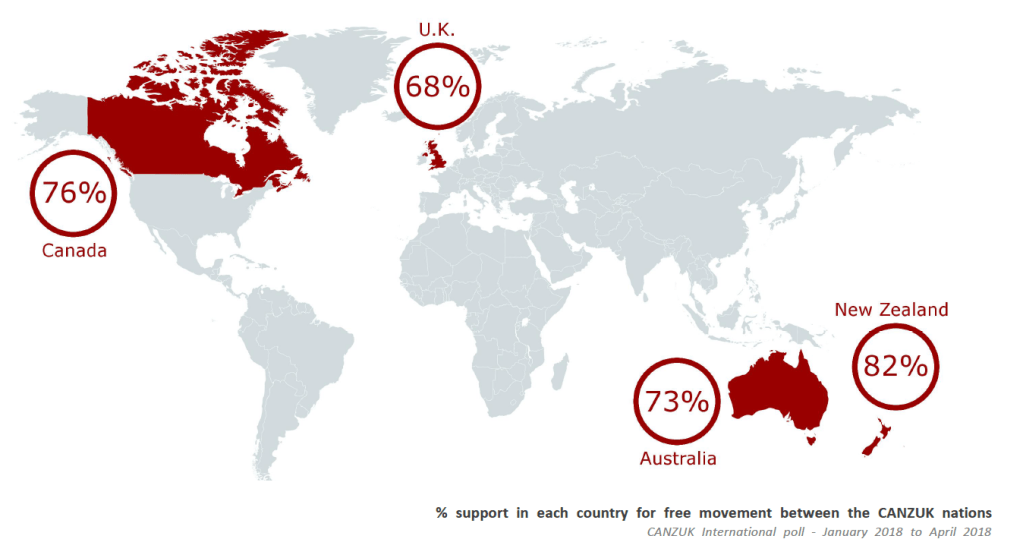
Forces are gathering for a union of four pivotal democracies – an entity known as CANZUK, an acronym for Canada, Australia, New Zealand, and the UK. Public polling indicates broad support: 68% in Britain, 73% in Australia, 76% in Canada, and 82% in New Zealand. Each nation will remain sovereign, yet they’ll cooperate in foreign policy, defence, freedom of movement and trade, recognition of qualifications, and sharing of security concerns—an existing example of such cooperation being the Five Eyes Agreement, which also includes the United States.
In terms of land area, this proposed union would be larger than Russia, boasting a combined GDP of $6.5 trillion and a population of 135 million. Its military budget would exceed $100 billion, making it the third largest in the world.
While many draw parallels between CANZUK and the EU, crucial differences exist. The CANZUK nations share a common language, heritage, and lifestyle. Their standard of living, employment levels, and political institutions run in parallel. Critics of CANZUK have termed it ‘a white man’s club’, but CANZUK International, the organisation advocating for the union, has stressed that the door will remain open to other like-minded nations sharing the same values, including India.
Historically, the CANZUK countries have fought together in defence of freedom, never against each other – unlike the turbulent history of European nations. Another critical difference with the EU is that no CANZUK nation will impose rules and regulations on another, unlike the centralised control from Brussels.
The emergence of the CANZUK union could reinvigorate global leadership, inspire the United States to remain globally engaged, and establish a third significant pillar of Western values alongside the US and EU.
Each CANZUK nation will also gain unique benefits. Canada could negotiate on more equal terms without the overshadowing presence of its giant neighbour. Australia and New Zealand could face China’s assertiveness more confidently, and Britain, once history’s largest empire, would regain its international influence and join the largest confederation on the planet – a reinvigoration sparked by Brexit during its dire straits.
The prosperity of CANZUK members could significantly increase as a result of this union. Critics who question the viability of trade due to geographical distances overlook the success of global trading giants like China and Japan. Advancements in AI and green technology, like the US Navy’s move towards virtually crewless ships, are likely to reduce shipping costs in the future, making the trading prospects even more favourable.
But perhaps the greatest beneficiaries of this promising development will be the young. They would be free to live, travel, study, and work across the expansive regions of CANZUK. Even retirees could benefit from the freedom to relocate. This exciting prospect is, to borrow a popular phrase, ‘a no-brainer.’ It should be for us grown-ups too.
The rise of the CANZUK union could potentially reinvigorate global leadership, inspire the United States to remain globally engaged, and establish a third significant pillar of Western values alongside the US and EU.
While Brexit initially represented a step away from supranational involvement for Britain, it may have ultimately set the stage for a stronger, more aligned union with countries that share deep historical and cultural ties. The post-Brexit era for Britain may not be one of isolation, but of renewed global influence and connectivity.
Many didn’t think Britain had much of a future outside the EU, but the world has always been our oyster. The CANZUK proposal is just one way we’re demonstrating that. Even domestically, we may find a solution to the aspirations of our member nations of the UK. As federal states within the union, they too could at last stand proud as sovereign states.
The notion of poor, tortured Ireland reuniting and choosing to join this new brotherhood of nations is not beyond the realms of possibility. This would be a testament to the appeal and potential of CANZUK, its promise of mutual benefit, and its respect for national sovereignty.
This is not a mere dream; it’s a potential reality within our grasp. It’s time to seize the opportunity and make CANZUK a part of our shared destiny. In an era marked by uncertainty and rapid change, the promise of CANZUK is a beacon of stability and shared prosperity, a testament to what nations can achieve when they unite under common values and a shared vision. Let’s look towards this future with hope and determination.

 The Last Foundling