Category Archives: society

The Flags Are Rising
The national awakening on September 13th represents a very strange statement being made by significant elements of the British people. Frustrated, and eventually driven to fury by the refusal of the governing classes to honour promises made to gain their vote, hundreds of thousands of flags of the four nations of the UK will suddenly make an appearance.
Flags for other countries are a cause of little comment. I was in Lithuania recently, and they were everywhere. Even our former colony across the pond will seek out every opportunity, or none, to raise the standard, proudly and unashamedly proclaiming its nationhood. Not so the British. For them there has to be a good reason, one which even unfriendly nations would seem churlish not to acknowledge. Ours are brought out sparingly, even judiciously, one might say. The reticent Brits are never anxious to over-egg their presence, even if their own flag once held sway across a quarter of the planet.
So what has caused this sudden about-turn? It was the bone-headed action of a local authority in cutting down British flags, put up to counter the appearance of a rash of foreign flags of a proscribed terrorist organisation, while leaving the proscribed flags in situ. It was the straw that finally broke a very patient camel’s back. To add insult to injury, the flags of the home country were unceremoniously binned like so much rubbish.
But the London Freedom Festival protest on September 13th, in reality, is about very much more than that bone-headed council. It is about long years of what amounts to abuse of the electorate: lies and bad faith, venal behaviour and pandering to the wishes of foreign states, many of which wish us harm, while all the time ignoring the wishes of the people who trusted them with their vote. No better example of the latter is the Chagos Islands fiasco. We end up giving something we own to someone who never owned it, and then paying that someone billions to lease it back. Tell me that I must have that wrong; but I haven’t. At the very same time we put our national security in peril, as well as that of our closest ally, by handing over the archipelago to a minnow of a state busily cosying up to the biggest threat the democratic world faces in the 21st century: expansionist and militarising China.
Also among the grievances are the years that a small minority of our people have preached to the rest of us of the wickedness of our ways. I speak of the fanatics of the woke brigade, the holier-than-thou bigots, the people who have allowed the tyranny of Stonewall to infect government, the law, academia, big business, the Town Halls – in fact, every agency which is in a position to make our lives a misery. Not only is their bigotry destroying lives, careers, marriages, you name it, but they are busy imprisoning people for voicing their opinions. Today, spontaneous talk is disallowed, since it must first run through the filter of: will it offend someone?
These same sanctimonious know-it-alls even have the gall to tell our young people that they should be ashamed of what their forefathers did around the world, and that a part of their hard-earned income should be handed over by way of restitution. The established church has even made a start on this absurdity by earmarking the first tranche of £100m. Where once our young people were encouraged to laud and seek to emulate the stupendous achievements of those who went before, these contemptible denigrators peddle an altogether different narrative and seek to instil a deep sense of guilt.
But what goes round comes round, and a reckoning is in the making. These young people who are now to be given the vote at 16 by this pork-barrel government are not, it seems, of a mind to vote for what they see as a band of losers. They do not buy into the prophets-of-doom narrative and the Britain-haters. Deep in their bones they know what a massive contribution their ancestors have made to the happiness of humankind. For the truth is their countrymen and women have made the modern world we know today, winning more Nobel prizes per capita than any other nation.
If we go to work in factories, it is because they showed us how to do it. If we trade across the broad expanses of the world, it is because they sought out markets for the products of those factories. If a rules-based order protects those products, it is because they put that order in place. If capital can be raised to produce and grow those products, it is because they became both bankers and insurers par excellence. And when all the toils of making an honest living are done, and it is time to play, who gave the world football? Who gave it golf? Who gave it cricket?
And when China calls its own recent summit of ‘friendly’ countries, was it a multiplicity of national costumes that we saw? No, not a bit of it! It was the English suit, even on our sworn enemies. Finally, when the Great Hall of the People echoed to the voices of hundreds of delegates from far-flung lands, was it Mandarin Chinese we were hearing? No, it was our own sceptred tongue.
So, bearing all these things in mind, and so much more that there isn’t space nor reader’s time for, does it not make utter fools of those who seek to belittle us? And the ones who should be truly ashamed of themselves are those who come from within our own ranks.
CANZUK: A Marriage Made in Heaven
There are few political outcomes about which any of us can be certain. However, the coming together of the Anglosphere seems almost assured. I am certain that when it happens, it will be a great boost for liberal democracy, becoming at a stroke the third pillar of the Free World after the US and the EU. It will also, at one leap, become one of the largest economic and military entities on the planet.
I speak, of course, of the settler communities of Canada, Australia, and New Zealand reuniting with their founder. A bipartisan poll has shown massive support in all four countries. While keeping their own parliaments, they propose to operate in unison in such areas as freedom of movement, job opportunities, recognition of each other’s qualifications, free trade, common currency; defence and intelligence, along with a joint defence policy. All will enjoy a high level of autonomy, much like the four countries of the UK.
This profound development could not have happened before this time. But a growing chorus argues that its time has come. Each of the now established nations needed to break free from the coattails of their founder, mature in their own right, shaking off any feelings of inferiority to their ancient motherland, and establish their own identity. This, over long years of autonomy, they have successfully achieved. All three punch well above their weight and are a credit to both themselves and their founder. The same could be said of the mighty United States, though its weight can never be in doubt.
Although the four nations of the proposed new union have been free for well over a hundred years to set their own policies, they have remained in remarkable lockstep with each other. So much so that if any of their citizens were to uproot themselves to another of the quartet, they would not feel themselves to be in a foreign land. So similar are all their institutions and the way they go about their daily lives, and so similar are the things they hold dear, that it is not surprising that such massive majorities for a reunion were achieved.
However, the world in which all four now operate has changed beyond all recognition. Who could have imagined that backward, dirt-poor China that occupied Australia’s backyard when it gained its independence would now be a digital, financial, and military colossus that casts a menacing shadow over its empty spaces, rich with rare earth materials and everything you can think of? How could Canada have known, when it achieved its independence 158 years ago, that its kindred neighbour to the south would grow so big as to make any dealings with it, trade or otherwise, totally unequal? Dangers and challenges surround these fledgling nations, as indeed they do their own mother-country since it left the EU. It is glaringly apparent that only their combined muscle can provide an answer.
Quietly and without fanfare, as is their preferred method, the nations of the Anglosphere are already reuniting. Britain’s exit from the EU has now got us back to where we were before that fateful sign-up decision that so upset our natural family. It has no option but to fashion a new future. In truth, it was never a proper fit with the EU, the successors of Charlemagne, wonderful as the concept of the EU was and is. It only joined because it was economically weak, while at the same time, Europe appeared prosperous. Britain’s horizons have always been global, notably marked by its history with the thirteen colonies. But that particular colossus, although it truly belongs in the proposed new union, cannot ever be a part. Ex-officio, maybe, but never a part. It is just too damned big. It couldn’t help itself from bossing the others around. Nevertheless, the emergence of a mighty new ally, fashioned in so many ways in its own image, could only but bring a smile to its face. The US would feel immense relief at no longer having to bear the burden of maintaining the post-war settlement alone. The creation of CANZUK (an acronym for Canada, Australia, New Zealand, and the UK) would also be a boost to the Commonwealth, various members of which, with closely aligned values, might well aspire to join. Singapore springs to mind, as it already shares a great many of these and is an economic fit.
Few would argue that the world would not be a better, happier, and more secure place, were CANZUK to become a reality. As we move into the New Year, I am hopeful that 2025 will see some truly positive developments, even if CANZUK is not one of them. 53 years of Syrian misery is at an end, and I believe that the present leadership means what it says about a Syria for all factions. Ukraine, too, I believe, will see an end to the war, though it cannot be that Putin can claim any sort of a victory. Also, I am sure that there will be a resumption of the Abraham Accords, once the guns fall silent in Palestine. Peace may, at last, come to that benighted region, which we — I am sorry to say, as the arbiters of the time — messed up on and which our progenitor nation, the US, will, hopefully, after a hundred years, make good on.
With all these things in mind, and many more, I would like to wish my own small family of readers a very happy and contented New Year.
Brexit and Beyond: Uniting the Old Commonwealth
On the seventh anniversary of Brexit, it is both disheartening and exasperating that the project remains shrouded in negativity, with scant attention paid to the opportunities it presents. A dazzling prospect lies in wait for the British government. By overwhelming majorities, the citizens of our erstwhile Commonwealth allies – Canada, Australia, and New Zealand – have signalled their wish for a revival of the kinship that united us at the dawn of the 20th century.
While steadfastly maintaining their sovereign parliaments, these nations envision sharing with us a common defence, security, and foreign policy. They also aspire to enable freedom of movement, commerce, recognition of qualifications, and much more. This collective interest embodies a potential union that could function exceptionally well. Our levels of employment and standard of living are broadly comparable, and almost all aspects of our societal framework; our values, culture, history, parliamentary system, law and language, are remarkably similar. If realised, this would form the largest union globally, and provide a sturdy pillar of support to a beleaguered Uncle Sam.
Objectively, such an endeavour could be considered a straightforward decision and one that should draw cross-party backing. So, why does Westminster hesitate to seize this momentous opportunity? Could Brexit yield a more significant dividend than to reunite our familial ties in such a monumental development? The renewal of this close relationship, now known as CANZUK, holds a promising future.
The emerging power of the CANZUK union
Democracy and our Western way of life are currently in crisis. The rise of a militarised China, a crazed and delinquent Russia, and increasing numbers of authoritarian states pose what some see as an existential threat to our Western values. Yet, a powerful development could potentially reverse this situation.
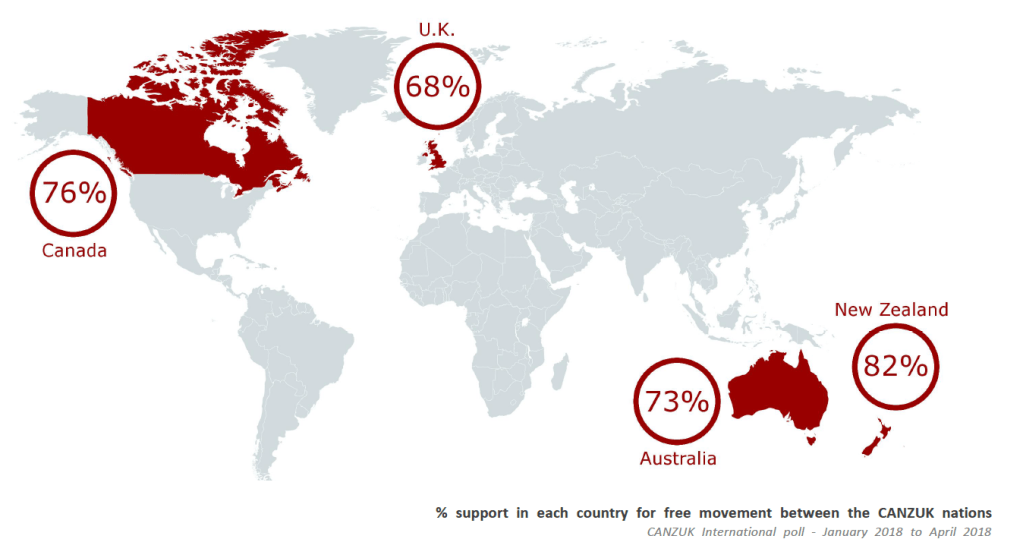
Forces are gathering for a union of four pivotal democracies – an entity known as CANZUK, an acronym for Canada, Australia, New Zealand, and the UK. Public polling indicates broad support: 68% in Britain, 73% in Australia, 76% in Canada, and 82% in New Zealand. Each nation will remain sovereign, yet they’ll cooperate in foreign policy, defence, freedom of movement and trade, recognition of qualifications, and sharing of security concerns—an existing example of such cooperation being the Five Eyes Agreement, which also includes the United States.
In terms of land area, this proposed union would be larger than Russia, boasting a combined GDP of $6.5 trillion and a population of 135 million. Its military budget would exceed $100 billion, making it the third largest in the world.
While many draw parallels between CANZUK and the EU, crucial differences exist. The CANZUK nations share a common language, heritage, and lifestyle. Their standard of living, employment levels, and political institutions run in parallel. Critics of CANZUK have termed it ‘a white man’s club’, but CANZUK International, the organisation advocating for the union, has stressed that the door will remain open to other like-minded nations sharing the same values, including India.
Historically, the CANZUK countries have fought together in defence of freedom, never against each other – unlike the turbulent history of European nations. Another critical difference with the EU is that no CANZUK nation will impose rules and regulations on another, unlike the centralised control from Brussels.
The emergence of the CANZUK union could reinvigorate global leadership, inspire the United States to remain globally engaged, and establish a third significant pillar of Western values alongside the US and EU.
Each CANZUK nation will also gain unique benefits. Canada could negotiate on more equal terms without the overshadowing presence of its giant neighbour. Australia and New Zealand could face China’s assertiveness more confidently, and Britain, once history’s largest empire, would regain its international influence and join the largest confederation on the planet – a reinvigoration sparked by Brexit during its dire straits.
The prosperity of CANZUK members could significantly increase as a result of this union. Critics who question the viability of trade due to geographical distances overlook the success of global trading giants like China and Japan. Advancements in AI and green technology, like the US Navy’s move towards virtually crewless ships, are likely to reduce shipping costs in the future, making the trading prospects even more favourable.
But perhaps the greatest beneficiaries of this promising development will be the young. They would be free to live, travel, study, and work across the expansive regions of CANZUK. Even retirees could benefit from the freedom to relocate. This exciting prospect is, to borrow a popular phrase, ‘a no-brainer.’ It should be for us grown-ups too.
The rise of the CANZUK union could potentially reinvigorate global leadership, inspire the United States to remain globally engaged, and establish a third significant pillar of Western values alongside the US and EU.
While Brexit initially represented a step away from supranational involvement for Britain, it may have ultimately set the stage for a stronger, more aligned union with countries that share deep historical and cultural ties. The post-Brexit era for Britain may not be one of isolation, but of renewed global influence and connectivity.
Many didn’t think Britain had much of a future outside the EU, but the world has always been our oyster. The CANZUK proposal is just one way we’re demonstrating that. Even domestically, we may find a solution to the aspirations of our member nations of the UK. As federal states within the union, they too could at last stand proud as sovereign states.
The notion of poor, tortured Ireland reuniting and choosing to join this new brotherhood of nations is not beyond the realms of possibility. This would be a testament to the appeal and potential of CANZUK, its promise of mutual benefit, and its respect for national sovereignty.
This is not a mere dream; it’s a potential reality within our grasp. It’s time to seize the opportunity and make CANZUK a part of our shared destiny. In an era marked by uncertainty and rapid change, the promise of CANZUK is a beacon of stability and shared prosperity, a testament to what nations can achieve when they unite under common values and a shared vision. Let’s look towards this future with hope and determination.
Only an intelligent and proactive response to the root causes of knife crime will work
Once regarded as an exemplar of decency and civilised living, parents in suburbs of Britain’s capital now fear for the lives of their children going out to meet their peers or even popping down to the nearest corner shop.
Week after week, the stabbings continue. Violent death stalks the young of our cities like a bacillus ready to strike at random. It is amazing that we have stood back and watched this wretched tide of misery rise with almost a detached equanimity. But something happened a few days ago which seemed to shake us out of our torpor. Last week, in quick succession, two seventeen dear old white children – a girl and a boy – died.
It is a terrible thing to suggest, but I believe society gave every impression of not wanting to over-exercise its concerns because the killings have very largely been confined to the non-white community. It was black on black, and mainly part of a gang culture which had developed. How mortifying that must seem to the families of all those other kids who have died to hear the alarm bells suddenly ring and note the attention which the two recent deaths have attracted. Were their children not as worthy of equal attention?
I do not think it fanciful to suggest that if this epidemic of stabbings were happening to white children, the army would be on the streets by now.
There was an echo in all this of the working class public’s justified rage at the efforts and astronomic sums dedicated to the search for the high profile and professional class’s child, Madeline McCann. Were their children not also going missing? Why was Madeline so special? And where was the fairness in a system that only took notice and opened its purse-strings when it happened to the favoured ones in society.
Now that the wider public have finally woken up to what is happening in its cities, we have to pose the question: what is to be done? First, we have to identify the drivers of knife crime. There is no single cause – there seldom ever is – but in my book, lack of prospects must feature highly. Any youngster not benefiting from a stable family life, a decent education and challenging/enjoyable extracurricular activities is fodder for the gang leaders.
No single factor contributes more to a youngster going off the rails than the lack of a father figure in family life. And no community in the country suffers more from this of this than people of Caribbean ethnicity. Sadly, people in this community are the very ones hardest hit by the killings.
If you do not accept this argument about the importance of a father figure, ask yourself this question: how many Jewish mothers are left to get on with it because papa has done a runner? And when was the last time you heard of a Jewish boy being arraigned in court for a knifing, or indeed for any anti-social activity? That is because family life is so cohesive and all-embracing. You could almost say suffocating. The sheer shame of letting down not just your family but your community is enough.
When there is a father figure, why doesn’t dad do his own Stop and Search before his boy steps out on to the street? I know that if I lived in one of the affected areas, I couldn’t live with the thought that my boy might be armed and dangerous. I would have to satisfy myself.
Then there is the matter of policing the streets. If a cast iron assurance were to be extracted from every one of the forty-three constabularies in England and Wales that those twenty thousand cuts in police numbers would be reinstated on condition that every last one went into front line service, we could expect something quite dramatic. Even the peddling of drugs would take a severe hammering. The new officers swamping the streets would come to be seen as the nation’s protectors. They could be expected in their role to accumulate from a grateful populace veritable mountains of evidence as to where the baddies were hanging out. When arrests came, they should be processed in double quick time instead of the hours each arraignment presently takes. That in itself puts a lot of officers off making arrests.
Then we must reinstate the youth clubs and all the related facilities, which were so ubiquitous in former times. When a young person at a loose end leaves the house knowing that his mates are just down the road at the youth club, rather than hanging about on the street corner, he is much less likely to see someone he can pick a fight with to impress his peers.
Of course, so much of the downward spiral begins with school exclusions. While a disruptive pupil cannot be allowed to erode the life chances of his classmates, equally he must not feel that society has washed its hands of him, like in so many cases the father has. Funds must be made available to schools to manage such pupils in a positive and inclusive way. Being chucked out of school and bumping into classmates on the streets later is almost certain to foster a burning resentment that can only lead to trouble, as well as humiliation, for the one that society regarded as a reject. If he cannot gain acceptance anywhere, he will seek it from the last redoubt of what we unkindly regard as the loser: the gang. There he will set about burnishing his credentials by doing something dramatic. A killing in that world would do very nicely. One way or another, a young person will seek the respect of their peers, even if has to be gained at the point of a knife.
What is needed on the part of society is an intelligent and proactive response to all the issues. Compassion for what has gone wrong in the lives of the perpetrators should lie at the heart of it.
Little Harbour is childcare at its finest

Grant has been visiting Little Harbour to teach Jacqui Sweet, Activities Co-ordinator, and children like Jake how to use their new 3D printer.
I recently visited the Little Harbour Children’s Hospice in Cornwall with my son, Grant, who has been giving his own time on weekends to teach staff and children how to use their new 3D printer.
Having spent my own childhood in care at the Foundling Hospital in more disciplinarian times, it was wonderful to see a real-life example of how childcare should be delivered. Unlike the children of my institution, who enjoyed good health in the main, tragically all of the young people passing through Little Harbour’s doors are afflicted with a range of life-limiting conditions. However, thanks to the love and dedication of the staff there, and the truly wonderful facilities and activities made available, these unfortunate children are enabled to live to the absolute full within the limitations of their conditions. The loving staff provide stimulating activities and organise daytrips for the children, and parents are able to stay there too for respite.
Little Harbour, along with many other children’s hospices, benefits from no state funding. The whole operation depends entirely on the generosity of members of the public. This generosity began at Little Harbour with a farmer who donated several of his precious acres to the cause of enhancing life-limited children’s quality of life.
I will be following this blog post up with a more in-depth look at the very fine work that takes place at Little Harbour, made possible by its many benefactors. In the meantime, if you are contemplating donating to a worthwhile cause, you really could do no better than Children’s Hospice South West.
Gods, Princes and Priests explained
Justin Welby, a modern-day pharoah
Spain’s Seville is not considered one of the great metropolitan cities of Europe, though with almost 700,000 inhabitants it has much to fascinate and a climate you can only to dream of. But four centuries ago it was such a city and all Europe stood agog at its magnificence and, more particularly, at the stupendous wealth unloaded at its quaysides. For it was here that the treasure ships from the newly discovered Americas disgorged their plundered cargoes of gold, silver and precious gems.
To my great delight, I recently spent three days discovering the city and took a cruise down its river of former opulence, the Guadaíra. I am a man who likes his city breaks and I have visited scores of Europe’s great cathedrals, but none overwhelmed me in quite that way that Seville’s did. It was vast and held aloft by columns twice the width of mighty Karnak’s, the Egyptian temple at Luxor.
As I wandered round I was struck by the sheer quantity of gold, silver and precious stones displayed – so much more than any of the other cathedrals I had visited – and it got me thinking.
Though never a Marxist, I have long believed that that he was not so far wide of the mark when he opined that religion was the opiate of the masses. Humanity needed relief, not to say hope, against the terrible catastrophes which regularly decimated its numbers.
Almost certainly, that cathedral’s enormous structure and its accompanying wealth came courtesy of those grateful mariners and, in particular, their captains for surviving the perils of the deep and coming safely home. Ocean going in those days was enormously risky. Of the five ships that Ferdinand Magellan set out with on the first circumnavigation of the planet, only one, worm-eaten leaky vessel made it home with eighteen half-dead souls out of an original complement of 260. That number did not include its captain. Our own Francis Drake was the first commander to survive such a voyage but he, too, lost four of his five vessels. Fortuitously, among Magellan’s lucky survivors, was a man whose job it was to keep a journal of the incredible events and sufferings of that epic voyage.
So surviving mariners had much to be thankful for. They were also mindful of the appalling deeds inflicted on the indigenous peoples they encountered. Those early conquistadors would not only have been anxious to give thanks for their god’s protection, but also to seek his forgiveness for their cruelty. How better than to bestow a portion of that plundered wealth on his house, the great cathedrals. Its priests would have been only too happy to encourage such a belief and provide absolutions, along with an assurance that continuance of such largesse would secure a safe passage to the hereafter.
If the forces which play havoc with man’s safe existence – droughts, hurricanes, earthquakes, floods, lightening and tsunamis – had been absent from the early Earth and it had been a big, beautiful all-providing planet, I do not believe humans would have felt the need to come up with gods. As it was, we had no understanding of the dark forces (as we saw it) ranged against us, what created them and, more to the point, what abated them. In man’s view, those forces had to be the work of all powerful gods. When those gods vented their spleen, it had to be because they were angry with us.
It made sense, in those circumstances, to appease them. Sacrifices, even human ones, might seem the answer. An original multiplicity of gods was eventually honed down to one and, despite all of science’s unravelling of the mysteries which so terrified early man, that god is still with us.
Man’s first societies needed no rulers, but as they began organising and learned to work together cities came into existence which vied with other cities. Soon rivalry erupted into violence. The most dynamic of the citizenry thrust themselves forward to take control. The era of power politics had arrived along with kingdoms. But kingdoms had to be secured at the point of the sword. It was a case of “might made right”. If somebody came along later with more might – just like in the animal world – then the incumbent’s legitimacy was lost.
This was the point at which fresh players arrived on the scene. The Christian priesthood offered the pagan Roman emperor, Constantine, a deal: if he would take the cross and make it the official religion of the empire, they would lend their support to his regime and sanctify it. It would not henceforth be relying on brute force alone, but it would have the kingship legitimised by the god of the new faith. The priesthood would put together a service (coronation) and have the ruler anointed in God’s name. He and his heirs would then rule by divine right. Those seeking to unseat him by violence would be deemed usurpers. It was a brilliant arrangement and rulers everywhere after Constantine bought into it.
Even weak or useless rulers who, in earlier times, would have been quickly toppled, were often enabled to live out their reigns. Such was the mysticism of the coronation ceremony that the population was driven to accept the monarch as God’s anointed. And God was not to be taken lightly. Faith in the teachings of the church was all pervasive and ruled every aspect of daily life.
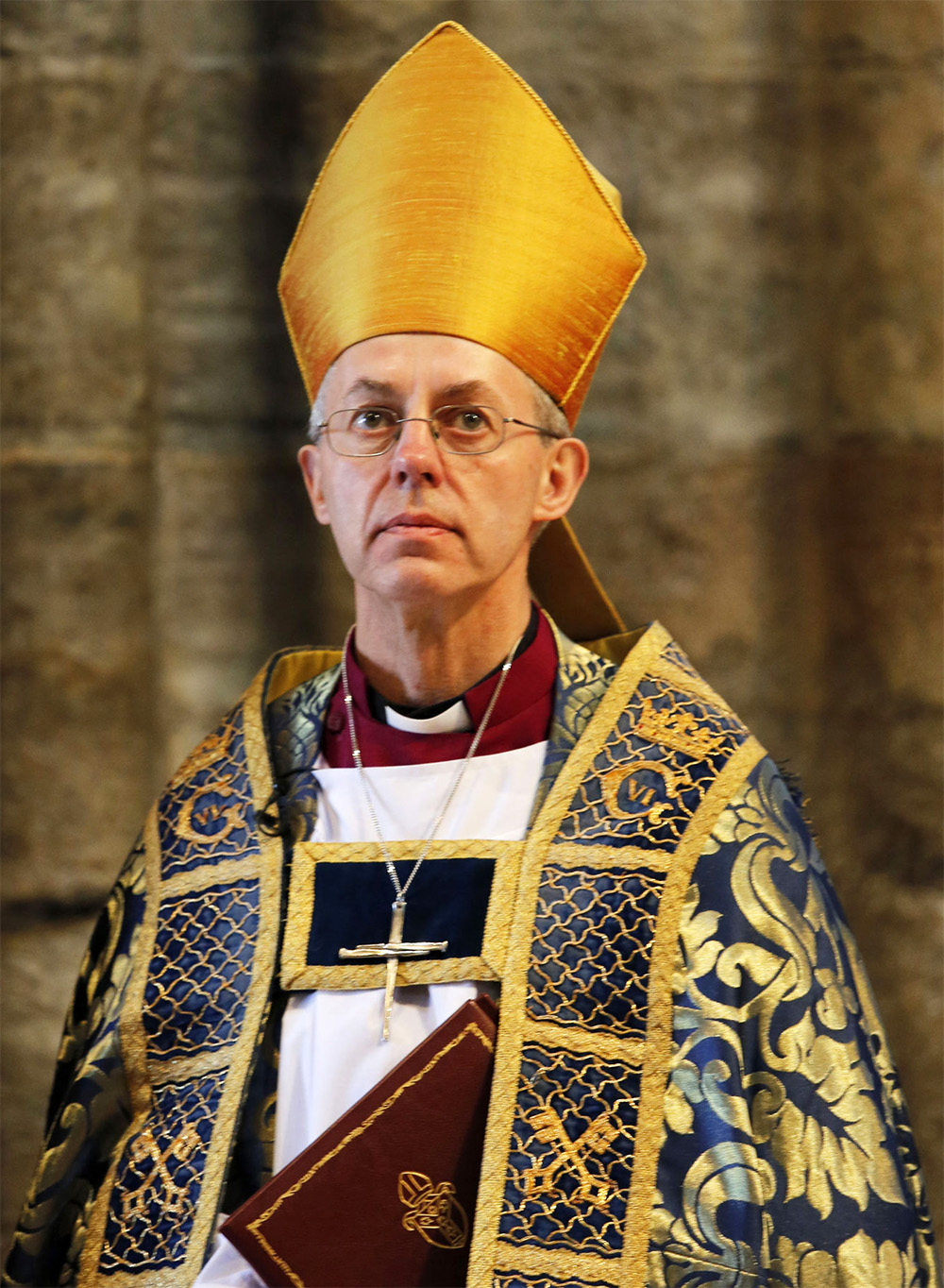
As for the church’s power and its own desire for riches, both of which ran counter to the founder’s tenets, its appetite grew exponentially. The mighty cathedrals, designed to overawe, represented its own rival palaces to those of the monarchs. Emulating royal pretensions, they even managed to get themselves officially declared ‘princes’ of the church. And in order to impress, and again copy the sovereigns, they designed for themselves rich vestments quite distinct from the laity. The elite – the bishops – fashioned crowns (mitres) modelled on those of the pharaohs, those most ancient and superior of all monarchs.
It was all a far cry from the open-air simplicity of their founders’ teachings, which abhorred the pursuit of wealth and needed no churches. It wasn’t long before the head of it all, the Pope, came to consider himself lord even to the sovereigns and that his authority outranked that of all the kings of Europe, whom he insisted drew their legitimacy from him.
The faith continues to attract widespread, though diminishing, support. In an age of incredible science, when we are close to revealing the Theory of Everything, kings still reign – though in fewer numbers – and priests still wave their incense and pronounce their benedictions. Though we understand now the origins of the forces which once were so inexplicable and destructive, certain of us still cannot bring ourselves to cut loose from the old superstitions – though Christendom is closer to it than Islam. In India, multiple gods still haunt the Hindu imagination.
As I walked away from the great cathedral, which housed Columbus’ tomb, I understood for the first time how this non-capital city held such riches. It was the first landfall of those treasure ships and the place where mind-blowing wealth was disgorged. My thoughts turned to those unkempt, near-naked mariners carrying armfuls of gems and bullion down the gangplanks and the overjoyed priests who would rush to greet them. Was ever a house of God better located?
Brexit and Trump are only the beginning

Best buddies looking forward to a golden future
I cannot move into another week without recording my thoughts concerning the one which has just passed. Something astounding happened.
A man was democratically elected to the most powerful job on the planet who defied all the norms of what is considered to be acceptable behaviour. This man made no concessions whatsoever to the sensibilities of the electorate he was appealing to and came right out to lay before it his brazen take on the world. In view of the outrage caused in so many quarters, how did such a man persuade that electorate to set aside the shock of his message and, most of all, the way it was delivered? He has now not only been handed the keys to all our futures, but he will be given the nuclear codes as well.
The story goes back a long way, perhaps half a century. At that time a world existed of nation states and of families within those states. Most had functioned for a long time – Germany was the exception – and people had grown surprisingly fond of them. They saw them as an extension of their own, close family and it gave them a strong sense of belonging. Almost without exception they were immensely proud of them. When troubled times came, it turned out they were prepared to die for them, much as a mother would die for her child.
Then came those two terrible world wars which, with the help of perverted science, made war deadly to the point of being suicidal. Humanity recoiled in horror and said never again. Agencies were put in place, starting with the United Nations and followed up by a multitude of other such as the World Bank, IMF, WTO, various NGOs, NATO and many, many more, all designed to govern the conduct of man and his disputes in a peaceable manner.
The bogeyman identified as being behind past conflicts was the selfish, jingoistic nation state. That, along with its borders, had to be downgraded and erased, over time, into irrelevance. Europe began the charge with what morphed, with the utmost stealth, into the European Union.
Also a new, more humane way had to be found to deal with individual misfortune and the Welfare State was born. The old were to receive decent pensions and they, along with everybody else, were to be medically cared for. The four great plagues of want, idleness, poverty and disease identified in the Beveridge Report were to be tackled wholesale for the first time.
But this was not enough. The architects decided that they must complete the work with what became known as political correctness. They must criminalise beastliness towards minorities – all minorities – however obscure. Eventually this extended to the very utterances which people made. A revolution was in the making and, like all revolutions, it needed its cadre of zealots to force it through. Step forward to carry out this work the intellectuals, the academics, the lawyers, the industrialists, the politicos, the entertainment luvvies and eventually the bulk of the media itself. Oh, and don’t let’s ever forget, perhaps the most culpable of the lot, the bankers.
The EU proved the perfect vehicle for making this revolution possible. It also made it respectable even though, indeed, most of it was anyway. While noble in its concept, the EU began the process of subsuming its patchwork of nation states into a homogenised whole. Globalisation and multiculturalism became the new buzzwords and the developed world was urged to indulge in an orgy of consumerism. This had the effect of ratcheting up debt to unsustainable levels and soon the bubble burst with the financial crisis of 2008 – the worst in living memory. Luckily lessons had been learned from the last catastrophic crisis, the 1929 Wall Street crash, and a much more joined up world was able to climb out of it with a fraction of the misery of before.
But, like all things, it came at a price and that price is the one which propelled Trump to power and is propelling us out of the EU. The little man who had listened to his “betters” for fifty years had had enough. He had developed a deep and bitter antipathy for those whose greed had brought the misfortune upon him yet walked off smelling of roses and richer than ever. He had watched, with silent rage, the power brokers ship his jobs to sweatshops abroad and saw his warm and loving communities decimated and turned into wastelands. All the while the men who had done it grew richer by the billion while the poor bloody infantry saw their wages frozen and their living standards plummet. Adding salt to the wound, as the little man saw it, was the multiculturalism which the know-alls had forced on him.
What unites the two seismic events of Trump and Brexit is a deep disdain, felt by many ordinary people in the Western world, for a ruling class which, without consultation, sought to change forever the very nature of their societies. But it has not gone unnoticed that this privileged elite have never been an active or even visible part of the societies they are busily changing. Theirs is a cloistered world of high gates and security guards where the hoi polloi are well and truly kept at arm’s length.
Their insular world now trembles before the forces currently ranged against it. But watch this space: Trump and Brexit are only the beginning. Fresh earthquakes can be expected right across Europe in the months ahead.
Trust the evidence: flying is safe

One of the worst aspects of the recent Alps tragedy is that the grieving families of passengers have a next to impossible task in recovering their loved ones among so mixed and fragmented a jumble.
We have all been shocked to the core at the terrible tragedy which unfolded last week in the French Alps. It is the stuff of nightmares: a deranged madman propelling us forward to an inevitable and horrible death. While millions place their lives regularly in the hands of the airlines, a surprising number do so with the utmost reluctance. The reason they do so is that they recognise it is the only practical way of getting to distant, exotic places and that the urge manages to override their fears.
We heed, as best we can, the mass of statistical evidence which says that flying is safe. As I write, 9,000 passenger aircraft are in the skies of the world carrying a population the size of Manchester. All will arrive safely. When 9/11 struck and the order went out to ground all aircraft, private as well as civil, 5,000 aircraft were in the skies of North America.
The loss of two Malaysian aircraft, and this recent German one in what seems like quick succession, has evoked all our ancient, primeval fears of doing such unnatural things as soaring high in the sky. ‘That’s for the birds,’ we think. Evolution, after all, has hardwired us to fear heights as a terrestrial animal, and it takes a supreme effort of will to set such fears aside. I am myself full of irrational fears and contradictions. What do you make of a man who flew his own hang glider yet is anxious about trusting his lot to an airline pilot? The pilot’s machine is infinitely safer and better maintained, and his skills in the air immeasurable better, yet still I preferred to rely on myself.
We have come a long way since those first spluttering engines of World War One with their rickety airframes and fresh air environment. They were the true heroes of flying, not us. Accident by accident over these hundred years, we have investigated the causes of failures. And modification by modification, aircraft have been brought to the point where almost nothing remains to be discovered.
The machines we put into the air today are almost as safe as the birds which evolution perfected. In fact it is possible to argue that in some important respects they are safer. Birds regularly fall out of the sky with heart or other physiological failures. On long migrations, they fail through weariness or failure to anticipate the weather. Sometimes they fail to gain the height necessary to carry them over mountain ranges. Planes almost never fail on any of these counts. Moreover, aircraft are able to fly over 13 times the speed of the fastest birds, which, as it happens, nest on the cliffs of Cornwall. Even as long ago as World War Two we were well on our way. Look how many shot-up bombers were still able to limp home, so much were their aircrafts miracles of engineering.
It is a fact that if we are to fear anything today it is ourselves. By far the majority of accidents are human error. Electrical, structural, mechanical and computer, they are all a lot sounder than the frailty of human nature. We have pretty well guaranteed physical soundness, but this recent tragedy in the Alps has highlighted how far we are from understanding the vagaries of the mind.
Few air disasters have been more shocking than this one. When Pan American airlines was blown from the skies over Lockerbie, disaster came like a thief in the night but with no suffering. Death, or at least unconsciousness, was instant. The same is true of the recent Ukrainian tragedy. What unfolded over the Alps were minutes of utmost terror and a final few seconds of unimaginable horror.
This nightmarish scenario was compounded at ground level. When the bodies at Lockerbie and Ukraine fell from their destroyed aircraft, they travelled to earth at terminal velocity of a falling object (120 mph) and for the most part, remained intact. When the poor souls of Germanwings Flight 9525 impacted the ground, they did so at 330 mph and were shattered on impact. Even the metallic parts of the aircraft suffered a similar fate. It was next to impossible for a visitor to the scene to know that this mass of debris had once been an aircraft. A mountain of unidentifiable, desiccated body parts were scattered over a square mile of mountainside. Consequently, one of the worst aspects of this terrible tragedy is that the grieving families have a next to impossible task in recovering their loved ones among so mixed and fragmented a jumble.
Lufthansa will have much to answer for when the final reckoning takes place. It appears their vetting system was so inadequate that it allowed an individual with a long history of mental instability to slip the net and fly their aircraft.
While we all place great importance on patient confidentiality, it appears the Germans are almost paranoiac about it. This, where certain occupations are concerned, will have to change as I believe it will worldwide. A duty needs to be placed on all doctors, which has the force of law, requiring them to inform a patient’s employer the moment they believe their patient unfit to fly an aircraft. The same should apply to train and coach drivers.
At some point in the not too distant future, we are going to have to accept that ground control will get you to your destination and back, as it has long done on far more complicated missions into space. Already our drones daily take off, complete their missions and return safely to earth. Once again, it is an irrational, primitive belief that only a man up front can be given ultimate responsibility. When we have grown used to safely journeying in our cars by automated, driverless systems – which is coming sooner than we think – then we may start to believe that the same technology can be applied to the air. Such systems are already feasible in our towns and cities and will soon be trialled here in the UK. It is only human irrationality which is slowing the process. When accidents and fatalities are seen to have been driven down close to zero with machines in control, then perhaps we may summon up the courage to trust the machine more than the man.
Gay schools aren’t the answer

If you remove certain sections of society from the mainstream you risk encouraging the majority to believe that they really don’t want to belong to the mainstream.
I was taken aback recently to learn of a serious proposal to set up a school for Gays. While a firm supporter of not stigmatising minorities – as a child of an unmarried mother at a time such things were scandalous, I know just what that means – I felt that this was simply a bridge too far. In fact I believe it could be counter-productive, harming the very people it was designed to protect; a classic case of the law of unintended consequences. Humans across the world belong to a single family. If you remove certain sections of society from the mainstream and create an environment in which they circulate for substantial and formative periods only among people of their own preferences you risk encouraging the majority to believe that they really don’t want to belong to the mainstream. We know the aims of Gays in making this proposal are laudable; they wish to experience and benefit from an education free from the slings and arrows of a taunting minority. But the answer, I fear, is not to remove them from the orbit of the bullies but to bear down and educate bullies into accepting that it is they – the bully – not their victim, who is the problem. It was never more clear to me than during my army service in Northern Ireland that if people are ghettoed from their fellows they will not relate to them and, as a consequence, would be capable of doing terrible things. And there, job discrimination was total – in schools, churches, policing, pubs, town halls, housing and just about anything else you could think of. The first question that any employer asked of you was, “are you Catholic or Protestant?” We saw in blood where that led.
Social attitudes can be turned full circle. We know this from things we have already achieved. Do you remember that ‘Carry On’ film in which a partying group of young medics came out and piled into an open-topped sports car and roared off? The noisy, raucous group were all the worse for drink. We thought, at the time, it very funny and so did the producer. Neither he nor we would think that now. In fact we are appalled that we ever thought it so. In similar vein was the ubiquitous glamorising of smoking on the silver screen. Also, look at our previous indifference to the disabled; we never bothered to put wheelchair access into anything. Then, just let a landlord – as happened when I first lived and worked in London – try putting in his window a sign reading ‘No Blacks, Irish or Dogs’. All hell would break loose. Women’s prospects have improved immeasurably from what they were and so have peoples’ of other races. I could go on. Indeed, some might argue that in today’s Britain your life chances might be improved if you were not of Caucasian stock. Racial, religious, gender and disabled abuse have all joined the bonfire of the unacceptable, as has hate language. Also that pernicious culture of being able to touch women up and, worse, and get away with it is thankfully at an end, though I do wonder if we are right in pursuing old men to the grave. But I acknowledge that justice must trump everything and you could argue that they were lucky to have got away with it for as long as they did before justice finally caught up with them. Finally, while we’re at it, let’s remember that poor unmarried mother whose family once turfed her out. That was not a million miles removed from stoning her.
My point in highlighting all this is to show that Europe in times past – often with us as flag-bearer – has had very backward attitudes. In addition to this we have been exceptionally cruel, physically as well as emotionally. It therefore ill behoves us, as we make progress, to lambast the Muslim world for its tardiness. The whole world hardly needs to take lessons from us in this area. There was a time, which lasted for seven hundred years, when Muslim Spain led the world in virtually all the sciences. While it was rescuing and translating almost all the Greek classics, we were transporting ourselves across the Mediterranean Sea and despoiling their prosperous, peaceable lands in Palestine. Our ‘great’ King Richard (The Lionheart) – who spoke no English and spent only a few months out of his eleven-year reign in England, bankrupting it in the process – wrought such cruelty on Crusade that even today Muslim mothers will quieten their little ones by saying “shhh… King Richard is coming”. He once decapitated 5,000 prisoners on the beach at Acre. Strange it is then that of all our many illustrious monarchs he is the only one honoured with a statue outside Parliament. An unfathomable people we are for making such a judgement. And in terms of cruelty, no Muslim country that I am aware of ever matched our grisly hanging, drawing and quartering routine, nor Bloody Mary’s 300+ burnings at the stake in a five year period, nor Vlad the Impailer’s bestial cruelties, nor the horrors of the 30 Years’ War.
It is very true that we have today a terrible problem – to put it mildly – with certain crazy Muslim men, but we have had our share of crazy men, even if they have not specialised in running wild on the streets with butchers’ knives and Kalashnikovs. The sheer magnitude and level of depraved brutality which our own continent has exhibited throughout the recent century should humble us considerably in our dealings with the rest of humanity. It certainly does not qualify us to hand out advice as though it is coming from on high, and as though we approach the world’s problems with clean hands. However, it is my belief that it is this very barbarism which has made Europe determined to do things differently in the future.
It may not seem so but we are moving into a kinder, more caring world. Not only have we such institutions now as the International Criminal Court, whereby previously unchecked rulers can be held to account, but we show concern and provide help when manmade or natural catastrophe overwhelms one of our brother countries. This is new. Every country now acknowledges that it has a duty to work towards some sort of a welfare state for its people. This, too, is new. Making war without United Nations authorisation is an option becoming increasingly difficult for sovereign states.
Social networking, Skype, emails and the instant availability of facts and information – as well as the next day delivery of goods on eBay and Amazon – makes ours a more joined-up world than it has ever been. And we are only at the beginning. Within three generations, virtually the entire human race will be able to communicate with each other in a universal language. What incredible good fortune that it happens to be our own which will be that medium – and what business opportunities that should present us with if we have the wit to seize them!
Meantime we must hold our nerve as we navigate through what undoubtedly will be treacherous waters, finding ways of containing and then rolling back the bone-headed fanatics who seek excitement on foreign battlefields as well as at home in the misplaced belief that their warped vision is the future. Yet we must do so without compromising our essential liberties and bring our Muslim brothers and sisters on board. Their thinking, young people, in particular, want all the same things we have, including democracy. We must find ways of getting them to prevail over their rogue elements and bring them on board too.
Viva Las Vegas
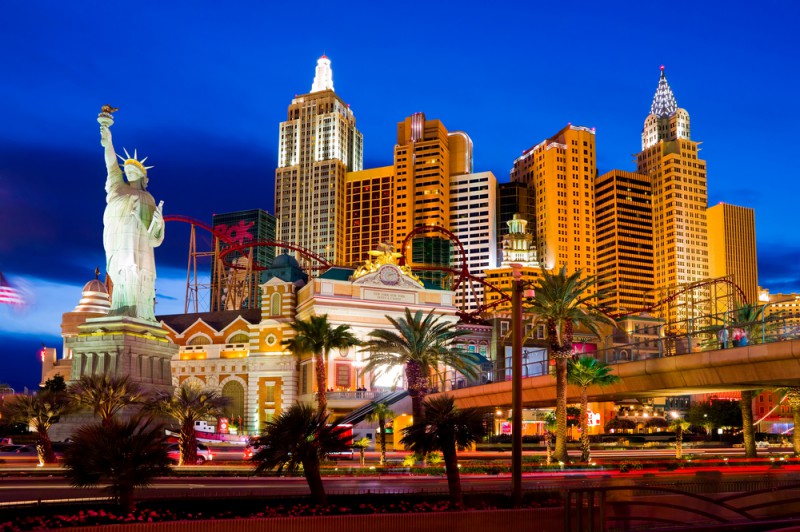
I’ve always viewed Las Vegas as a totally artificial construct – something dumped in the middle of the desert and catering to the most vulgar, hedonistic, licentious and tasteless leanings of human nature. In many ways it is these things, but in other important ways it is a great deal more.
I’m sitting here in our bedroom on the 28th floor (top) of the 3,626-bedroomed Flamingo hotel close to the 3,933-bedroomed Bellagio hotel as well as opposite the 3,960-bedroomed Caesar’s Palace hotel on Las Vegas’ famous ‘Strip’. What brings me to this exotic location is an invitation from an award-winning San Francisco broadcaster to talk about my recently released book. My wife and I thought it would be an opportunity lost if we didn’t see as many sights as possible of the western US, and Las Vegas is the jumping off place for the Grand Canyon. These three hotels alone, according to our tour driver, have more rooms than all of San Francisco’s put together. Vegas is awash with them and these three represent only the smaller part of an incredible total.
I’ve always viewed Las Vegas as a totally artificial construct – something dumped in the middle of the desert and catering to the most vulgar, hedonistic, licentious and tasteless leanings of human nature. In many ways it is these things, but in other important ways it is a great deal more. My wife and I are not gaming types (never having bought so much as a scratch card or a lottery ticket) and not a nickel slipped through these canny fingers of ours in the three days we have been here. But it is the jumping off place for the Grand Canyon and the Hoover Dam, and it seemed churlish not to explore this ultimate symbol of western decadence and see if we could discover what makes it tick.
To begin at the beginning, I doubt I shall ever again be assigned a bedroom more palatial than the one we have; it has to be more than twice the size of any other we have stayed in. We showed interest in the receptionist who came from Hong Kong and had a little chat. She told us Hong Kongers yearned for the old days and determinedly kept as many symbols and aspects of their colonial past as the Beijing authorities were prepared to countenance (and actually, as it turns out, it’s quite a few). I think our interest and the fact that we were from the old colonial power was rewarded with this magnificent top floor bedroom with its spectacular views. Considering the amazing online deal my wife got, we were truly lucky.
America, as we all know, is a big country and it likes – wherever possible – to do things big. America also works; it’s rare you encounter anything with an ‘Out of Order’ sign on it or malfunctioning in any way. It also does things in style (the showman is never far away) and here you will find everything, absolutely everything: the good, bad and the ugly. The good – and truth to tell there are so many ‘goods’ – is that it is full of so many unexpected delights. One such is a wonderful water course… one is a fountain display in front of the Bellagio hotel the like of which I have never seen. It must be unequalled in the world. Also, no city on earth brings the wonders of electricity so brilliantly to life. An orbiting visitor from outer space would have to wonder what this incredible glow from the blackness of the surrounding desert was all about.
You might say that a fake volcanic eruption in the giant forecourt of one of the strip’s hotels would have to be tacky. But it is not. It is, in fact, a truly breathtaking spectacle and, like the water display, free. There is, of course, much that is vulgar and much that is kitsch, such as Little Venice, but it is a very superior kitsch. Every single structure is built to the highest order using the best materials and the finest craftsmanship. And everywhere is spotlessly clean. Pity the litter-bug Brit who indulges that particular vice of his: he will be jumped on from a very great height. But make no mistake, this place is about money – as much of the lovely stuff as they can legitimately extract, though I have to say they do not harass you. Prices, with some exceptions, are not extortionate. It took a whole half mile of walking to get through one hotel: MGM and its mall. The walk took us past thousands of games machines, umpteen roulette tables, shops, bars and cafes. Any visitor to Vegas needs first to get in training: the walking will test them to their limit, especially those parts under the blazing sun. What a relief that my two knee replacements had bedded in and that I walk the two-mile journey to my shop and back every day.
We visited in the autumn when temperatures are at their best (the high 20s (75F – 80F). But as states go, Nevada is a poor one – close to desperately poor. As a desert state, it has little or no arable land and precious few minerals. Something had to be done. Thankfully it had the mighty, 1,400-mile-long Colorado River, and on it bounty. Las Vegas became possible as did – 400 miles away – Los Angeles. In my own lifetime, Vegas has grown from a few thousand to 2.1m, and it is still growing apace. It is based almost entirely on the service industry. If our excursion driver to the canyon is to be believed, 90% of its workers are on the minimum wage and, irritatingly to those of us from Europe, he made what we would consider an unseemly powerful pitch to be tipped. It is sad that someone has to abase himself in this way to make a decent living, but probably he doesn’t see it that way as he has been doing it so long and has got used to it. The bogeyman in all this is the employer who, by improper means, gains a cheap workforce. But there’s another way of looking at it. America is famous for its service; everybody is keen to help you, to smile at you, to please you. To them we must extend thanks for causing our supermarket checkout girls and others to stop being surly, to engage with us, look us in the eye and smile at us. May this not in part be because their living is not guaranteed and they need your reward for looking after them?
On reflection, it is not so different in my own little shop. I cannot be indifferent to my customers. I must at all times engage with them and provide the service they are looking for. If I and my wife are now celebrating the 20th anniversary of the shop’s opening, may this not be because we have done this? This grim recession has taken its toll. Perhaps 25% of our takings have been lost, but we are still standing and signs are beginning to look up.
But returning to Las Vegas, and how it seeks to please and relieve you of a dime or two, everything operates on a huge scale. The buildings are ginormous with more shiny glass and steel skyscrapers than you are ever likely to see in one place, except perhaps the Gulf States and some newly built Chinese cities. Although much of Vegas is now 40 years old, it looks remarkably pristine and un-weathered. That’s down to the same desert conditions which helped preserves the pharaohs and their monuments. The place heaves with people, but somehow absorbs them so that they do not seem to be too many. There are masses of Malls so that you will still find wide, empty spaces. Las Vegas is America’s premier playground – it’s guilty secret. Running through the country’s psyche is a vein of Puritanism that includes a loathing of gambling. Even now, a majority of the states ban it. It all goes back to those pilgrims who left my own city of Plymouth almost 400 years ago to create a better England, a New England, in a far-off wilderness across the ocean.
Here in the desert, their descendants have conspired to offer a bit of light relief to those earnest hopes of yesteryear. In the process, they have gone a long way to rescuing their basket-case state. Rich widows come here – some regularly – to spend their husband’s fortunes in the cause of cheering themselves up. Ordinary Americans come here because it’s just one helluva place. Executives come here for conventions, naughtiness and show-time on the side. Outsiders like ourselves come to gawk, and newly-weds for the ‘quickie wedding’. From day one the Mafia made it their home and large dollops of their ill gotten gains have been laundered through it and financed its expansion. Hollywood too, along with its stars, once looked down their noses at Las Vegas, but now play court to it. And above it, all the sun shines down for 320 days of the year. It’s an amazing place, and like Muslims with their religious obligation to visit Mecca once in their life, consumerist Westerners should feel a similar obligation to visit this desert El Dorado: this hedonistic, earthly temple of pleasure.
Incivility in the 21st century
A strange thing happened to me the other day, but on reflection perhaps not so strange. I went to say hi to the chairman of my old tennis club as I was travelling close by his house. We were never close but for ten years we were both active participants and would talk between matches . That was twenty five years ago. About five years back he dropped into my shop, not to buy anything but to renew acquaintances, or so I thought. Now I believe it more out of curiosity than anything.
Expecting a civilised reception I was kept on his doorstep just long enough for him to make a factitious remark and for him to say that his wife, Joan, who was also a club member, was doing something on the computer. Here was one old man of long-time acquaintance, reaching out to another old man, only to be given the brush off. Why I say this bleak reception was not so strange is that it speaks perhaps of our inability to relate to each other as we should.
The old club chairman was always given to the patronising put-down, so I was not unduly perturbed that he remained the old unreformed Dave. But, just the same, it got me thinking about the level of incivility that our country so often exhibits in this the 21st century. Once upon a time, each of us knew the names of our close neighbours – surname as well as Christian. As for those mutual visits for ‘cuppas’, they went out of the window eons ago. We really did make an effort to be friends. Gossip used to be rife in those days, most of it harmless stuff but the fact is that it helped to grease the wheels. In truth, people were genuinely interested in their neighbours. It is hard to imagine that so many of these awful present day cases of child abuse as well as neglect would have passed unnoticed. Perhaps another reason we don’t get to know our neighbours is that we don’t bump into them on our walks to the shops. We simply exit our houses at high speed, leap into our car and race off at even higher speed. Rarely a wave do we trouble ourselves with.
So what is it that makes us so distant and seemingly uninterested in those about us? I suspect it has a lot to do with the independence which rising prosperity has given us. It is both a blessing and a curse. The fact is we don’t need each other as once we did, or at least we imagine we don’t. It is interesting to note that the poorer a society is, the closer people are with each other. It is as though adversity brings them together. People of a certain age will often tell you how great the camaraderie was in the years of war and how everybody was everybody else’s friend. Even social class distinctions came close to vanishing. All at that time stood in mortal peril – at least in the cities – and shortages of everything were acute. Even in the years following, when there were only the shortages to deal with, people still went to each other’s help where they could.
But gradually the consumer society took over. In the old days, acquisitiveness was virtually non-existent and ‘keeping up with the Joneses’ unheard of. Today, the green eyed monster looms over every neighbourhood and further divides people. My wife, who endured many more years of deprivation (under Communism) than we did in the West, tells me that one of the saving graces – and there were not many – of the old USSR was that right to the end people helped one another. They knew their problems and provided that most essential of palliatives: a shoulder to cry on.
If possessions and acquisitiveness is part of the problem – perhaps the major part – it is hard to see things getting better any time soon. It is a fact that the larger the city, the lonelier you can feel. In that case more is very much less. Perhaps we in Plymouth should take comfort from the fact that we are not too big and blessed with a great mix of attractions both natural and manmade. For my own part, I have never regretted picking Plymouth from 25 other cities in 1967 to set up my health club. All of the cities I shortlisted had populations over 200,000 and, at that time, had no health club. I felt certain that that sort of number would guarantee me a good living and so it proved. You should have seen some of those other grim industrial abodes that were on that list. I’m so glad I gave them a miss!
Finally, a grateful thanks to the kind and civic-minded person who, following my most recent column in The Plymouth Herald gave us back those lamented flowers in Ridgeway’s five tubs.
Have the years in Downing Street addled the PM’s brain?
I am glad the government has banned that sinister-looking council vehicle going round with a camera on the top. We all had deep misgivings about Google trundling round photographing everything in sight, but at least that wasn’t a means of filching money out of our ever more depleted pockets and there were many clear positives to the whole operation.
Ours is the most spied on country in the whole world and, to our shame, that includes N. Korea. What is it about those in authority over us that they treat us as they do? Is it that they don’t trust us? They’ll have plausible answers of course – they always do. Not the least of them is that catch-all one of ‘combating terrorism’. But we combated IRA terrorism for thirty years without compromising our essential liberties.
We have to be very careful about going down the path of the surveillance state. The powers-that-be, including the town halls, seem to relish lording it over us – watching our every move, socially engineering us, politically correcting us, and nannying us with a patronising ‘you know it’s all for your own good… don’t get yourself worked up’ sort of attitude. The fact is we are right not to trust them; all the time they are taking liberties with our liberties.
The Cameron government promised more openness. ‘Transparency’ was the word. And all the while the Court of Protection – another Blairite invention – continues on its merry way (except that it isn’t at all merry). Terrible injustices are daily taking place behind closed doors with social workers being treated as if they are expert witnesses and who, in too many cases, are themselves operating behind closed minds. Even the President of the Family Court has expressed his extreme disquiet and called for less secrecy, but still the injustices go on.
David Cameron has called for Magna Carta to be taught to every kid. Is this the same David Cameron who wanted recently, for the very first time in English jurisprudence, to hold a trial so secret that even the very fact that there was to be a trial at all was not to be disclosed? Magna Carta, indeed. Who can forget that cringe-making, toe-curling interview with America’s most famous interviewer, David Letterman, in which the British PM didn’t know what Carta stood for. Eton educated, was he? With a first-class honours degree from Oxford thrown in for good measure? Something went badly wrong there. Even little old me, educated in the Foundling Hospital and at work at fifteen, knew that. Perhaps it is the years in Downing Street that have addled his brain. That hothouse of intrigue and backstabbing must take its toll.
But don’t think me ungracious to our Dave. For all his many deficiencies, he has turned the economy round and we must give him credit for that mighty achievement. There is also a real chance that our kids will stop sliding down the international education league tables and begin the climb northwards. Then there’s that pernicious client state of welfarism that Gordon Brown positively pushed which is being dismantled and a sensible one – such as the Welfare State’s founder, William Beveridge, wanted – being reinstated (but still in a far more generous form than ever he envisaged). So each of these important areas which will determine our nation’s future we must give the present incumbent of Down Street credit for.
A city close to my heart
Although Plymouth has been my home – by choice – now for forty-seven years, there is and will always be another city close to my heart. It is that great throbbing metropolis of London.
I was born there on Grays Inn Road which, on a quiet Sunday, may still be within sound of Bow Bells. If so, that would make me a true Cockney – a born, though not bred, one. Unfortunately the not-bred part renders me incapable of fathoming most of those strange yet endearing Cockney terms.
When I was born in May 1939, London stood on the edge of a cataclysm which would test its metal as much as the plague, the great fire or that earlier fire when Boudicca’s enraged followers torched the Roman city in AD 60. Luckily, when the bombers came, I was safely ensconced forty miles north in the lovely little Essex market town of Saffron Walden. From that area would be assembled the mighty armada of bombers which make good on Churchill’s promise to repay the Luftwaffe with interest tenfold.
When I returned to the city as a sixteen-year-old in 1955 to find a job, it was a sad place. It was not long since its skies had been darkened by Hitler’s bombers. My job was to take news photographs to the art editors of all the leading periodicals and newspapers of the day to see if they were interested in featuring them. The agency was based in Fleet Street. When I stepped out on my rounds I could see the massive structure of St. Paul’s cathedral 500 yards away on the top of Ludgate Hill. To the right and left as you walked up that famous hill was a wasteland of bombed out buildings. Feral cats and other creatures had made the ruins their home. All over Central London, which was my stomping ground, were similar sad sights. I could never quite understand how, amidst such destruction, Wren’s masterpiece had survived. (Later I learned that, apart from an element of luck – which some might prefer to regard as divine intervention – this was because orders had gone out from on high (not that high) that, whatever happened elsewhere, the great cathedral must be saved. The firefighters, therefore, made it their business to prioritise it.)
When I was born, London was the largest city in the world which, perhaps, befitted the world’s largest empire ever. Though today thirty one other cities have overtaken it in numbers, it is still Europe’s largest if you exclude Moscow, which is a Johnny-come-lately having ballooned since the fall of Communism. Before this it was only half London’s size and you needed a permit to go and live there.
When I took up my job, a pall of gloom hung over the city. It was only a decade before that the doodlebugs and V2 rockets had come visiting. We talk of austerity today, but those times knew the real thing: a biting hard period of real deprivation which makes today’s talk sound something of a joke. There was simply not the money to give people a decent life, never mind make good all that bomb damage.
It was a dirty city, too. Those building which had survived were encrusted with a thick, black layer of industrial grime. And the grime was still coming down. Once, I had to get off a bus in Harrow and take my turn to walk in front with a torch to help the driver to avoid mounting the kerb. The smog was so thick you could barely see your feet from a standing position. It was actually quite scary. The dear old Thames, which today is alive with every kind of fish and aquatic creature, was then a dead river.
Unlike Berlin and so many other shattered cities of Europe, London, despite everything, still had a pulse – even a beating heart. But it was weak and its population shrank as so many of its citizens migrated to the leafy suburbs and the new garden cities erected close by. And while all this was going on, the great empire, whose imperial will had reached out from the city across the world, was being disbanded. Truly, it seemed, London’s glory days were over. It would have been a brave pundit who would say it would ever rise again to its former pre-eminence.
Yet hey, that is exactly what has happened. Few would say it was exaggerating to call it the coolest city on the planet. In 2012, with the Olympics, it had the chance to showcase itself like never before in its history. And what a success it made of it. Athletes and visitors alike were stunned at how well that most challenging and complex of events was managed and how beautiful the city had become. Even the sun made a brief appearance, as though to bless our endeavours. London may not exercise hard power to the extent it once did, but it projects soft power by the shedload.
When I treat myself to a visit, as I like to do every three months or so, I look around and marvel at the transformation that has taken place since I trod it walkways as a youth. As its skyline grows ever more interesting, it remains the financial centre of the world, beating New York, Hong Kong and Singapore to the spot. And its many great parks and myriad little squares have grown even more beautiful. Racial bigotry has all but gone, with no more signs to be seen in landlords’ windows saying ‘No Dogs, Irish or Blacks’. Couples of mixed race walk hand in hand and its streets echo to the sound of dozens of languages. Street cafes are everywhere and British cuisine has been turned on its head. It is now right up there with the best. The city has a multiplicity of world-class chefs.
It is at last a truly cosmopolitan place. Not only is the shopping the best to be had anywhere in the world, but, glory be, London now hosts its best fashion houses. Now there’s a surprise for all of us. Perhaps that all began long ago in a non-descript place called Carnaby Street.
So there we have it, my second favourite city. One which, along with our hopefully-reviving economy, we can all celebrate.
We have fallen short on honour
As a country which abhors state sponsored killing and the grisly process of snuffing out a human life, I find it perplexing and distressing that the British Government will not lift a finger to save a British grandmother facing death by firing squad in Indonesia. I will not get into the details (she was a drugs mule) of why she finds herself in her present situation. But she acknowledges her foolishness and offered full co-operation to the authorities.
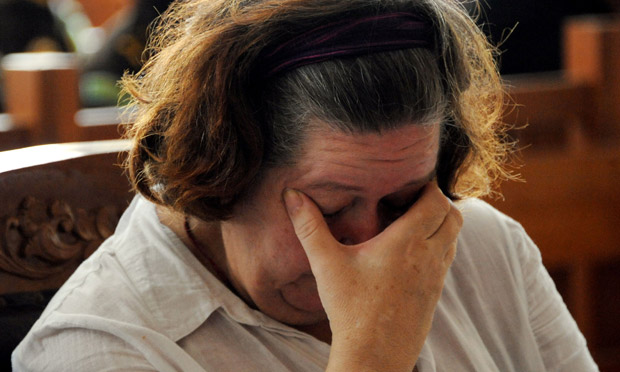
British grandmother Lindsay Sandiford lost her appeal last month over the British Government’s refusal to fund her legal challenge against a death sentence.
As for the men who put her up to it, they have received light sentences. Many aspects of the trial were deeply flawed so that any examination will show that a death sentence was totally uncalled for. An appeal funded by legal aid would almost certainly highlight this, but our own authorities will not grant this.
They are more than willing to provide legal aid to umpteen tycoons – millionaire Asil Nadir springs to mind, as does that property developer reputably worth £400m who is hiding his money from his ex wife. And, of course, there is unlimited funding at taxpayers’ expense for any number of foreign nationals who wish us harm and for their never ending appeals under the Human Rights Act for permission to stay amongst us.
Ours is a nation they despise, whose culture and laws they wish to overthrow. Yet they are happy to take advantage of its lifestyle and the benefits system which makes that possible. The reason why these expensive appeals by self-proclaimed Jihadists so often succeed is that we are unwilling to send them back to their homeland in case they are mistreated there. Yet here is the ultimate case of mistreatment – death by firing squad – and it is happening to a British born woman who has lived most of her life here.
There may well be millions living in our country who have no legal right to be here. Any one of them, before they could be deported, would be able to throw themselves on the mercy of our courts and run us up huge legal costs before we could send them home. Where, I ask myself, is the logic or consistency which allows us to say no to a British grandmother and yes to one of them?
All this reminds me of the cold-hearted, honourless attitude of the Gordon Brown government when it would not allow Gurkhas, who had frequently put their lives on the line for us, to settle in our country at the end of their service lives. It took the redoubtable Joanna Lumley to help that government change its mind.
But right now there is another ongoing scandal which this time concerns the Cameron government. It relates to interpreters in Afghanistan. Two hundred or so who have risked their lives working for us in that benighted country are to be abandoned as next year begins the drawdown of our presence in that country and thus our need for linguists. They are fearful of what will become of them and their families once we are no longer there to protect them. The answer seems a simple one: let them come back with us. But shamefully that is not the response of our authorities. The interpreters are being told they must remain and take their chances. How truly inhuman is that? When the presently contained Taliban presence in Afghanistan is augmented by floods more coming in from Pakistan, once we are gone these interpreters are dead men walking. The Jihadists will take a terrible revenge. They will not care a hoot that the whole Afghan operation was authorised by the UN. Anyone who assisted, as they see it, the foreign invaders, can expect their special brand of punishment. What is at issue here is not just the saving of lives of people who have risked all for us, but the very honour of our country. The idea that we can happily grant asylum to countless others who have no claim on us is beyond comprehension.
Present day Russia is very much a gangster society led by an authoritarian government claiming to be democratic. But in one important area it puts us to shame. That is where honour is concerned. My Lithuanian wife’s father was a colonel in the Russian military. When the thirteen countries which formed the Russian empire – which it chose to call the USSR – broke away and gained their independence the Russian state could quite easily have washed its hands of obligations to the nationals of those newly independent states who had served it for their pensions and other rights. But it did not. My wife’s father receives a full and generous pension from Moscow.
How did we handle a similar situation when our own legions and public servants came home from our far flung colonies? We abdicated the duty to pay their pensions. We turned to the new rulers of India, Burmah, Ghana, Malaysia and the rest and said to them: “It’s up to you, old boy. You must pay their pensions”. If later they reneged or found they couldn’t afford it or felt they had been blackmailed to get their independence and stopped payments then that was that. Our attitude was tough. “Your quarrel,” we said to the poor man who had sweated all his life under the tropical sun, “is with the new rulers”.
Honour is a noble thing and it grieves me to think that my country has been short on it in so many instances. I hope Cameron will do the right thing where those brave Afghan interpreters are concerned and that he will intervene, before it is too late, over that wretched grandmother.
Philpott represents all that is despicable about our species
With the approach of the weekend I fret about what topic I can try to interest the reader in next week. But it seems the answer is clear: the Philpott case. A bit like the immigration issue, if you mentioned it you were in immediate danger of being labelled a closet racist, but now we can have an open and honest discussion. So it was too with Welfare.
Did it ever occur to Philpott that fire is not so easily controlled as the hapless women who came into his orbit?
In that case you were a stony-hearted – boot on the neck – oppressor of the poor. In both cases the bleeding hearts hoped by such calumnies to shut down the discussion and for generations they succeeded. Now Philpott has breached the dyke in magnificent fashion and the second of these taboo subjects has fallen to the dictates of rational argument.
If Philpott has done nothing else positive in his whole miserable, outrageous life he has, at least, opened the floodgates for a full scale debate on the whole meaning of Welfare. Now, let us be clear from the beginning: all right minded people pity the poor and disadvantaged and are prepared to move heaven and earth to ease their plight. But just as vehemently we feel a mighty anger at those who pretend to be in that category.
Long ago (1988) the British Shoe Corporation closed on me after years of pursuit for the back rent and balance of a 14-year lease for a business whose premises they rented to me. I had sold it in Glasgow six years before. You see, in legal parlance, I was ‘The Leasee of Last Resort’. It is a practice now banned by Parliament. What had happened was that the man I had sold my health club to had got into business and matrimonial difficulties and had done a runner to Australia. Muggins, here, was left to pick up the pieces. The Shoe Corp was finally advised by its sharp lawyers in London that the best way to force my hand was to take out an order in bankruptcy. At that time I was coming to the end of my 21-year lease for my Plymouth city centre health club and was making preparations for a new line of business – the ski centre – and I knew that if they made me bankrupt that was never going to happen. I was forced, as a result, to liquidate all my assets and that included two houses.
As a now homeless person with three children I ended up in a housing association property, but I was enabled, with the help of investors, to continue the ski project and drive it forward to completion.
The reason I tell you all this is that I saw at close quarters the benefits system in action – or at least two significant parts of it. My neighbour on one side was on disability benefit. There was a brand new disability car on the driveway. You can imagine my shock when later I saw that same person’s photo in a local newspaper, having completed a half marathon. My neighbour on the other side used to get up at 5.30am for his six o’clock work start. He told me that out of about 60 housing association properties only three were paying the rent. He felt a deep rage at this. The rest were claiming either to be one-parent families, disabled or unemployed. There were a few pensioners. Daily we could see the so-called unemployed going off to their cash-in-hand jobs or the fellas of the so called one-parent families parking their cars down the road and sneaking in through the back door to spend the night. So let’s not pretend that there is not widespread abuse.
The burden, especially during the longest recession in 200 years, has become intolerable as well as unsupportable and its effects are deeply pernicious.
Next year is a special year for me: I will have been at work for 60 – yes, 60 – years. I did not celebrate my 70th birthday – particularly, as I felt that in today’s world, unless you are unlucky, 70 is no big deal. But the thought has recently occurred to me that next year is different: it represents my own little Diamond Jubilee. You see, I am old school; I am deeply proud of not being a burden to my country and blessed with health that allows me to continue contributing my penny’s worth to its well being. I get up in the morning and walk the mile to work and there I meet the public – to whom I must continue to be nice and disavow what some would say is a normal right to be a grumpy old man. I set to, repairing shoes, cutting keys, servicing watches, engraving trophies, making wooden house and other signs and framing pictures. None of these things could I do before the age of 55, so I think I may have disproved that old dictum that you cannot teach an old dog new tricks.
When I was about to leave school at 15, the idea of not working was not on the radar. There weren’t benefits as we know them today. My foster parents took the view they had done their bit and it was up to me to do mine. Three years after starting I got hauled off to the Army to do my bit there for two years as a National Serviceman and I managed to get shot at by the IRA. Quite sobering it was. But the point of all this is about being useful to society if you can. I was 21 when I heard President Kennedy’s famous line in his inaugural speech when he said “Ask not what your country can do for you, but what you can do for your country”. Did Philpott ever think such thoughts? I think not. Nor, unfortunately, do multitudes of others. That is the trouble. It was right that William Beveridge, in his famous report, sought to abolish the evils of want, hunger, idleness, ignorance and disease. It was wrong that noble concept was hijacked by scroungers and the workshy. We – all of us – are culpable for the stupidity we displayed when we allowed it to happen. Naively we believed in peoples’ essential goodness and probity. Yet it has turned otherwise honest folk, who saw their neighbours getting away with it, into dishonest scroungers themselves. Now, perhaps, the party is coming to an end and we can begin the long climb back to our core values. We may, in the process, start to balance the national books.
As for Philpott himself, he represents all that is despicable in our species. He was a bombastic, narcissistic bully with a deeply cruel streak who even imagined he was fast becoming a celebrity, perhaps eventually a national treasure. He thought he could lead the media by the ears believing it to be something else he could control. He was also very stupid. Did it never occur to him that fire is not so easily controlled as the hapless women who came into his orbit? He may continue to try to play the big man as he has done all his life, particularly with women, but that won’t last five minutes under the rigours of the prison system. I shudder to think what might happen if his fellow inmates gain access to him. Prisoners are infamous for exacting their own kind of primitive justice, especially where crimes against children are concerned. A speedy visit to that same eternity to which his lunatic actions consigned his six innocent children might well end up being a much sought after escape.
Mid Staffs is a man-made scandal
I have not written about anything that causes me so much pain as this article does. This is because as a Briton, proud of what my country has achieved down the ages, I am ashamed of the shocking scandal unfolding in what was meant to be our pride and joy: the NHS. Nothing in my experience begins to compare with the sheer magnitude of it all; the needless deaths, through wanton neglect, of almost certainly thousands of people in our hospitals.

SIR DAVID NICHOLSON: Fish rot from the head
Fish rot from the head and any man – and we speak of Sir David Nicholson – who believed that the totalitarian system that was once the USSR was a good thing should never have been put in charge of such an organisation as the NHS. Apparently his hero was the gruesome Soviet leader, Leonid Brezhnev. It shocked me how readily and swiftly the PM and Heath Secretary sprang to his defence. Perhaps it was because Nicholson had a reputation, when ordered to do things, of carrying out those orders. While that may be so, the consequences, as whistleblowers made clear to Nicholson, was an unfolding tragedy of epic proportions. But orders are orders and Nicholson ploughed on, heedless of the human misery he was unleashing. In order to achieve his purpose and and keep to his ‘good’ name as a man who could be relied on to deliver, a climate of fear was created throughout the NHS. How very USSR-like.
I will not detail the horror stories which have emerged: you are all familiar with them. But instead of being reassured, looked after and returned to health, where possible, people died in their hundreds, indeed – across the NHS – in their thousands. A single hospital stands accused of up to 1,200 deaths.
We all remember the unconscionable time we often waited for routine operations and A&E. The last government decided to do something about it. Everything was done with the best of intentions, but as we all know, the road to hell is often paved with good intentions. When it became apparent that their action plan was not working out, another well known maxim kicked in: the law of unintended consequences. At that point Nicholson and his Labour masters should have paused and taken stock. But they did not.
So what has become of us that we have failed in almost the most fundamental of all our duties, the care of our old? When our troops burst in on Belson concentration camp they found a level of horror – of man’s inhumanity to man – not known in the whole of human experience. We put the perpetrators on trial and hanged them. At their trial they pleaded that they were obeying orders. What they did not plead – though they might have done – was that they had been conditioned for years to see their victims not as human beings, but as the lowest of the low – a sub-species – not worthy of using up precious resources. I fear that when our old people – be they in care homes or hospitals – fall into frailty, incontinence or dementia, something of a similar attitude takes hold in disquieting numbers among those charged with looking after them. Yet in their case they do not even have the excuse of saying that their government had told them their charges were worthless. So, what is it that allows lethal, criminal neglect, which were it directed at a child or even a dog would send us into paroxysms of fury ending in stiff prison sentences but does not do so with our old and helpless? I truly do not understand it!
What is incredible is that the unfeeling apparatchik who presided over it all was not only not held to account, but promoted to the top job in the NHS. How very public sector-like. And this man – would you believe – is judged by himself (and Cameron) to be the best person to sort it all out even though he admitted to a Commons Select Committee that he had no idea what was going on in the wards. Well, it’s a funny kind of CEO – in whom 90 per cent of his own workforce have no faith – that hasn’t a clue what the troops are up to. And even funnier that such a level of incompetence should inspire the political leadership to think that in this broad land of 63 million there is none better.
The Francis Report into the failings of the Mid Staffordshire Hospital Trust wanted to name names, but using, as ever, our money – just like the BBC – the ‘fingered’ individuals engaged the sharpest, most expensive lawyers in the business to threaten Robert Francis with law suits. After three months of arguments and delay, he buckled. It all, thereafter, magically became the fault of ‘the system’. Nothing, said the chastened Francis, was to be gained by ‘scapegoating’. Sorry, Robert, but people did this thing and people must answer. Start with David Nicholson and move down to ward level. It cannot be too strongly emphasised that the whole farrago involves multiple, pitiless deaths which on a head count makes the Harold Shipman outrage look like a trifling matter. And at least Shipman’s victims were despatched painlessly and their road to Calvary travelled with great expedition.
A chief characteristic that distinguishes our species from every other in the animal kingdom is our sense of dignity. From the moment we get up in the morning to the moment we go to bed, we carefully nurture the image of how we wish the world to perceive us. Take that away and you have inflicted the cruelest of hurts. So being careless of people’s nakedness and forcing them into adult nappies because it is too much trouble to help them to the toilet is unforgivable; to leave them in soiled, cold, soaking sheets covered in their own dried excrement caked in overgrown nails which nurse graduates feel too grand to cut is beyond my powers of description; to force them to struggle to reach for water and food which is beyond reach is totally criminal.
Death is the single most difficult event that any of us will have to handle. To meet it in squalor, neglect and suffering over a protracted period with all dignity stripped away is impossible to equate with a civilised society. In my view we are all guilty, every last one of us – just as the entire German nation was guilty of the Holocaust. In both cases we allowed it to happen on our watch. We strut the world stage fixated on our favourite hobby horse, Human Rights, lecturing anyone unfortunate enough to cross our path on the virtues of compassion, yet we show nothing of it on too many of our wards. Shouldn’t Charity begin at home?
Those charged with looking after the fathers and mothers who fought two World Wars for us, and whose sacrifices in the years following brought us social security and prosperity, have a sacred duty to perform. They should remember that they were not always the sad, helpless individuals they see before them, but once vibrant men and women who held down jobs and brought up children. If it would help them to understand this, let a photo be affixed to the head of every bed to show their carers how they looked in their glory days and let a caption tell the story of who they were and what they did.
Are you a dog, Irish or black?
Two things caught my attention this week and led me to think that I must write about them. First, we have recently noticed that more females are being aborted in this country than males and, second, that homosexuals want their own Olympics. They are widely disparate subjects, but they have one thing in common: both groups, down the ages, have been victims of discrimination.
If you were going to be born human it has historically always been better for you to be born male. Even in the more enlightened, liberal societies of the West this is still the case – though clearly less so than in times past. We are working hard on the few remaining unaddressed areas of inequality. They tend to be now of the less obvious kind, being more of a subtle nature. But they are there.
That greatest pinnacle of inequality, the aristocracy, is on the threshold of yielding primogeniture – led by the monarch, who has let it be known that she has no objection to a female inheriting the throne, even where there are younger brothers. Why, indeed, should she when she herself is the lucky beneficiary of discrimination on account of the accident of her father having no sons? You might say she became monarch by default. However, history has amply demonstrated that female monarchs can do every bit as good a job as can males; witness Victoria, Elizabeth I and, indeed, the present incumbent.
So if we have learned to value females as much as males, how come we have more females currently being aborted than males? The answer, clearly, must lie with our immigrant population, large swathes of which have brought the malign baggage of boy favouritism with them. (Scans, of course, allow for early identification of gender.)
Burqa-clad Afghan women show identification cards as they wait to cast their votes at a school converted to a polling centre in Kandahar, Afghanistan.
It seems to me there is only one way to address this issue. We must discourage the ghetto mentality in our immigrant communities and insist on adopting mainstream values, as the Americans do. The burqa and niqab, for example, strike me as no more than prisons of dark drapes – and like a prison there is no escape. Their sentence is one of life. They must learn to live with it. There is no place in 21st century Britain for medieval mindsets which demean and devalue women, even to the extent of dictating what clothes they wear.
It is economics which dictate why many Muslim men think as they do; they believe that male children have greater earning power and are better able to look after them in their old age. When we have educated and seduced them into wishing for the delights of Western consumerism, which after all produces jobs, they will realise that the only way they will acquire the goodies is by putting their women out to work. And since we are well on the way to equal pay for both sexes, we must hope that economics and self-interest will play a large part in overcoming their medieval mindsets.
It is my belief that, notwithstanding these aberrations brought in from abroad, we live in a kindlier, fairer and more forgiving world in the West than we have ever done. Discrimination, bigotry, prejudice and violence in all their ugly forms are on the run – and rightly so. When I was a boy in the fifties, no one thought it odd, much less outrageous, for a landlord to put up a sign in his window saying ‘No Dogs, Irish or Blacks’. If a wife got beaten at home by her husband, the police would rarely intervene. It was, in the common parlance of the time, ‘a domestic’. Now all of these are criminal matters and rightly so. Who would argue otherwise?
As for landlords not welcoming homosexuals, no notice in the window would be thought necessary. The then generally accepted, ‘disgusting’ nature of the relationship was considered to make their exclusion obvious. And besides, such debauched subjects were best not touched on and certainly not spoken of in print by putting a notice in the window; rather children seeing it would be their worried concern.
Then there was the huge discrimination against disabled people. That too is being addressed. The recent Paralympics has taught us much in this regard, and was a giant step towards goodness and equality. As a nation we can rightly take pride in what was achieved. It can fairly be said that we have set a benchmark for others to follow – a Gold Standard, if you like.
Yet one of the last great prejudices that we have to overcome is our attitude to mental illness. We still do not give it anything like the sympathy and attention it deserves, and millions – yes, millions – suffer as a result, usually in silence and quiet desperation.
However, in our laudable efforts to come to grips with all of these things and undo the wrongs of the past, we are in danger of creating absurdities. This call of Boris Johnson’s – backed by David Cameron, no less – for London to host the 2018 Gay Olympics seems to me a game too far. All it does is suggest that homosexuals are, indeed, different – which surely is not what they intend.
Positive discrimination in jobs and other areas is also something we need to watch carefully. If not, we may be in danger of creating a backlash from the mainstream population. I sometimes think that we have travelled so far in that direction that – with the right qualifications – your life chances in Britain today may be better if you are not Caucasian.
In formulating my thoughts for this article, it came to me that long ago I was myself a victim of a quite pernicious form of discrimination. I grew up in a school which was purpose built for illegitimate children: there were six hundred of us. Society had once been prepared to let such children die on its streets before one day it would come to their rescue. On his visits from the docks to Central London, a merchant sea captain called Thomas Coram would be distressed by the sight of abandoned and dead babies. He decided to make it his life’s crowning achievement to do something about it, and seventeen years of incessant lobbying finally brought him in 1739 a Royal Charter to set up Britain’s first Children’s home for the ‘Abandoned & Destitute’ which he called the Foundling Hospital. It was Britain’s first charity.
But while we children had to be eternally grateful to men like him – and a hundred and thirty-five years later, to Dr. Bernardo – we in the Foundling Hospital had a particular cross to bear. We were the children born in sin – the ‘Untouchables’ of our particular culture. And so it remained until as late as the nineteen fifties, when a foundling girl was dismissed from her job because her boss found out about her origins and would not allow her staff to work with her. One of the consequences of this sad and cruel outlook was that all of us felt the need to hide the circumstances of our birth and upbringing and keep it as our own dark secret; it fostered a sense of inferiority and shame. In one sense we were on a par with the dogs and Irish in those ‘No Dogs or Irish’ signs. We were considered not welcome, even dirty.
Of course, as ever, hypocrisy reigned – in this case literally. The one who should have set an example – the king – could have as many bastard sons as he wished and all doors would be open to them. They would even be ennobled and likely as not receive a Dukedom. The Duke of Monmouth even made a bid for the crown itself before he was defeated in 1685 and executed by his uncle, James II. So I suppose in my own way, deep down, I must have been affected, perhaps even scarred by it all. Of course, unlike those with physical handicaps it was not there for all the world to see, but the emotional and mental damage must have been considerable – especially since we were allowed no contact with our mothers (we had been given different names as babies so that we could never search them out). Equally, the mother could never steal back and reclaim her child.
I have often wondered what a shrink would make of me, though I have endeavoured, despite my many failings, to be a good father and husband. The fact is that we are all born in the same messy way, and king or not, we will all shed this mortal coil in the fullness of time. There is a great justice and equality here. What matters is the period between the two events. All efforts should be directed towards achieving equality here also; a level playing field for all.
Today, when almost half the children being born are illegitimate, looking down on them as second-class citizens is both impractical as well as nonsensical. Personally, I regret the numbers being born out of wedlock since evidence shows that children thrive best in a committed family environment. Just the same, we will not force the non-married mothers into an economic cul-de-sac, as once we did, where they cannot afford to provide for their children. Neither will we saddle those children with a cruel burden of undeserved shame. Mothers and fathers will even escape prison if it felt that their absence would seriously impact on their children.
We are a better society than once we were, of that I am convinced. We may not be frequent Christian church-goers anymore, but we have an infinitely stronger Christian conscience. And we do not hang people. We have ‘listened’, at last, to what that great American president, Abraham Lincoln, once said when he appealed to the “better angels of our nature”.
Children need love, not red tape
What are we to do with agencies employed by us to carry out a specific task yet which give every appearance of simply refusing or being incapable of carrying out that task? I have a pretty good idea what industry or commerce would do. In America they would say they’d need to kick ass. This particular task is so important that the Prime Minister himself has joined the fray.
Here I refer to those agencies responsible for getting children out of the care system and into loving and supportive homes.

Black and coloured children are often the hardest of all to place.
Last week OFSTED published some truly shocking statistics. Among the many figures which made such depressing reading was the fact that only one in eight of the people who wished to adopt were approved by social services. From a total of 20,000 adoptions in the mid 1970s, the figure has fallen to a fraction over 3,000 today.
Nobody, apart from that closed circle of social services, knows the breakdown of reasons why so many were rejected and they won’t tell us. What is known is that many of the reasons are varied and extraordinary. So much concerning children these days is conveniently hidden behind a veil of secrecy. That veil permits intolerable things to happen in our name.
Take the latest: the virtual kidnapping of the two orphans of the Alpine murders in France. The dead mother’s sister wants to take care of them, but oh no, social workers say they must be taken into care. Their disdain of the children’s surviving family is so great that they will not even answer their emails or other enquiries. Shocking tragedy is compounded by gratuitous additional tragedy.
UNICEF revealed in a recent report that 60 per cent of children brought up in our national childcare system end up either criminals, homeless or suicidal. How bad is that terrible statistic? It should make us all feel ashamed. So finding children homes and getting them out of care is of the utmost importance.
Unfortunately we live in a box-ticking age. You wouldn’t want to know the number of boxes which have to be ticked before you are given the green light to adopt. Like the driving test it has got harder and harder, though in this case exponentially so. So hard, in fact, that another report said that most of us wouldn’t be able to adopt our own kids. It therefore seems nonsensical for the Government to announce a National Adoption Week calling for thousands more people to apply to adopt. Last year 25,380 did just that, but only a measly 3,048 made it through the multiple hoops and mile-high hurdles that were put in their way. Not exactly an encouragement for more to come forward.
My own advice to Social Services (and this is from someone who spent 15 years in care) is to take your hat off to a person who will take on somebody else’s child. There is no pecuniary incentive to do so, unlike fostering. And they will spend a river of love and treasure over the years in making that child their own. In fact, this should be the default position in of Social Services. In my view it takes a very special kind of person who will set aside the ties of blood.
Evolution makes it easy for the natural parent to bond. To do so in other circumstances is laudable in the highest degree and we should stand in awe of those many who choose to do so. With the way things have developed you could almost be forgiven for thinking they are treated with suspicion by Social Services, as though they must prove themselves first. Yes, of course there has to be proper vetting, but is it right that the bar should be set at such a height that most of us parents would not clear it?
You might say it was great good fortune that because of lucky biology we didn’t have to take the test. Pity the poor would-be parents who were not so lucky. Why should they be double punished by being put through the mill in quite the way they are? And what are the reasons they are rejected?
As I say, Social Services will not give us a straight answer; indeed, they give us no answer at all. But we do know that if one of the applicants smokes that will count against them. Or if they are of a certain age, that too, or if in not-so-good health, or too fat, too poor, too stupid or too messy or too much of anything (a member of UKIP, perhaps); all will be weighed in the balance. Most contentious of all is if they are not of the same race. Black and coloured children, as it happens, are the hardest of all to place. Of course it would be ideal if children could all look the same as their adoptive parents, but are we to take the view that a black or coloured child would be better off staying in care if we cannot find an ethnically perfect match? Again my hat comes off to those couples who will happily take a child from another race, and there are more of those than you would think. And I’ll tell you what! All decent people – who despite the litany of horror stories in the papers still form the great majority – will have nothing but admiration for those who do.
More must be allowed to adopt across the race divide because, in truth there is no divide, as Social Services would have you believe. If there were, black and coloured contestants on the likes of X Factor wouldn’t stand a chance. In fact, so far have we come in race relations that I have actually come to believe that your life chances in Britain PLC may be better today if you are not Caucasian.
The other great scandal is the length of time it takes the authorities to process an adoption – anything up to three years (the average time is 636 days). That is a lifetime to a child.
So not only have the barriers to come down but the speed must be greatly accelerated. Never mind looking for the perfect match racially as though you were looking for the perfect kidney. The fact is that we live in an imperfect world and getting those kids out of care pronto and into the warm embrace of a loving family must be the overriding priority. Remember the wretched outcome of those sad 60 per cent who never made it out of care and what became of them.

Olympic legacy should re-ignite British pride
What a game-changer the Olympics have been. When I was born, London was the largest city in the world. Now there are 30 larger – though it is still the largest in Europe and North America.
We agonised as to whether we had made the right decision to host the games in the first place, though we felt a frisson of excitement at the challenge and dared to hope that we could pull it off. We knew we were a prime and juicy target for a terrorist attack and felt it next to impossible to guarantee that there would be no chinks in our armour.
We fretted over a gridlocked city, militant train drivers going on strike, and whether we could hold our nerve at stage managing such a colossally intricate extravaganza before the focused gaze of the whole world. Most of all – amidst the gloom and despondency of the longest recession in living memory – we worried about the sheer cost of it all. Yet every anxiety has been laid to rest in magnificent style.
The world will long remember these 2012 games and Britain has been showcased as it has never been in its long, long history. It was a project of immense and overarching complexity and we could have been forgiven for our worries as to whether we were any longer up to such a challenge. But that too has been laid to rest. We may not be the titan that bestrode the world when I was born – the only one to look Hitler straight in the eye and not blink – but we remain the repository of immense skills, artistry and organisational powers. The challenges that lie before us are daunting, to say the least, but we have proved to ourselves that however big and complicated they may be, we can cope.
In the past we have acquired something of a reputation for being always able to muddle through, but that can hardly be said of the way we have handled these games. It augers well for great projects like the Thames Estuary Airport; the Bristol Channel tidal energy scheme; the high speed rail link and perhaps anything else we might wish to put our mind to like the extraction of our massive reserves of shale gas.
We have been enthused with a renewed spirit of “can do”. Far from being a nation in decline, we can start to believe that we may be a nation on the cusp of great things again. With our massive reserves of oil around the Falklands, we can become energy-independent again and make ourselves indispensable to our European partners by supplying their needs too – no bad thing in the tough negotiations which lie ahead to repatriate many of the powers we have lost.
As we are all well aware, finance rules the world and the City of London rules finance. Of all metropolises, London seems to be the one that the “movers and shakers” most rave about, buying up real estate wholesale. It is cosmopolitan; tolerant; open; a good place to do business; is perfectly placed – time wise – to transact on the same day with both east and west; boasts an unrivalled theatre-land, along with – at last – good restaurants; and as if all this were not enough, it speaks the world’s lingua franca.
Empire gave us links and goodwill that no other country can match. We have our cosy little Commonwealth Club, spread all over the planet, and we play against each other in our cosy little world of cricket. What fools we have been not to maintain the great trading links we developed over centuries with those who were always best disposed towards us. Had we done so we would not now be so exposed to events on the continent as we are today. Even now it is not too late to reverse this shortsightedness. We should be putting together trade missions with the same zeal and fervour as the missionaries of old who carried the Gospel and opened the way for trade.
Having landed ourselves with the Olympics, we knew that we would be watched as never before for our competence and flair (if there was any) and we surprised the world, not least ourselves.
As for the Paralympics, we even set a new benchmark, having pioneered it – like so much else – in the first place. Disabled people have never in all history felt better about themselves and that is wonderful. In so many respects they took our breath away. Their feats would have outperformed most able-bodied people and they showed guts beyond belief.
In my own humble way I too am bionic – like so many of them – with two knee replacements. I’d be happy – even proud – to stand alongside them, if they would have me. Maybe future organisers should think about a 100m sprint for the over 70s with knee replacements. I’d be up for it in an instant, shouting, “Rio here I come!” The training, I promise, would start at once.
Like many of you (I suspect) I am sad that I could not see all of this wonderful jamboree. But I intend to buy a DVD of the highlights. And there you go! There are some of my Christmas presents taken care of already. For once I wont have to rack my brains for something that will not disappoint.
We’ve bin let down by our council
It has always upset me that our people are considered the litterbugs of Europe and that our streets are disfigured in the way they are.
Long ago Mrs Thatcher displayed what many of us at the time considered the eccentric trait of picking up rubbish strewn along her line of walk and disposing of it. She recommended that more of us should do the same to make Britain a tidier place. I have to confess that I share that eccentric habit.
Walking with my son the other day our local Tesco Express – a distance of three quarters of a mile – we commented on how litter was lying around, even in one of Plymouth’s more affluent districts. But then it hit me whose fault it principally was: it was the local authority’s.
In all that distance there was not a single bin. What right, we both asked ourselves, have the powers that be to criticise people when they themselves fail in such a basic function as providing receptacles? Do they seriously expect young people – the principal offenders – to carry their rubbish for untold distances? They even have the effrontery to believe they have the right to punish the miscreants when they have failed in their own duty. It is ludicrous and completely unreasonable.
I have a suggestion for Plymouth City Council; indeed, it might make it the cleanest, tidiest council in the Kingdom. Give us the bins and then you can consider yourselves entitled to go after us if we do not use them. In fact, it is a suggestion which might usefully be taken up at government level. Were it to legislate that every council in the land put out bins commensurate with the size of its population (X number of bins for Y number of people) we might, at last, move away from that less than flattering sobriquet, ‘Europe’s Litterbugs’.
While we are on the subject of councils failing in their duty, why is that they are so inconsiderate in the hours that public loos are open? It is nothing short of scandalous that an entire city centre is devoid of them during much of the 24-hour day. The same could be said of our world famous Plymouth Hoe.
Before the former Derry’s Cross filling station and car park was sold off to coin a buck, there was a 24/7 facility there. My own suburb of Plympton, with a population of 35,000, has its one and only loo locked up from three in the afternoon.
Such callous disregard for people in distress – particularly older people with bladder problems – is quite unfathomable. Would they win a case were they to prosecute a person caught peeing in a public place? I think not. Particularly when they themselves had transgressed in such an important Human Right – a truly genuine one for once. Cherie Blair, in her chambers, would love to fight their corner.
Having said all this, it is only fair to give credit where it is due: well done Plymouth City Council for its recent ‘Best Run Council’ award. It is clearly doing some things right, like collecting rubbish once weekly.
On a less critical theme, the afterglow of the Olympics will stay with us for some time I hope. And let’s not forget that we still have the Paralympics to look forward to. Around the world, disabled people have a hard time and none more so than in the Third World. When we look at someone afflicted with a physical – or mental – disability we should all say silently to ourselves, ‘there but for the grace of God go I’ and act accordingly.
It is heart-warming that even in a country like China, wherefrom time immemorial the state felt no obligation to intervene, things are changing. Having had charge of the previous Olympics – with its now obligatory Paralympics – has brought home to them what is the right and noble thing to do.
That afterglow of which I spoke should encourage us in the harsh years that lie ahead. Projects don’t come bigger than the Olympics, and even if we say so ourselves: we made a thundering great success of it. All the world was impressed, even enthralled.
In my entire life (73 years) no single feat of organisational brilliance of ours has come anywhere near it for scope, efficiency and aplomb.
Those blues that have dogged us through all the years of the rundown of Empire and beyond have finally been laid to rest; now, at last, we know that we still have what it takes and can compete with the best – even beat them. So now let’s apply that spirit of ‘can do’ to get out of the hole we’re in and fashion a bright new future for ourselves.
The cruel betrayal of a lost generation
Last week I went with a friend to see the new Batman movie, The Dark Knight Rises. It was very good, with spectacular special effects and some surprisingly mature themes for a movie based on a comic book superhero.
Among the many ads before the movie, there was an Olympic-themed one which promised the world to the Batman audience. It blared out that old mantra – with which we are all regaled today – that each of us is possessed of “amazing abilities”.
The media pumping out of the London Olympics hint at much the same thing – that the contestants are ordinary people, who through dedication and hard work have turned themselves into godlike Olympians. Well, maybe some have, but the vast majority are gifted with that something extra: the ‘X Factor’, let’s call it.
Perhaps the worst offenders of this insidious rubbish of ‘prizes for all’ – that we each have got what it takes and that we are all winners – are the teachers’ training colleges, pushing their skewed and fanciful notions of education and throwing out so many of the tried and tested old certainties. And let’s not forget the politicians who, as always, have let them get away with it.
Well, I’m sorry to disappoint, but most of us are ordinary. We are not winners, born with great intellects or reservoirs of Olympic-winning genes. We plod along making the best of what we’ve got, paying the bills – though even that gets ever harder these days – and not nurturing any illusions as to our ‘amazing abilities’.
 Propagating this cruel myth was that disastrous charlatan Tony Blair, who, along with his many other sins, set out to raise university entries to wholly unrealistic levels. He and his political and academic cohorts insisted that no fewer than half of us had the ability to benefit from a university education, when the truth was that by far the majority would have suited vocational qualifications. In order to achieve their purpose, they dumbed down and degraded qualifications year after year while, all the time (surprise, surprise), trumpeting the ever rising number of passes.
Employers saw it differently, though, as did even the universities. They complained that the entrants reaching them were not fit for purpose, that they lacked even the basic skills of literacy and numeracy, and that they had to spend precious time and resources in getting them over this initial hurdle before they could even begin to put them to work.
Our society today not only faces economic meltdown, but it is peopled with individuals with wholly unrealistic expectations. Wives expect perfect husbands and husbands expect perfect wives; the magazines tell them so. Divorce is easier than ever! If you’ve fouled up, try someone else. Why bother seeing if you can identify what’s gone wrong? Worry about the kids later!
School leavers – little emperors and empresses to their parents – are shocked that their teachers, who promised them so much and waxed lyrical about their abilities, have lied to them. These unfortunates, who were conned into spending precious years chasing Mickey Mouse degrees due to their lack of ability, are shocked all over again when they find that the world of work is not the least impressed that they are a graduate in achieved a BA in Golf Management, Surf Science or Third World Development.
Unable to get jobs, in so many cases, and certainly not ones commensurate with what they were told their degree would bring them, they look with horror and depression at the mountain of debt they were encouraged to build up while they were chasing moonbeams. Half their working life will be spent paying off those worthless degrees. This has to be the cruellest deception of them all.
Realism is the thing most lacking in our young people today. It is not their fault; parenting skills, the ability to discipline along with standards of probity have all evaporated. With, in so many cases, couch potato, disinterested parents who bought them off from troubling them, what role models did they have? Bad tempered expletives were, everywhere, the order of the day. And those who should have known better outside the house made a bad situation worse by further indulging them and encouraging false expectations.
Then along came the lottery millionaires followed in quick succession by Britain’s Got Talent, The X Factor, Big Brother and the ‘Victoria Beckham factor’ (i.e., marry someone rich). Anyone can strike it lucky! Fame is the name of the game. Just look at what happened to Victoria, Jade Goody and Jordan! Why bother with the hassle of applying yourself to your studies when you can achieve it all and more by a lucky and lucrative break into the dream world of Celebrity?
Victoria – who admitted to never having read a book (though, would you believe, she’s currently into Fifty Shades of Grey. Watch out, ‘Goldenballs’, she’ll be coming with the cuffs next!) – couldn’t even sing, and poor Jade couldn’t string a coherent sentence together.
Tragically, there is not a lot that can be done for the present, lost generation, so cruelly betrayed by the left-leaning liberal establishment. But hope is on the horizon for the next. Reforms are in train which may well turn things round. We must pray that they will, for a chill wind is blowing from the East, which promises only to get chillier.
One thing only will save us: a knowledge-based, productive and hard-working workforce, as it alone has any hope of competing. The cosy world of an easy, unopposed living which the West has enjoyed for half a millennium is coming to an end. May the best man (or woman) as they are saying this very day at the London Olympics, win.

Child abuse takes many forms
Any society purporting to call itself civilised has one duty above all others: the protection of its most vulnerable, the young and the old. Even armies on the rampage have generally respected these two imperatives.
We are, however, failing to protect our young in an area that is increasingly coming to the fore: allowing our children to become obese.
The truth is that overfeeding is every bit as damaging as underfeeding, yet a malnourished child turning up at school would pretty soon attract the attention of the authorities.
So let’s look for a moment at the consequences for a child of allowing them to become obese. First, the whole of their school experience becomes a misery; they are be picked on mercilessly, and utterly useless on the sports field; groups would likely shun them and the obese child would become the perpetual outsider; and any consequent emotional scaring would likely be carried into adulthood.
The irony of it all is that they are being set up by those who most protest their love for them for a whole range of illnesses in later life, and condemned to what is almost certainly an early grave.
If this is not abuse, I would very much like to know what is. What form of love is it that a parent would do such a thing to its child?
If we can agree that rescue for the child trumps all other considerations, then what are we to do? It seems elementary that we must work for a solution through the parents. But if, despite all our efforts, a satisfactory outcome cannot be reached, then we should be prepared to remove the child and find a dedicated foster parent.
Moving on to another form of child abuse, the recent ruling of a German court found that circumcision, due to cultural conventions, is a criminal breach of a child’s bodily integrity and of its human rights. It is unfortunate, to say the least, that the ruling had to come, from of all countries, Germany. Had it come from a British or American court – both largely free of modern anti-Semitism – there would still have been a howl of protest, but it would have been much muted.
We all abhor FGM (Female Genital Mutilation), and quite rightly it carries a heavy prison sentence. Yet it seems there are over a 100,000 women in our country who have had this procedure done to them and there has not been a single prosecution. Scandalous hardly seems sufficient an adjective.
If we deplore this act of barbarism for young girls, why do we take such a different attitude for young boys? Both involve pain and suffering to no medical end. How can an adult have the right to violate a child’s body?
Surely it is right to take a stand against such primitive and barbaric practices which should have no place in the modern world. If it is deemed important for religious purposes, why could the procedure not be put on hold until the child is of a sufficient age to make an informed decision? If their faith is strong enough, then doubtless they will comply in the fullness of time. But at least the decision would be theirs to make and not one that has been imposed on them.
Muslims as well as Jews will, I have no doubt, be up in arms at what I am suggesting because they too insist on the procedure. But neither faith could succeed in painting me as a bigot since I consider myself a true internationalist. I believe in the oneness and brotherhood of man. There are so many Muslims that I admire, just as there are Jews.
Lawrence of Arabia loved the Arabs and saw great nobility in their culture, and there has always been a strong Arabist lobby in the foreign office. We failed tragically to get a lasting solution that did justice to the Arab cause when we overthrew the Turkish Ottoman yoke in World War One, though all acknowledge that there was no easy solution either then or now.
As for the Jews, I glory in the fact that it was British arms and blood that made possible the state of Israel. So many millions exiled and persecuted around the world deserved a homeland of their own. I only wish we could have achieved the same for the many millions of Kurds as, indeed, we could have done.
I am saddened at how things have turned out, but Israel should heed the wise words of Winston Churchill when he said “in war, resolution; in defeat, defiance; in victory, magnanimity.”
No people in history have suffered in the way the Jewish people have, and no people know better what it is to be dispossessed and scattered to the winds. Pain and suffering puts you in a unique position to understand what it is like to be at the receiving end.
All reasonable Arabs now accept the permanence of the Jewish state – particularly now that, in extremis, it can defend itself with nuclear weapons.
Now is the time for Churchill’s exhortation of ‘magnanimity’ to come into play. Let the children of Zion pick up their winnings and leave the table. They can then go on to be a powerhouse for a resurgence of success and prosperity throughout the benighted Middle East which so fuels the Jihadists’ nihilist dreams. It should not let its fear plunge the area and the world’s fragile economy into chaos with a strike against Iran.
Iran knows perfectly well that it, rather than Israel, that would be “wiped from the map” in the event of a conflagration. The self same pressures which kept the Cold War from becoming hot would come into play were Iran to acquire the bomb.
The irony of it all is that the Jews and Arabs are ethnically the same people: they revere the same prophets and regards each other, along with Christians, as ‘People of the Book’.
What is needed now are cool heads and wise leadership, which could lead to a flowering of a lot of very talented people on both sides of the divide.
The Greatest Show on Earth
It may be said that the gods have punished us these many wet summer months for some misdemeanour of which we are unaware. But it appears they may have stayed their hand in ruining the most spectacular sporting jamboree on the planet.
 By this time of year the country’s lush foliage is normally beginning to wilt a little. Sometimes even our abundant and lovely grasslands are looking a bit browned off. But with the way it has all panned out it has made this summer, of all summers, the lushest it has ever been. Truly, if the sun shines on all this, our sceptred isle will look like no other place on earth. The nations of our planet will return to their homelands realising, perhaps for the first time, what a beautiful place we inhabit.
With its cosmopolitan and multicultural dynamism they are unlikely to deny they have been privileged to spend a fortnight in the coolest city in the world, and the closest thing to an earthly paradise beyond its city boundaries.
Danny Boyle’s evocation of the Britain he cherishes I hope will do us proud. Someone once said that “it is not what you are, but what you would be”. I believe that to be true and beautifully put.
No event provides such an opportunity to showcase yourself as does the Olympics, and what a sporting year this is already proving to be. We came within a whisker of carrying off the Wimbledon title and Bradley Wiggins has triumphed in the mighty Tour de France in what is surely the greatest single sporting achievement in any of our lifetimes.
We cannot know how many medals we will carry off, but I am sure we will acquit ourselves well. We are, after all, fielding two and a half times as many contestants as we did in Athens. And we are on our own home turf.
What an inspirational overture to all the contestants about to mount the podium to listen to the melody of the Chariots of Fire. We made that film and with it we made the world’s heart beat faster.
We are a little nation, but the footprint we have left on the world is that of a giant. It is small wonder that the author of ‘Jerusalem’, the gifted but delusional William Blake writing at the height of the Industrial Revolution, believed that we were a chosen people favoured by god to be a light to the nations. Only that explanation, he considered, could account for such extraordinary and overwhelming success in the world.
Reticence and understatement are in our genes, but the world looks to, and expects, the host nation to lay out its wares. What are those wares? We have sent out our sons and daughters to every corner of the planet in the greatest diaspora in human history; we created the greatest empire ever known to man and seeded it with justice, law, democracy and the world’s first – and likely to be its only – universal language; and our scientists, entrepreneurs and engineers catapulted the world into the Industrial Revolution: the only true change in the human condition since hunter-gathers turned to farming. It is not too much to say that we have invented the modern world.
And let’s not forget, during this great celebration of human physical prowess, our own contribution to sport. Just listen to the roll call of competitive sports we invented: football, golf, rugby, cricket; baseball, tennis, polo, modern boxing, darts, eventing/horse trials, billiards, badminton, squash, hockey, snooker, sailing, motor racing and Formula One, table tennis, cycling, rowing, ice hockey; bowls, ten-pin bowling, some forms of skiing, mountaineering and curling. It doesn’t appear we left very much for anyone else, does it?
So as tomorrow you enter this great festival of human endeavour be proud of who you are and of what your ancestors have achieved. Try to live up to them – not easy, I know – but remember, too, those many, still alive, who bought in blood and treasure the liberties that we and the world enjoy today.
Recessions come and go, but in the great pantheon of the gods, you – a little people living on less than 1 per cent of the world’s land surface – occupy a special place. You have done wondrous things. For all our many and grievous faults, I remain convinced that history will be kind to us.
Now go out to get some gold and lay on the greatest show on Earth!
Acts of civic vandalism
Parents hold their children in trust. They do not own them; we only own ourselves.
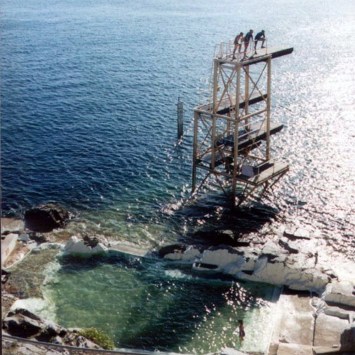 Until we are old enough, that duty of care is vested in those who brought them into the world. If they fail in that monumental task then society’s duty is to step in. And it failed lamentably in the case of the British woman in Spain who snuffed out the life of her two young children.
Once again we have Social Services frantically buck-passing and failing to measure up. Exercising always due diligence, we must not be afraid of being more interventionist. I said as much last week when I supported Sir Michael Wilshaw’s efforts to give deprived children a chance by sending them to boarding school. But provision for our young people extends far beyond the remit of Social Services. Our town halls have a part to play also.
Most days, after I close my shop, I like to round off the day with a cappuccino on the Hoe seafront. One of the pleasures I have enjoyed – along with myriad tourists – is to watch the young people having fun on the diving boards and rock pools of the foreshore. Not anymore.
The powers-that-be in the town hall had other ideas. Aided and abetted, no doubt, by ‘Elf ‘n’ Safety’ they closed it all down and demolished the lot. Even after two years I still feel cold fury at what they did.
It was, in my view, an act of civic vandalism. I never saw an accident in all the years visiting, much less a fatality. What I do know is that the kids loved it and it didn’t cost them a penny.
Did the dunderheads of the dept. involved reason, in their twisted logic, that the kids would turn their attention to the newly revamped and expensive-to-use Tinside Lido and spend their pennies there? No way!
They were, for the most part, poor kids who didn’t have many pennies. But thanks to the city’s forefathers they did have a lot of fun. At huge expense, Plymouth’s forefathers had created something that generations of Plymouth youngsters had enjoyed. It had become part of their childhood memories – even folk law.
What I want to know is: who gave the vandals the right to nullify all this and spend huge extra funds to do so?
Their predecessors had dug deep into their pockets to create a leisure facility because they recognised that they had a duty to provide for young people and in so doing help to keep them out of mischief. All that expense of yesteryear, however, was over. All their successors had to do was maintain it, but even this was too much.
Young people have a need for exciting and challenging things to do, and so in fulfilment of that need they took themselves a couple of hundred yards down the road and hurled themselves into the sea from a rocky cliff face in what is known as ‘tombstoning’. There, the dangers were real if not always apparent. If the tide was not out far enough, they could easily kill themselves.
So when the decision was taken to cull their previous, marvellous facility, did the numbskulls responsible not take this into account? I think not.
You see, they fail to think these things through, and so the law of unintended consequences comes along and hits them over the head.
Whether it’s exhorting kids to wear goggles when they play conkers; preventing little old ladies setting flower arrangement in cathedrals unless they have criminal-record checks; not allowing hanging baskets in seaside resorts in case they fall on someone’s head; or not allowing the emergency services to go in to three feet of water to save a life; they seek to wrap us all in cotton wool and take the risk out of each and every sport and situation.
They do not realise that measuring risk and pitting ourselves against the odds is part of the human experience.
A large part of the fun of sports is knowing that there is an element of risk. Take it away and you have neutered most of the fun.
Our kiddies’ play parks today may be full of colourful plastics and rubberised flooring, but they are sanitised affairs and do not hold a fraction of the thrill of the play parks their parents enjoyed.
Kids need to learn how far they can go and arm themselves for the future in the school of hard knocks.
Look at the pathetically short-chained swings they insist on today, and compare them with the mighty chains of yesteryear that allowed you to soar almost to the heavens.
Yes, the duty of care is multi-layered; town halls should remember that as well as others. They almost forgot it at Mount Wise when those marvellous facilities which the poorer kinds of Devonport enjoyed so much were almost swept away. Only a public outcry stopped the axe from falling.
It was the same sad story with our precious lido. Hands off, I say, please.
A hard core of dysfunctional families
A hard core exists within our country of seriously dysfunctional families: around 130,000 or so according to a recent government-commissioned report.
Children from these families can best be described as ‘feral’, and they account for a disproportionate amount of the crime in their communities.
Their parents are simply not cut out for the hugely responsible job of care and parenting, with all the sacrifice and commitment which this entails. The truth is they cannot even manage their own lives, never mind those of their often many offspring. As a consequence, these children receive no parental guidance and in many cases no love either. Their lives are doomed from the very start, and it is difficult to know what can be done in such a situation.
A suggestion has been put forward by the head of Ofsted (Office for Standards in Education) to pluck these children from their hopeless home environments and bestow on them the very considerable benefits of a boarding school education.
Although nothing can compensate for an abusive and loveless setup at home, what could go a long way to giving these unfortunate children a chance in life is to give them a first-class education – something to which their own parents attach no importance.
Regardless of what has gone on at home, a mind that has been stretched, educated and, yes, disciplined, can still break free from a hopeless family and go on to better things. Such a cultivated mind might return to their families during term breaks and talk some sense into their feckless, couldn’t-care-less parents.
At the very least, if they did not succeed in this – although some might – they would be later able to present themselves to the world of work as potentially valuable assets to their company of choice.
The newly appointed head of Ofsted, Sir Michael Wilshaw, deserves to be praised for being prepared to address this difficult issue.
Britain has always been admired around the world for the quality of its boarding school ethos. They turned out to be the elite that made it possible for us to hold our worldwide empire together. It was very much the model on which Plato himself said would make for an ideal education.
Not long ago, the children’s charity UNICEF released figures concerning the life chances of British children who passed through Britain’s current care system; they were truly shocking and dispiriting. Based on historical evidence, the figures stated that 30% would likely grow up to become criminals, 20% homeless and 10% suicidal.
Such statistics caused me to wonder why it was that such a large majority of my own peers in the Foundling Hospital made happy and successful lives for themselves. They had, after all, been very much in ‘the care system’, and in their case did not even know who their own parents were.
But the new school which replaced their 200-year-old one in central London was a truly splendid affair with top-draw facilities; it occupied around a hundred acres and had its own farm which provided fresh produce for the children. The teachers and housemasters were, for the most part, kindly and sympathetic people who had themselves been well educated. But there were red lines and they were crossed at your peril.
Children developed a respect for authority along with a love for their country and were sound in the three Rs. There was an emotional deficit, just as there is in today’s troubled children, but the ordered life, three square meals a day and sound, if basic, education allowed them to overcome their other difficulties.
Why I am so convinced that Sir Michael Wilshaw’s has got it right is that the removal for a large part of the year from the mayhem and inadequacies of their home life will introduce them to another world. They would be free to realise their full potential, learn to treat others with respect and eventually step out into the world as cultured, educated human beings. What is not an option is that in the face of such appalling figures from UNICEF we do nothing. The whole situation shames us.
Sir Michael Wilshaw is to be lauded, not vilified, for his brave intervention in this perilous field of what to do with our problem children. If he is successful, the country will owe him a debt beyond measure. Pilot schemes must be set up without delay and the results carefully monitored.

Skivers won’t turn around our fortunes
It is natural that workers in the public sector seek to weaken the law of the jungle in their state-funded workplace as best they can, but it must be remembered that the jungle is still where wealth is created.
It cannot be allowed to open up a gulf in remuneration, security and work conditions which causes resentment in that part of the economy that must produce the wealth to keep things going. It is unimaginable that any private business should say to its workforce, ‘don’t bother attending the office for the seven weeks before, during and after the Olympics. Do it all from home!’ But that is what is proposed for no less than 400,000 civil servants working in Central London.
This kind of disconnect with reality speaks volumes. Not even communist Chinese economics came up with such a ludicrous suggestion at their own Olympics.
There are two worlds which exist within our country: one of them is the closeted world of the public sector and the other is the brutal world of the private sector .
The Victorians had two guiding principles: sound money and a small, non-intrusive state. They ran the civil service with 4,000 against today’s 500,000.
They ran India with 1,000, spent 2% of GDP on Armed Forces which controlled half the world and all its oceans. Such was their power that they imposed the Pax Britannica which lasted a hundred years. It was only the second universal peace since Rome’s famous Pax Roma. They were stunningly successful in almost all their endeavours – except for one: they did not care sufficiently for the poor and disadvantaged. But even here, they began to develop a conscience.
Prompted by the evangelicals and people like Dickens, they began to mend their ways and see that their Christian beliefs did not sit properly with the squalor to be seen on their streets. So little by little, welfare became an issue.
By 1945 it became the lodestar which governed all state thinking. Armies of bureaucrats came forward to administer the new system (armies of what, when I was doing national service, were known as malingerers) also came forward with their hard-luck stories.
So at the very time that wealth creation was being relegated, the welfare state was being elevated. In the end, the welfare state became insupportable.
If this recession has served no other purpose but finally to get us to see all this then it will not have been in vain.
Of course, we must continue to do our duty by the disadvantaged, but we face a hard task in winkling out the malingerers.
Almost all of the third world countries must go down the road we went in taking better care of their people – but if they are wise they will learn from our mistakes.
As it is, at the moment, they enjoy a huge advantage over us competitively in that they do not carry the huge expense of even a limited welfare state. That, together with much lower wages, makes it next to impossible for the West to compete.
But their peoples are already demanding – and getting – increased pay packets; they are also demanding better work conditions and welfare for the disadvantaged – all of which will cost money.
When we have eventually completed the much harder task of convincing all our able-bodied people who presently feel no conscience about not working to work, there will be a meeting point at which we will all be competing on a substantially more level playing field.
This scenario has already been played out in several former third world countries such as Japan, Taiwan, South Korea and Singapore. They were all once undercutting us wholesale, and it will be the same with China, India and Brazil.
There are penalties with being an innovator – the first in the field in any activity. Inevitably you make lots of mistakes; but those coming later can take advantage of what you got wrong as well as the much greater number of things you got right. Once of the reasons Germany created the as successful an industrial model as it did was because it was able to avoid making the same mistakes we did.
One of those was with its technical colleges and apprenticeships. They elevated distinction on the factory floor; doctors of engineering and the sciences were as highly regarded as doctors of medicine in Britain and the landed gentry. There was not the same prejudice against those who got their hands dirty as opposed to those who kept them clean, as there was in Britain. Your smart boy was as likely to head for the factory as he was for the professions.
It is easy to forget that as little as 10 years ago Germany was being talked about as the sick man of Europe, having taken our place pre-Thatcher. But then she set about freeing up her labour markets and keeping down costs, including labour. Result: Germany über alles. And we must do the same.
The newly released Beecroft Report must be acted on. If we want jobs, we must make it as easy as possible for firms to hire, and that has to include the right to fire. No employer gets rid of a worker who is an asset to their company, and workers must know that their best protection is to be so. Only the skiver needs to fear, and why shouldn’t he? He won’t turn around our fortunes.
Shameless bankers still don’t get it
 Ordinarily it is not a healthy thing to look for scapegoats in any and every bad situation, but neither is it sensible to ignore blatant wrongdoing.
Bankers have done terrible things to the peoples of the western world.
What has to be understood by the banking community is that they are in a position of trust. People deposit their precious savings in what, until recent times, was the certainty that when they needed them they would be safe and available. In old age, it would be there to ameliorate the sadder downside of being old.
The funds which the banks hold are, quite obviously, not their money; and they have certainly not earned a right to keep it. If they see it as part of their proper function to grow depositors’ money, then they are only entitled to do so in ways that are totally safe. But this is no longer their priority.
They have also have come to see themselves differently, almost as though they are the elect of god. Lloyd Blankfein, Chief Executive of that wicked empire, Goldman Sachs, certainly didn’t seem to be in any doubt when he declared in a 2009 interview that he was “doing God’s work”.
They traded financial instruments so fiendishly complex that only the former NASA scientists that created them understood them. Collateralised debt obligations? They might as well be speaking another language.
Viewing themselves as godlike Olympians with the power to move mountains, they set about gambling on a scale never before known in human history. In the run-up to the financial crisis, investment bankers annually exchanged financial derivatives to the value of one quadrillion dollars in international financial markets. To put that figure into perspective, by 2007 financial institutions were annually exchanging 10 times the inflation-adjusted value of the entire planet’s manufactured goods over the previous century.
Theirs, in their world view, was not a job to be compared to any other. The sheer scale of their operations proved that. They revelled in the sobriquet awarded them: ‘Masters of the Universe’.
Buying into the bankers’ warped take on life were the politicians, ever greedy for the crumbs which were dropping wholesale off this beneficent table into their coffers. As with the make-or-break power of the Murdochs, the politician – when asked to jump – would only reply: how high?
Now events have conspired to puncture the hubristic dreams of these lords of creation. We, the blameless, have been obliged to mortgage our and our children’s future to save the rotten system and, in the process, their necks.
The hole they have dug for us is pitiably deep. And meantime, we learn of hungry children being bought meals at their schools by their teachers.
Do we see contrition for the misery they have inflicted on so many millions, or gratitude for what has been done to keep them in work while so many others have been laid off? Do we indeed!
That shameless bonus escalator is again in full swing and everything as far as they are concerned is again business as usual. For the rest of us it is deep anxiety, joblessness, falling living standards, savings returns decimated, and no guarantee that we’ll ever get out of it.
The question therefore arises of why there should not be a system in place, as there is partially in the US, that allows for prosecutions and prison terms. Would ‘Fred the Shred’ be luxuriating today on his £400,000 a year pension were he to have been operating on the other side of the pond?
Malpractice which impacts so horrendously on people’s lives, and the very survival of the system that keeps the world afloat, should not be without the severest sanctions where it can be shown that wrongdoing has taken place.
Footballers cannot operate except within a strict framework of rules, and yet a system which can bring down the world is allowed to do virtually as it pleases. The trouble is that the people we would have to rely on as the enforcers are too much involved and in hoc to the people they are being asked to police.
Four years into this banker-driven recession we are entitled to ask why nothing meaningful has been done. Would they be so ready to destroy our livelihoods if they knew that they would face prison terms for bad and criminal practice?
That senior executives of Barclays Bank this week have awarded themselves two-thirds of their company’s profits, leaving the remaining third to the shareholders, strikes me as little more than corporate theft… or grand larceny, for want of a better term.
One way or another we have to find ways of cutting these unrepentant Masters of the Universe down to size.
Gordon Gekko, of the 1987 Wall Street movie starring Michael Douglas, would have been proud indeed that his “greed is good” message to the world had been so thoroughly absorbed and acted on by his successors.
We have recently learned that the executives of the top 100 FTSE companies will have collared 205 times the pay of their average workers within the next ten years. Fifty years ago, it was considered acceptable for the man at the top to earn twenty times that of the man on the shop floor.
Yet the FTSE barons have been awarding themselves an increase that averages 13% for each of the past twenty years. And this is from the very people who have been laying off thousands of their workers during these years of recession. They don’t even feel obliged to look after their own.
There is a shamelessness to be seen that sets no limits on greed.
Even performance does not come into the equation; failure will attract reward to almost the same degree as success.
Just like the politicians with their fraudulent expenses, the bankers in their casino madness just don’t get it. They feel themselves to be unjustifiably picked on: the hapless victims of a wicked witch hunt.
The virus has spread to the Civil Service, the Town Halls, the Utilities and others paid from the public purse. They too have seen the chance to enrich themselves: they too have joined this pernicious business of ratcheting up the pay differentials.
Is there no limit to the shamelessness on display? Would a differential of a thousand times satisfy their ravenous appetites?
Desperate to plug the glaring hole in the country’s finances, the Chancellor of the Exchequer must wait to get the better part of half a billion pounds that Goldman Sachs owes all of us. Despite a £1.5bn profit from its British operations, they have found a way of delaying payment which they readily admit is due. Shame on them.
That bank truly represents what a former British Prime Minister once memorably described as the “unacceptable face of capitalism”. No bank in history has had so many fines levied on it for scams and bad practice.
As for the American CEO of Barclays, Bob Diamond, he truly does live up to his name. That £26.4m package of his would buy an awful lot of the sparklers. Never mind diamonds being a girl’s best friend. They’re Bob’s, too.

The demise of titans
We are about, I think, to witness the fall of two imagined titans: one from the world of showbiz and the other from the world of politics.
The first is Simon Cowell – a latter day phenomenon of the small screen – and the second is Nicholas Sarkozy – the man who promised a Thatcherite revolution and who dreamed of being a little emperor like that other interloper from Corsica, Napoleon.
Cowell, who I will concede has admitted making serious mistakes in the past, has now got himself into a mindset in which he believes he can do no wrong and that everything he touches today will, inevitably, turn to gold.
But many now argue that he showed very poor judgement in jettisoning Sharon Osbourne in favour of Dannii Minogue – I’ve asked why, myself, many times – and that Sharon would have been a much more feisty and entertaining judge.
Now we come to his greatest error of judgement: the decision to co-operate with Tom Bower in the production of a biography.
Had he troubled himself enough to read just one of that distinguished biographer’s works, he would have realised in an instant what little good to his carefully crafted image he would do him.
Long ago I read his expose on the publisher, Robert Maxwell. What an annihilation of that monster it turned out to be! Although I haven’t read his recent work on Bernie Ecclestone, the Formula One boss, it was so unflattering that Bernie came to believe that if only he had co-operated with the writer, Bower couldn’t have helped but to have come to an appreciation of what a truly wonderful man his subject really was: and so he advised Simon accordingly.
Suffice it to say that Bernie is not any longer flavour of the month with Simon.
The truth is that if you’re going to submit yourself to the laser-like investigative eye of Tom Bower, you’d better be as normal and squeaky clean as it’s possible to be. It turns out that Simon, as many of us suspected, is neither of these things.
He has offended that largest constituency of his – his legion of adoring women fans. Even his often cruel put-downs of X-Factor contestants were forgiven because they were viewed by many as no more than the truth, and were seen as the honest response of a man who abhorred humbug and insisted on telling it as it was.
They managed to convince themselves that inside his callous exterior he was a pussycat; one even with a heart of gold. It was, after all, well known that he was crazy about dogs. What was less well known was that he had a huge problem with humans.
Many of Simon’s female admirers wanted nothing so much as for him to find the woman of his dreams who would help him settle down and produce lots of little Simons. But they didn’t know that he was in the grip of myriads of the strangest habits; that he was afflicted with a degree of narcissism that would have made Narcissus himself blanch; and that he saw women, even a wife, as nothing more than appendices to his overweening lust for power and wealth.
Poor Mezhgan Hussainy, who ecstatically agreed to become his wife, was on a hiding to nothing and would suffer only humiliation before – like so many others – she was cast aside.
Women, it seems to Simon, are seen as trophy objects to be used and discarded at the will of the great showbiz Don Juan. But what they must never do is come between him and that drive for dominance on the small screen.
Will it be the big screen next? The much hyped tie-up with the deeply unattractive Sir Phillip Green was meant to sweep all before it. Whatever happened to that?
Worrying developments for Simon recently must be the fiasco game show ‘Black & Red’. But worst of all is dear old sclerotic Auntie BBC stealing a ratings march on him with its hugely successful show ‘The Voice’. Has Simon finally peaked?
As for the little emperor Sarkozy, who delights in lambasting all things British and playing the sulky schoolboy by insulting our own prime minister: he too seems in danger of getting his comeuppance.
The pity of it is that in demonstrating its contempt of its coarse, bling-loving president, the French electorate are about to plunge the eurozone into its worst crisis yet.
Even Sarkozy’s lovely trophy wife, Carla Bruni, doesn’t seem able to help as she is held in almost as much contempt as is her husband.
In ordinary circumstances, presenting the French nation with a little baby emperor would have earned a few Brownie points – the loving family, doting father and all that – but even baby Sarko hasn’t seemed to have helped. Even our own Wicked Witch of the West, Cherie Blair, did achieve a slight, if temporary, softening of her image when baby Leo came along.
Why the socialist, François Hollande, will rock – perhaps even sink – the eurozone boat is because he wants to prescribe for France more of the doctrinaire spending madness that got us all into this mess in the first place.
No chance under him of cutting loose from that ridiculously uncompetitive 35-hour week! And his pursuit and confiscatory tax policies on high earners is certain to unleash an exodus of the very people that France needs most to pull her out of her largely unacknowledged quagmire.
It says it all that the man cannot even recognise the demographic time bomb of a low birth rate, an ageing population and longer life expectancy that is forcing the rest of the developed world into raising its retirement age.
One of the few, modest achievements of the would-be new broom that Sarkozy promised for France – increasing retirement age to 62 – is to be struck down and go back to where it was.
Mon dieu !

Words can hurt more than sticks and stones
I knew a man once, a very dear friend, who was in a horrendously abusive marriage.
The abuse came in the form of the language which was deployed against him by his wife. To be sure, it wasn’t only that; there was violence too, but it was the language that was the most alarming.
I know this because he felt that no one could possibly believe how depraved and evil it was unless they could actually hear a recording, and that he duly made; several of them. I was stunned.
The recordings were full of the vilest language our otherwise beautiful tongue has yet conjured up. Truly, soldiers and sailors in their billets or berths couldn’t have ‘bettered’ it.
I asked him why he didn’t get out of it and he replied that he didn’t want to lose his children. What could I say to that? He was of the opinion that there is a gap in the law which fails to recognise verbal violence as being as damaging, in many respects, as physical.
As a boy we got used to the corny old saying ‘sticks and stones may hurt my bones, but words will never hurt me’. Yet, as we grew older we came to see this for the absolute nonsense it was.
It was perfectly possible not so many years ago to say just about anything you wanted to say: it was called Freedom of Speech, and that ‘holy cow’ allowed us to call people spastics, coons, yids, mental retards, Nancy boys, cripples and an endless repertoire of other demeaning terms.
Look, for example, at what passed for entertainment on the television. Alf Garnett at bay in Till Death Do Us Part or the ‘funny’ man Bernard Manning in full flow.
It took us a long time, but we came to realise that such bigoted, verbal diarrhoea could not be tolerated in a civilised society. Freedom of Speech had to have some limits. It could not be used to pillory and degrade minorities. We actually had long before come to recognise that when we created the law of blasphemy.
To say that words cannot hurt is to state the purest form of rubbish possible. Words can scar (for life); they can destroy self esteem; humiliate and degrade; crush the spirit; and can even drive a person mad.
Although referring to language’s written form, its message holds true even in the spoken form. ‘The Pen is Mightier than the Sword.’
Language is the most powerful weapon we can ever deploy against a person.
Not before time, society set about addressing this very real problem in its midst. And so a whole new industry was born: it is called ‘political correctness’, although in many of its aspects it might, more accurately, be described as ‘behavioural correctness’.
Few would deny that we were right to tackle this cruel form of abuse and are the better for having done so.
Only verbal abuse of the elderly is still permitted and I worry at what it says about us that we have allowed this most vulnerable sector of our society – the one to which we owe everything we have – to remain almost the last to receive such protection.
Like all new industries, the people whose jobs depend on it feel they have to keep up the momentum; justify, if you like, their existence. They spread the net wider and wider and probe into the most unlikely and deepest of recesses looking for that ever more elusive injustice.
If things go on as they are we may arrive at a situation where we are afraid to open our mouths lest we commit a felony.
The free flow of conversation itself may end up being imperilled as we put ourselves on mental override before we release our thoughts to a live audience.
I feel the time has come to put a brake on this whole burgeoning industry of political correctness.
Yes, we were right to look at all aspects of how we do things and what we say. Fairness and equality, along with tolerance, must always remain central to our way of thinking. But we are in danger, as always, of allowing the locomotive to run out of control.
It is interesting to note that we are not alone in wrestling with these thorny problems. The French are about to abolish the term ‘mademoiselle’ at the very time we are about to ban ‘Mrs’ on all government documents. Should the quaint term ‘Spinster’, still featured at every Registry Office, also be consigned to the dustbin of history?
While a very necessary transformation has taken place, it is important that we don’t end up making fools of ourselves and creating a lawyers’ paradise where all concerned argue, ad nauseam, as to whether offense was intended and the law breached.
Things are getting sillier by the minute.
Is it sensible to ban wolf whistles? Who will know which navvy among the many was the culprit? In any case, where’s the offence? My ex used to love it when she walked past a building site. She was guaranteed one every time.
Whilst not ordinarily in favour of any governmental expansion (in fact I am in favour of the reverse) I might be prepared to consider one exception: a new Ministry of Common Sense.

The new Plympton library
 After the devastating fire at Plympton library four years ago, a phoenix of a new library has arisen: 50% bigger and incorporating all the latest must-haves in a modern library. At a time when libraries across the land are being closed due to austerity cutbacks, this is serendipity of the highest order.
All this week there are events, and on Thursday it is authors’ day. I have been much privileged to be asked to contribute on that day. But what shall I speak about? My book, of course, but I shall also speak about children’s issues since it is much of what the book is about.
In researching the book, I came across a startling set of statistics; they relate to a recent UNICEF report. It stated that 60% of children passing through the present childcare system grow up to be either criminals, homeless or suicidal. And we must not assume that the other 40% have made successful lives for themselves; more probably they have muddled through and simply don’t qualify for a place in that terrible roll-call of tragedy.
These figures caused me to consider the fate of the Foundling Hospital children of which I was one. They were taken into care as weeks’ old babies, fostered out for their first five years and then sent to the hospital for their next ten.
The hospital, now called Coram after its 17th century founder, Captain Thomas Coram, has an association called the Old Coram Association (OCA) which encourages old boys and girls to keep in touch with each other. It publishes a twice-annual magazine and stages umpteen gatherings each year at its central London headquarters.
What emerges through all this communication is that, for all its faults, the hospital’s children made infinitely more successful lives for themselves than is the case with today’s deprived children. So what is going on?
Foundling children were institutionalised at a very tender age; they were subject to the harshest and most disciplinarian of regimes – although, it has to be said, no harsher than many of the country’s top public schools of the time – and should, therefore, be prime candidates for a failed life. They didn’t even know who their mother and father were, or even what their real name was (a new one was given them by the hospital). Yet despite all these things they have become, for the most part, loving parents and successful people.
The only conclusion that I and other ‘old boys’ can reach is that the hospital’s policy of fostering them out for their first five years saved the day. Children are tougher and more resilient than we often give them credit for. Having been surrounded by love and security since babyhood, they were able to survive the rigours of what was to become. But what they cannot survive is a messed up, abusive early start to life: nothing and nobody can undo such damage inflicted so early. If this is true – and all the evidence points to this being the case – then it seems to me that we have to move fast and adopt a much more hands-on approach where babies at risk are concerned.
The rights of parents absolutely have to come secondary to those of the child. It is well known that social services will bend over backwards and go to incredible lengths to keep mother and child together. And by the time they wake up to the reality of the relationship it is, in almost all cases, too late. The child is irredeemably scarred.
If it becomes apparent that the parent, or parents, for whatever reason cannot provide stability, love and a decent standard of care then I believe the baby should be removed as a matter of urgency and placed in an environment where it has all of these things. Intervention at the earliest point – once the facts have been established – is of the absolute essence. Who would deny that if such a policy had been in place for poor Baby P, he would not be alive today?
I would not even be averse to sending them, during term time, to a school such as the Foundling Hospital – ran with all its stunning facilities. There, in today’s world, they could be guaranteed a standard of education second to none. Think of the pressure cooking excellence that a live-in school bestows. And don’t say ‘yes, but it would be cruel to send them off from their home during term time’. Isn’t this exactly what the elite of our country have done for centuries and continue to spend thousands of pounds doing? Sending them at the tender age of eight from the far flung outposts of empire in times past, not to see their parents for years, never mind every school holiday?
Armed with this very superior education, wouldn’t society have gone a very long way not just in saving them, but off-setting the sadness of the loss of their own inadequate parents?
If you can spare some time to join with me, we can discuss some of these very important issues. I can also answer any of your questions with regard to my book. The opportunity comes at 2.30pm at Plympton Library on Thursday 9th February. Another local writer, John White, who writes military and political thrillers, will also be there.

A black box in every car
A letter recently unearthed during a house clearout dated 1925 read as follows: ‘Dear Mr. Grainger, We respectfully draw your attention to an under-payment of fifteen pounds, eight shillings and four pence made on your recent income tax remittance. We are sure this is an oversight. May we suggest the 31st of next month as being a suitable date for settlement of the balance. If you require clarification as to how we arrived at this figure we would be most happy for you to call at this office where we will endeavour to explain. In the meantime we remain your Most Obedient Servant’. How very polite and considerate this all is. No doubt here who the boss is.
The signing off tells you all you need to know: the state in those days knew its place. It was, of course, nonsense to suggest that its agents regarded themselves as anybody’s servants, but the then powers-that-be thought it important to continue to emphasise what the proper relationship should be. Today it is all different; government is in the driving seat.
With 4 million CCTV cameras in place (by far the highest number of any country in the world – North Korea included) and the planet’s largest DNA database and every conceivable detail of our lives – both personal and financial – logged, we are well and truly skewered and corralled. The East German Stasi (secret police) would have been proud.
Only the media stand between us and total subservience. That is why almost the first act of any authoritarian regime is to muzzle it. What people need to understand is that authority, be it central or local, has an insatiable urge to accumulate power – to regulate and control. It cannot help itself. It is in the nature of the beast. Only our ability to scrutinise it through the media and force it to submit itself for re-election has any hope of controlling its growth.
We like to preen ourselves as being almost the freest society on earth. But does this really stand up? We are bossed around to an extraordinary degree. Gone is the fanciful notion that ‘an Englishman’s home is his castle’. Hundreds of agencies have the power to barge into them and they don’t need a scaling ladder to do it either – just the local plod to intimidate any would-be heroes.
Our government recently wanted the power to lock us up without charge for 90 days and only the most extraordinary of efforts got that figure down to 28. And that is still one of the longest in the civilised world.
I cannot help believing that the age of terrorism has been a godsend to those most zealous in their urge to control us. It has given them the perfect cover to push through a range of measures under the mantra ‘Do you really want to get blown up?’ Well, the IRA were blowing us up for thirty years and were much more competent with explosives than the Jihadist buffoons – and just as ruthless. Yet we resisted bringing in all these special measures on the mainland so beloved of New Labour. They even talked of putting aircraft-like black boxes under every car bonnet until this was laughed out of court. But in truth it was no laughing matter.
They talked also of having all 62 million of us DNA tested – naturally, of course, so that they could catch more criminals. Townhalls were authorised to conduct certain types of surveillance on its citizens, and that ended up checking out people who were trying to get their kids into a decent school. Let’s not forget either the recent national census. Look at the ridiculous scope of the information it sought. And if you were unwilling to provide it, look out! You would be bludgeoned into submission.
But all is not yet lost. We appear to have a government (glory be!) which actually says it wants to devolve power from the centre to the regions. I never thought to hear it, but it says ‘Whitehall does not always know best’. It wants schools that answer to parents; elected police chiefs who have to clock up results or be thrown out; Mayors who have to run their cities competently or face the same fate; and even a social security network that protects the truly vulnerable, but not the army of scroungers.
The attitude of entitlement which so many display is truly marvellous to behold. What gives a person the idea that he or she is entitled to lie in their bed of a cold winter morning while their neighbour must get up and go off to work? And then, as if to rub salt into the wound, hold out their hand for large chunks of their neighbour’s earnings so that they can enjoy a not-much-different lifestyle. It’s actually all very bizarre. But the fact is that so many do really believe that they have that right. There’s no accounting for folk!
Nobody wants a return to certain of the bad old days. But not all of them were bad. We ought to cherry-pick what was best. Among them was neighbourliness, self-reliance (of the fit and able) and straight dealing – honesty if you like. Even today, members of the older generation are so imbued with this ethos of self-reliance that their pride will not allow them to take benefits that we would like them to take.
Two-pronged way to lose weight
We are now into the serious business of the New Year, what we will make of it and what it will make of us.
Huge issues confront us. Will we climb out of this trough of despondency? Will we keep our jobs? Will our biggest market implode? Will America put its sub-prime market disaster behind it and start getting back to work? Will Israel bomb Iran and so plunge us into another oil crisis? Will the Arab spring end up landing us with a clutch of fanatical fundamentalist states? Will the Arab world’s most pivotal state, Syria, descend into civil war?
On not one of these issues can the most gifted political pundit give any guidance as to the likely outcome. So for myself I am going to sit tight, wait on events and try not worry too much. I suggest you do the same.
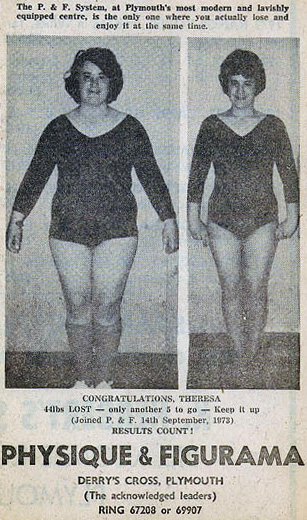
On the home front, for 25 years (particularly the later 21 in which I ran my own health club), January was the most frantic month of the year for me.
People were looking to the summer. They had been pigging out for a solid two weeks. They wanted to go into it looking better – slimmer – than they currently did. Two thirds of my entire year’s advertising budget for new members was spent in the first quarter of the year, since in that short time, if I was lucky, I could expect to enrol three quarters of my annual members.
It would cost me no less than £19,500: money spent in this very newspaper.
From time to time we managed to get some truly spectacular results (see inset pictures of one of our successes of 30 years ago).
The legacy of those Physique & Figurama health club days continues to endure for me.
Every Monday before I set out for work in my shop on Plympton Ridgeway, I, along with my wife, get on the scales and have a weekly weigh-in, writing it down along with the date.
Keeping our eye on the ball is the name of the game. This week, along I suspect with many of you, I had a terrible shock.
Of course, at 72, I could not run to pumping the iron, fast and furious. Instead I walk three miles a day at a brisk enough pace as to force me to breathe through my mouth. So yes, in its more modest form, exercise still continues to play a part.
I have always taken the view that three elements determine our future. One of these – our genetic inheritance – we can do nothing about (for the moment), but the other two, diet and lifestyle are entirely within our gift to control.
One of the reasons we enjoyed success over so many years in the health club was that it was never an either/or approach – dieting or exercise: it was both.
That way it did not require a superhuman effort as if you were relying on one only. Since for most people the problem was, and is, insufficient exercise and too many calories then it made perfect sense to pursue both. That way you only had to work half as hard than if you were relying on one.
So much of the success in fighting the flab is in the mind, and it does not do to ask too much of yourself. Willpower has been made extra difficult to raise in our super indulgent, lazy age and the less of that rare commodity you have to summon up the better. So the two-pronged approach was best.
You had a better chance of enjoying yourself; staying the course and seeing it though to the end.
Our great city hero, Sir Francis Drake, had it exactly right. Of course he was commenting on something entirely different, the three-year first circumnavigation of the world in which the captain survived to see it through.
But what he said still holds true for so much else. He said: “There must be a beginning of any great matter, but the continuing unto the end until it be thoroughly finished yields the true glory.”
It would be silly to equate anything we have done with Drake’s stupendous achievement, but the message is clear. It was what drove me on during the also three-year slog to complete my book, The Last Foundling. It ran to 409 pages and there were so many times I felt myself running out of steam as well as willpower, but I pressed on.
Now I must apply myself to losing a considerable amount of weight and having done that, keep it off. That last bit, keeping it off, must be the “until it be thoroughly finished” part of what Drake was referring to.
Man’s best friend
If man’s natural best friend is his dog, then his material best friend must be his car. I have long considered this a given. Men, in particular, obsess about this mechanical marvel. What else can explain the phenomenal worldwide success of the BBC’s Top Gear? Every Sunday these myriads of aficionados can be seen lovingly caressing cars’ lines with their polishing cloths, devoting a level of tender loving care which often puts that devoted to their children to shame. I actually believe there are men out there who, given the choice between their wife and their car, would chose the latter. Mind you, I think the same could be said about not a few of the wives!
I once knew a woman for whom the family car was all that seemed to matter. When, for instance, she split with her husband the only item she chose to keep was the brand new car which her husband had recently paid cash for. Anxious for an amicable separation, she didn’t ask for half the house or its contents, nor for half of her husband’s valuable share portfolio; only the car.
What can explain the otherwise inexplicable? I think I know the answer. Our species was originally a wanderer, a hunter-gatherer. When it gave up following the game and settled instead for a stationary, farming existence it didn’t lose its love of the outdoors nor of travelling. Going back further in time the same could be said of his continuing, ape-like love of climbing trees. We all, as kids, couldn’t resist a good climbable tree any more than we could resist walking along the top of a wall as though it were the bough of a tree. That too, it seems to me, is an echo from our ape like past.
For millennia most of us lived and died in an area no more than eight miles from where we were born. But then came the train, glory be! And then the car, halleluiah! The free spirit in us was liberated in a way not known even to our distant ancestors; it was as though we had sprouted wings. We were able to get places even faster than a bird! But unlike them we didn’t even have to work hard to do it. We could accomplish it effortlessly, in warmth and perfect comfort, surrounded by an amazing range of gizmos to amuse us, all the while listening to our favourite melodies. Here, surely, is the extraordinary appeal of the car. We have even made it beautiful to look at.
But who has come along seeking to spoil all our fun? Yes, you’ve got it: big brother. Despite providing jobs for millions, the state almost sees drivers as public enemy no.1. It tells us the car is a killer and a polluter, and it’s selfish to journey to work in a car made for five with only one in it. And as for getting places faster than a bird? “Well, we’ll soon sort that!” it thinks.
Up go the speed cameras and, when the public learn how to deal with them, up go the average speed cameras. The name of the game, you see, is to knock his speed back to such an extent that he’ll eventually opt for a bike. Meantime, let’s give him a taste of what stage coach travel was like with potted roads to contend with! In go millions of speed bumps along with chicanes to make him swerve violently.
Loving it, our transport masters sit in their swanky offices dreaming up what new road schemes they can inflict on us and what roads they can stop us using by making one way. But the bit they love the most is the way they are empowered to pick our pockets shamelessly with their fines and almost the most expensive fuel in all Europe.
All of which brings me to my final point. Didn’t a certain government, when it came to power recently, promise us that ‘the war on motorists is over’? Well, eighteen months on, I’m still waiting.
Prince of hypocrites
So, Hugh Grant’s at it again! His supporters’ club must be dwindling by the minute. But none of it would matter too much were it not for the fact that he insists on lecturing us on matters which have a distinct whiff of humbug about it.
Nothing irritates the British public so much as hypocrisy. While Grant’s latest antics seem only a short step from the broom cupboard episode of poor Boris Becker, at least Becker showed genuine humility at how he had let himself and his fans down. But the self-obsessed, narcissistic Hugh Grant shows none. What’s more, Becker has demonstrated over the year a touching regard for his child, shock as it was and totally unplanned for, and knowing as he did what opprobrium that incident brought down on his otherwise lustrous head. He has nonetheless shown himself to be a marvellous father and totally, in my eyes, redeemed himself for that moment of madness.
Forgive my scepticism in Grant’s case (notwithstanding a few fine words from him), but looking at his track record I shall be very surprised if fine words translate into reality ten years down the line. Yet I hope, for his child’s sake, that I am proved wrong.
Grant has had a lot to say recently about press intrusion, and it does worry me tremendously that this inquiry into the Press Complaints Commission has so many people on it that seem ill disposed towards the press (including people who, for want of a better term, have been caught out at one time or another: Keith Vaz is one who immediately springs to mind). The political establishment will find it difficult to forgive the humiliations of being exposed as venal and self serving in the expenses scandal. It is a running sore which some politicos believe cries out for vengeance. I hope the majority are public spirited and big enough to acknowledge that the press were doing no more than their job – indeed their duty – in bringing it to the attention of the public.
But let me be quite clear about one thing. We are talking about the most vibrant and fearless national press in the whole world; an institution of which we should all be proud. And while in pursuit of stories, some of its people have been over zealous and crossed the line in to criminality, we have perfectly good laws which could have dealt with these matters, if only the Met had been doing its job.
It cannot be repeated too often that it was the press which blew the whistle on itself over phone hacking. I never subscribed to the venerable (in age) News of the World, but how I grieve for its demise. It’s a bit like that old saying ‘the death of any man diminishes us all’. Well, the death of the NoW has diminished us. It was offered up as a sacrificial lamb in the hope that it would silence the baying hounds, when in truth it should have been James Murdoch and his band of miscreants who were offered up. The paper had by then been cleaned up (Rebekah Brooks excepted), but as usual it was the ‘poor bloody infantry’ that was laid on the altar.
While watching BBC2 recently, who popped up lamenting the invasion of people’s privacy? Yes, you’ve guessed it: our old friend Hugh. It was truly nauseating listening to him. Equally vociferous in the cause of muzzling the press has been Max Moseley (caught out by the News of the World). For all its sometimes sanctimoniousness, and often own hypocrisy as well sleaziness, the News of the World could still boast a proud record of expose. How many, many were the stories down the years – which the public had every right to know about – did it break in its 168 years of publishing? Sad, sad that it has gone. Even the sleaziness – or most of it – can be forgiven. Experience has shown that an element of tittilation is required to spice up sales. I would argue that it is a small price to pay to help in the battle for survival. Sad, sad that it has gone.
It is uniquely difficult in today’s high speed, digital world to maintain a financially viable press, and many regional papers are having tremendous difficulty competing for readers’ attention. Many are closing. They will never return. We risk, at our peril, taking away their necessary freedoms (which in any case are subject to strict laws of defamation).
When I was in the States recently, I had an object lesson in how very good our press is by comparison. Theirs was boring, parochial and expensive. The BBC’s founder, Lord Reith, spelled out what he saw was the Corporation’s duty to the public: it was “to inform, educate and entertain.” Our press does that in bucket fulls. Let’s keep it that way.
Where open justice is meaningless
One of the worst afflictions our country suffers from is a culture of secrecy.
Where it all began is difficult to say. It certainly became more virulent in the period leading up to the First World War, when the country became paranoiac about our naval secrets being stolen by the dreaded Hun. Then, in 1989, came that draconian, catch all, Official Secrets Act, which ended up making it possible for the number of paper clips Whitehall used being classified as a state secret.
But nowhere is this culture of secrecy more evident than in the family courts. Terrible things are being done in our name behind closed doors, and always the excuse is the same: the need to protect the vulnerable. I suspect, however, that a very large part of its application is for a quite different reasons, including miscarriages of justice, botch-ups, executive incompetence and little-Hitler power structures which brook no interference.
The Blair government got so many, many things wrong, but one thing it did get right was the introduction of the Freedom of Information Act. But, true to form, and in typically British fashion, it was hedged about with so many exclusions and let outs that most of its teeth were drawn before it ever reached the statute books. That is why when you put a simple question, as was done recently, to 90-odd town halls, barely half of them reply. You cannot draw any conclusions from the half which did answer since they are almost certainly the ones who have the least to hide, surely.
Say what you like about the Americans, Australians and the rest, but they are much more open and upfront; not devious and condescending like our lot. Here, there is a patronising ‘don’t bother your little heads, leave it to the experts, we have your best interests at heart’ attitude.
But returning to my bête noire, the family courts, there is almost a conspiracy of silence where they are concerned. Children, in numerous cases, are being legally abducted on the flimsiest of social worker say-so. These little demigods are instrumental in breaking up families so that the child is separated from its parents. Put up for adoption, these children are never to be seen by their parents again. The heartache is unbearable. All this is agreed in closed sessions, and woe betides anyone who in their anguish lets slip a name, for they will go to prison.
Open justice is a meaningless concept to these upstart, dangerous jobsworths. And their skewed attitudes are also at work in the adoption agencies. So politically correct are they, that they will not allow couples to adopt across racial divides (yet one of the great glories of our people is how accommodating they are to people of other races. We would feel nothing but admiration for a couple who opened their door, as well as hearts, to a child of another race). Neither will they if one of them smokes, nor if they are too old, nor if they are this or if they are that.
Two years and seven months it takes on average for them to process a child: an eternity in the life of any kid. And so many are the hoops to be jumped through that it is difficult for any loving couple to be optimistic about their chances (which might – who knows in this topsy-turvy world – actually be improved were they to be gay or lesbian). Indeed, a recently commissioned report stated that the criteria is so strict, the box-ticking so extensive, that most people would not be able to adopt their own children!
Sixty children under the age of one were adopted last year. Yes, 60, in this nation of 62 million. Meanwhile, some 65,000 children languish in care with their childhoods slipping away, and with them their life chances. Shining light on our grossly inadequate care system, the United Nations Children’s Fund, UNICEF, recently published a set of very disturbing statistics, indicated that 60% of those poor children end up to be either homeless, criminals or suicidal.
Only one other duty – our care for our elderly – equals that of our duty towards our children. Just as the old gave us our past and present, our children are our future. If we do a good job by them – love them, educate them, nurture them – then you can empty out half our prisons in the future and keep our streets free of rioters.
I am one of the very lucky few, after having spent my first 15 years as a foundling in institutionalised child care. My heart bleeds for the ones less lucky – the huge majority – who will suffer all their lives for their screwed up childhoods. Yet the Sharon Shoesmiths of this world feel free to shrug off their culpability and pocket their million pound compensation/pension packages. Scandelous.
Celebrity
Most children today have such a cosseted, undemanding life at home. In too many cases their every whim is pandered to. They become little Emperors, missing out only on the imperial purple. Instead they get designer clothes as a substitute. Naturally, they expect this child centred mollycoddling to continue when the day comes to begin their education, and in so many ways it does. If you have a cushy, spoiled, indolent life at home and school you are likely to carry this forward into the workplace.
The very first of life’s many disciplines is getting to school on time. Failure, only a little while ago, was almost unthinkable: it was hugely embarrassing and carried a substantial penalty. This sowed the first seeds of being a good timekeeper.
A few years back it was voguish to deride the Victorians and use them as a way of insulting people. Not anymore. We have come to an appreciation of their towering achievements; they had a work ethic that inspired the world and powered the Industrial Revolution. Recently I read a letter which had come to light from a 17-year-old Durham miner in the trenches of the western front in WWI. I was quite blown away by the literacy of the lad. Not only that, but the handwriting was almost a work of art: beautiful calligraphy. The poor lad almost certainly suffered from trench foot and would have had an army of lice crawling over him as he wrote that letter.
Then, on another occasion, I saw a paper of 20 questions which 11-year-olds, a little earlier, were expected to answer. Three of them were beyond me.
Right now in Singapore, India and China that very same sort of rigour is being applied in schooling. Go into an Indian classroom and you will think you have passed through a time warp. It is the very model of the classroom of their former rulers. They may have said their goodbyes to us, but they are not too proud to cherry pick the best we had to offer, including our wonderful language.
What great societies have to guard against is the soft living and compromised standards that their very success induces. The Greeks despised the Persians for their effete ways and the barbarians the Romans for their dissolute lifestyle. And we know who came out on top in those standoffs.
No one is saying that we should not enjoy the fruits of our success, but we must maintain our core values and the essential disciplines which go with them. Otherwise we will go the way of Nineveh and Tyre.
Not helping in this struggle to maintain standards is the West’s current obsession with celebrity. It has reached farcical proportions. Time was that to be a celebrity you had to have done something; something pretty amazing. And you had not to blot your copybook along the way. Yet today we shower adulation and honours on former drug and sex addicts, philanderers, rotten bankers, shady party funders, time servers, spin doctors, failed politicos, useless Met chiefs and not so brilliant actor/showbiz types who, in many cases, deny the country who made and furnished them with their great wealth a small part of it to fund its necessary expenses.
Young people are mesmerised by the lure of fame. They are being seduced by the idea that their life chances are unaffected by not taking their studies seriously. Why endure the tedium of swatting when you can nab a mega-rich footballer, try your luck on the lottery, win the X Factor or be a Page 3 girl? There’s always something out there. And if all else fails there’s always that soft-touch dozy lot down Social. And if you prefer not to work, well that’s a lifestyle option, innit. And no worries either about having no points on the social housing list! No prob… just have a baby or two… or three… or four.
It is truly a sad spectacle to see all those delusional wannabes packing out the car park of The X Factor waiting for the call. And what does it say about us that the producers serve up for our edification and ridicule the most hopeless, cringe-making losers. There is almost a gladiatorial games feel about it all when they step out in front of 5,000 people to demean and make fools of themselves and, inevitably, be hissed and booed. Many are genuinely puzzled, even furious, that others cannot see the enormity of their talent. Some, undoubtedly, have mental health problems and it is hard to believe that the producers do not know that.
The truth is we have to be realistic and accept that few of us have that sort of shining talent which will leave our peers breathless. Equally, we must accept that the odds against us winning the lottery or The X Factor, or bagging a Wayne Rooney, are slim to the point of vanishing.
So what is the alternative? A humble acceptance of not being a super nova, but being ordinary. Normal, if you like. Being normal is not such a bad thing. Great nations are not built by the glitterati, but by the quality of their ordinary people. It was those ordinary people who Wellington, by the way, described as “the scum of the earth” who handed him his victory at Waterloo after a daylong pounding by the best that the French could throw against them. Hallelujah, I say, for the common man; more properly termed ‘the salt of the earth’. His loves and lives beat nine out of ten of the never satisfied divas.
Taming Brussels
For a brief moment we thought we had got on top of the financial woes of the Credit Crunch and our personal and governmental debts which put all our livelihoods at risk.
At incredible potential cost, we had recapitalised our banks and put them on a sound footing. And then we began the painful long haul task of bringing our deficit under firm control. So far so good; the markets were impressed. The heat was off Britain.
But then the markets turned their gaze on the warring Europeans and their troubled, ill conceived euro.
The sovereign debt levels of the periphery countries quite spooked them. A slanging match had developed between the thrifty north and the spendthrift south. The Germans, in particular, were furious at the feckless and economically illiterate way the south Europeans had behaved, and the talk was that they had had enough of the haemorrhaging of their hard earned dosh. The whole future of the euro – and with it the European Union – hung in the balance.
Greece was the domino likely to go down first and very likely to carry a string of others with them. It was never an easy country to govern, and lovely people though they are, one of their irredeemable failings is that they make almost a national sport of not paying their taxes.
Yet at the same time, because they were part of the wonderful European Union, they expected to enjoy all the social benefits of the conscientious taxpaying north. How do you square a circle like that? After all, the north only got all those benefits because it was willing to cough up.
Greece’s public sector is bloated to the extent that it makes our own flawed product look like a sleekly toned race horse. What’s more, it only turns up for work when it feels like it and its appalling levels of absenteeism pass with just the Greek equivalent of a Gallic shrug. Then, after a semi-detached life of half work they insist on retiring ten years before the rest of us. No wonder the boys in their lederhosen are hacked off.
Yet despite what he and his other diligent north European comrades feel, he will not get his pride and joy deutschmark back. The ruling elite will see to that! The political classes have invested too much political and other capital in the so called ‘European project’ to let it founder. But after terrible dithering and lack of leadership which has propelled them to the wire, they have drawn back from what they see as the abyss of a collapsed Europe.
They are now determined, at last, to get ahead of the curve. They are putting together a package of such breathtaking proportions – three trillion (or 3,000,000,000,000) euros, no less – that even the money markets will recognise that they are putting their money where their mouth is and back off.
Yet the package will need approval of all 17 members of the eurozone and all 27 members of the Union for treaty amendments. Part of the deal, I’m sure, is that the people who underwrite the deal – principally the Germans – will insist on a future level of fiscal rectitude which will make it nigh on impossible for such a situation to arise again. There will be an oversight of all 17 member states’ budgets with a majority power of veto.
It will be, effectively, the final part of the jigsaw towards a united Europe: for all intents and purposes a fiscal union, which along with the existing monitory union will finally give the European single currency credibility. Politically, it couldn’t have happened at the beginning or at any point along the way, but dire necessity has forced the issue. It’s an ill wind that blows no good. The new Europe will not be such a bad place to belong so long as all that nonsense of an interfering Brussels is dealt with.
This is a heaven sent opportunity which will not come again. And because they need our signature on the treaty, we can insist on repatriation of those matters we all know to be flawed, such as the Working Times Directive, border controls, fisheries protection, and even that horney old chestnut: the Common Agricultural Policy.
Way back when we were haggling over the Maarstricht Treaty, they came up with that amazing word “subsidiarity”. What ever happened to it? It was adopted by the Union and was specifically designed to constrain Brussels.
If we seize the moment, we can then settle down to becoming the good Europeans we were always willing to be, instead of the perpetual awkward squad.
The world of tomorrow is going to be one of the big battalions, and Europe is a very big battalion indeed; one more than capable of stopping itself being pushed around by a resurgent China or anyone else.
Plod under caution
A searching spotlight has been directed on to police in recent weeks as a result of the recent riots. It is true to say they are all that stands between us and anarchy, since we are not a militarised state with a large standing army. (We have always found work for the latter to do far from our shores.) But anarchy did, indeed, descend on us 4 weeks ago and for a while the nation trembled at the thought that it was running out of control. What disturbed it most was not the perception, funnily enough, that rioters were on the rampage, but that the police were powerless to stop them. Let us be clear about one thing: it was not lack of numbers which created the difficulty; at 143,000 officers the police are 50,000 greater in numbers than when they faced down the miners. What it all comes down to is how those numbers were deployed. I was shocked to learn the other day that the time of greatest police deployment was on a Monday morning and the time of least was on a Friday or Saturday night. What is going on? It seems to me that the police are working themselves into an office mindset whereby they see themselves as a basically 9am to 5pm operation with overtime paid for unsocial hours. I was even more shocked to learn that in one constabulary almost half of all officers make no arrests in a whole year. And other constabularies perform in similarly dismal fashion.
What the public craves above everything is a visible presence on the streets and it has begged for this for years. But Plod wishes not to plod any more. It’s highly unglamorous and a little demeaning. Much better a high speed chase, lights a flashing and siren screaming. Now that’s glamour! In between times there’s cruising the streets in their costly, often alloy-wheeled cars (preferably with a pretty young thing for company) and seeing not a lot as they pass. The public wishes to see the money which is extracted from it under duress spent responsibly. It does not regard two officers ‘patrolling’ safe areas while they chat away to each other not noticing much as money well spent.
We know that gang culture blights our larger cities, but what do the police do when the Prime Minister wants to engage the services of a proven gang buster from the States and put him in charge of the rudderless Met? They throw up their arms and say ‘we’re not having a foreigner coming over and telling us what to do’. They know a game changer when they see it; he would be jumping on their Spanish Practices and spoiling everything. Indeed, a few years ago a South African policeman came to work at one of the constabularies. He took his job seriously and his arrest rate was light years ahead of his colleagues. What happened? He was sidelined and virtually sent to Coventry. He left in disgust. We have 43 Constabularies in Britain and the crime clear up rate in some are, again, light years better than others. Were this to be the case in a company, the CEO would descend like the Furies on the laggards: heads would roll and things would change. Nothing less than a rout-and-branch shake-up of the police is required.
But it is certainly not all their own fault. They have been blown this way and that way by the armies of bleeding hearts, health & safety directives, race & equality demands, box-ticking requirements, political correctness and courts who make their bringing to trial efforts a joke by handing down laughably lenient sentences. Even their dropping of the term Force in favour of Police Service tells you how confused they are. They cannot any longer be seen to project an image of firmness. They are ‘At Your Service’, if you please! But there is one area of law enforcement in which the police do show genuine zeal. That is their pursuit of the motorist. A hugely disproportionate level of resources are devoted to motoring offenses. Is it, I wonder, because they are easy pickings? Like shooting pop-up ducks at a fairground. The British motorist is the perfect customer: he goes quietly, is not abusive, and best of all never violent. What is never recognised is that he is the most considerate driver in the entire world with a death rate which reflects this. My Baltic wife, when we married ten years ago and she came to live here, remarked how willingly people gave way on our roads and even gave a little return wave when they were thanked for their kindness. She said such gentlemanly behaviour would be unthinkable in her country. An elected head of each constabulary – answerable for his or her own performance, with real powers of hire and fire in the top echelons – would be a good start and could work wonders. And a Home Secretary who would stand up to the vested interests within the Force and say to them that the vacant post of head of the Met was open to all, foreigners included, would also help. What does it say of David Cameron that he meekly acquiesced in his Home Secretary’s refusal to look for the best wherever it could be found? I doubt that Mrs. Thatcher would have tolerated that sort of cheek from her Home Secretary, or even Gordon Brown for that matter.
What a distance we have fallen
In the ongoing debate about the UK riots it is important to explore further its causes as well as possible remedies. A great mystery for many is why by no means all of the rioters were from deprived, ill-educated backgrounds. What we have to recognise is that below the veneer of civilised life there lurks an anarchic streak which needs only a few factors to coalesce to release mayhem. (St. Petersburg was the most civilised of cities until its people started to eat one another under the pressures of the German seige.)
One of the factors, I suggest, which let the anarchic genie out of the bottle was the images of the early rioters getting away with stealing much sought after goods with impunity, with the police seeming to be impassive bystanders. The many rioters not normally associated with the lawless underclass saw their acquisitive instincts rise to the fore; they felt powerfully envious and jealous that others were acquiring the things which they themselves valued highly and were doing so unimpeded and without risk, so it seemed, of consequences. Ours, as we are all very well aware, is an extremely acquisitive and materialistic society and the temptation was very great. And so adding to all the other tragedies of the last few days is that of bright young people throwing their futures away. For obvious reasons, and to maintain that veneer of civilised conduct, we must come down hard on rioting. There was a time when rampaging, destructive rioters were shot on sight. As for arson, the law has always bracketed it very close with murder because in so many cases it ended up with just that. Of course those days have gone, although the arson view remains.
Many have drawn a parallel with the blatant and offensive greed we see at the top of society. They are not unconnected, though they are not the same: these people have said that a climate right across society of the devil take the hindmost and every man for himself has had a corrosive effect and they are right; they have further pointed out that the sums involved in what might be called Grand Larceny by the upper classes make their hapless imitators in the lower orders look like pathetic amateurs; perhaps more disgracefully, the big practitioners have used their superior wits and education to mask the wickedness of what they are doing. For the fact is they do know what they have been doing and are still doing. But they have been rumbled (highlighting the need for a free and untramelled press). There is, as a result, a very great anger out there among the public.
Not one of the agencies which shape our lives sets an example of probity, save perhaps the military: not the town halls with their obscene rewards for second rate executives; not the parliamentarians who frame our laws; not the police who receive payment for information; not the press with its eagerness to get an expose; not our financial institutions; nor even the House of Lords who are meant to be above it all, packed full as it meant to be with people we are asked to admire as a result of their lives of supposed selfless service in whatever field they have specialised in. But what of the professions? Have they performed better? Don’t believe it! We have doctors conning a witless government into paying them 30% more for less cover and work. We have ambulance chasing lawyers rubbing their hands with glee as they pursue what should be hopeless Human Rights cases at huge expense to the taxpayer (step forward Cherie Blair). And we have accountants stretching the law to breaking point as they seek ever more ingenious dodges and tax havens for their rich clients. Why do people in corporations such as Sir Philip Green along with the likes of philanderers and ex-drug users such as Mick Jagger and Paul McCartney as well as clean (as far as we know) Cliff Richard and actors such as Sean Connery and Roger Moore, all of whom along with Rod Stewart short-change their country’s treasury get honoured? They are not patriots, they are cheating scoundrels. Sanctimonious Bono’s U2 cheats even poor benighted Ireland of its desperately needed dues. All of these people and bodies have been found wanting and intent only on feathering their own nasty little nests at the public expense.
Corruption, fraud, dissembling all are alive and well in the British state. Oh, for that magnificent body that we once created in distant India – the ICS (Indian Civil Service) – which in over a hundred years of dedicated and selfless service never found one of its servants corrupt. They were chosen after perhaps the stiffest examination ever known to man (the Mandarin exam being a possible exception) and they were expected to be fluent in the language of the area they were seconded to. Setting example, leading from the front, taking the rap that is what all of us look to in our leaders. When did the last politician (David Davis excepted) resign his post on a point of principal or even when a monumental cock-up has been made in their department? Yet funnily enough, Enoch Powell was one of those to do so. Indeed, the last one that I can think of was Lord Carrington over the Falklands and that was nearly thirty years ago. Even lying to Parliament seems not a resigning matter any more. And we have a Speaker who appears little better than a clown (the previous one was no better, being both ignorant and corrupt). What a distance we have fallen. Where oh where, by the way, was the Archbishop of Canterbury in the terrible events of last week? A few words concerning Christian values would surely have not gone amiss.
Not until we show that we will not tolerate reprehensible conduct can we, with justice, expect what used to be called ‘the lower orders’ to respect the law. But meantime we must hold the line on the streets. Let the work begin. Perhaps we can now see a little of that ‘Big Society’ that David Cameron is so keen on. They were there with their clean up operation the morning after the riot.
Police must lose Robocop image
How humiliating that perhaps the greatest city in the world, known to everyone since the very first Caesar, has fallen to the latest incarnation of the Vandals. What happened last week has been headline news all around the world to what should be the huge embarrassment of every person living in these islands.
How did it happen? It happened because a group of amoral young people saw an opportunity to unleash their feral instincts and have what was to them some real fun. Underpinning this was a unique chance to help themselves to items that their state handouts would not allow them to buy. They did not set out to harm anybody, but that was the inevitable consequence. They just wanted everyone to get out of their way so they could do as they pleased. Where did the forces of law and order feature in all this? First they were caught asleep on their watch with the only two senior officers who might have made a difference pushed out of their job because of pettifogging nonsense over phone hacking. So the ‘Great Met’ was rudderless. They should have been monitoring the Twitters and realised that in today’s joined-up world they can get advanced warning of what is likely to happen. Wake up Met, the Internet is here! Then when they did spring into action they stood back, looking like RoboCops, and stared out from behind their shields. Were they afraid?
There is a terrible disconnect between the police and the lawless underclass, who view them as the despised enemy; someone, who in their take on the world, can be to blame for the boring pointlessness of their lives. But who, we have to ask ourselves, is truly to blame? Back we have to come as I said in my last spiel to the lack of values inculcated at family level. And who encouraged that? Why, the ‘bleeding hearts’ who said that discipline at all levels – be it at home, school, the policeman on the beat – should be eased. Reasons must be sought for bad behaviour. We must try not to be so judgemental. And as if we were not storing up enough trouble for the future with such policies, we failed to give these luckless kids a decent education.
A few decades ago there was one arm of the state which might still have saved these sad cases of hopelessness: the military. Two years before the mast (National Service) would have knocked some real sense into them and taught them many real and valuable skills. They might even have come to take some pride in their country’s military prowess down the centuries and come to love her. But, alas, we must deal with the situation as we find it now. First of all we must get behind the Education Secretary’s revolution in the classroom. Then we must support the policies which encourage people into work and penalise the workshy and the malingerers. But most all we must do everything we can to reinforce the family and ditch the silly notion that a father isn’t altogether necessary.
I am pleased that we did not rush into using water cannon, rubber bullets and tear gas. The foreigner may be shocked at the images coming out of London and elsewhere, but he should not get supercilious and start tittering. Germany, France, Greece and others have all resorted to these but, except for Northern Ireland, we never have. And our policemen are virtually alone in the world in not being seen to strut the streets with a pistol at their hip. Such is the British way and the foreigner stands in awe at such law enforcement. We have ethnic groups who do not yet understand these things, but in time they will.
Meantime, it would help if our police stopped dressing up like Robocops. If they are to connect with these feral young people they should look as casual as possible, not like someone who has leaped straight out of ‘Grand Theft Auto’ or some computer game they have been playing… someone they have just zapped into oblivion. Even our ‘Bobbies’ on the beat are padded out to an absurd degree and no longer look normal. Mrs. Thatcher’s police faced worse violence during the miners’ strike without these scary looking outfits, but yet they managed to contain the situation. But the difference is that they got stuck in; they didn’t cower behind their shields and allow the collieries to be torched. It was just the same when the print unions took on Rupert Murdoch at Wapping. All done without a lot of show-off, expensive paraphernalia, but with a determination to oppose lawlessness at any cost, even to themselves. I bet the boys presently in Helmand Province would laugh their socks off (or perhaps weep) at such pusillanimous as we have seen on the streets of London recently.
Ian Blair, the former head of the Metropolitan Police, has so much to answer for with his politicising of the police and his insistence on political correctness. What a disgrace that we must now refer to him as Lord Blair! But in all this sad litany of woe there is a very great silver lining: we can now be sure that the police will not allow themselves to be caught again with their pants down at the London Olympics next year.
Norwegian killings
The recent shocking events in Norway have affected us in a particularly unusual way, as we have long come to view the Scandinavian family in a special light. Although they may once have been among the most violent people ever to walk the earth, that was a very long time ago; like so many others whose characteristics have changed beyond all recognition – think Romans, Germans, Japanese – we now regard the Norsemen as paragons of virtuous and peaceful living. If such an event can occur in such a region then it can occur anywhere. But perhaps I miss a vital factor here; perhaps I should restrict my comments to the developed world. Why do I say this? I say it because we have not yet heard of an outrage of this sort in Africa, Latin America or the East. And we have not heard of it in the countries of the Mediterranean basin.
A common feature of all the perpertrators of these crimes is that they are loners. They do not come from integrated and loving families; they have chips on their shoulders because they feel themselves neglected and unwanted. Their parents, in pursuit of notions of equality and a right to continue the hedonistic lifestyle of youth, even after they have ‘committed’ and produced children, do not want to be burdened with the sacrifices of parenthood. Forget the cover which hatred of the outsider provides – in this case Muslims. If they didn’t exist it would be the Jews, Gypsies, homosexuals, or other such minority groups. The loner has to have something to hang his grievances on.
One factor which distinguishes this atrocity from the others is that the killer had no wish to kill himself. For a start – with his warped thinking – he believes he is acting in a righteous cause and need have no bad conscience. To him, the end justifies the means or, as Stalin put it: ‘A single death is a tragedy, but a million is a statistic.’ And in that respect he is no different from the Jehadists. What’s more, he is young and will, due to Norway’s 21-year maximum jail term, be walking the streets again in his early fifties (during this time he will be enjoying some of the cushiest prison conditions in the entire world). Also what is different is that he has left us a veritable mountain of his private thoughts via the internet. He has spent years cataloguing everything. His ‘manifesto’ alone runs to an astonishing 1,430 pages, the majority of which will no doubt be rambling nonsense. We shall further have a chance to analyse his twisted logic in minute detail in one-to-ones during the months and years ahead.
What this sad and tragic tale seems to say to me is that government policies throughout the developed world must be skewed to resurrect the values associated with strong and stable families. Parents must be brought to understand that if they produce children they must stand by them; that they must make sacrifices to ensure that they have happy memories of their childhood to draw on and to know that they were loved and cherished. It is a bitter harvest indeed that we are reaping as a result of the decades following the fifties, when adults were free to be as promiscuous as they pleased – thank you, pill – and to pursue a ‘me, me lifestyle’. And don’t tell these people about duties; they only want to hear about rights.
The euro
How could Greece’s economy, which makes up only 2% of the Eurozone, potentially bring the whole house of cards crashing down? It is down to what the jittery markets make of it all. If they believe that the new bailout’s austerity demands (the second tranche) are unenforceable on a people who are now close to ungovernable, then they will panic, and a panicking bond market cannot be resisted. Indeed, we British had firsthand experience of this on ‘Black Wednesday’. And besides, the Greeks don’t have the stomach for more austerity: they would rather default on their debts and tell north Europe to get stuffed; they see only a future of unending misery as things stand.
As for the still fragile and barely recovering banks, there would inevitably be huge shockwaves all over again. But it’s the thought of a domino eftect on the other tottering economies of south Europe (Britain in extremis will save Ireland from going under) which is the stuff of sleepless nights. No body (neither the ECB nor IMF) can raise the sort of money needed to save the likes of Spain or Italy: it is truly a doomsday scenario which, amazingly, has got even China and India thinking they might have to step in.
The Euro is going to have to go back to the format which it originally drafted; that’s to say that only economies which can meet the five strict criteria laid down can be members. Alas, it was the failure to adhere to these requirements and the mad rush to admit anybody and everybody – and all the fudging that took place besides – which has led to the present situation. In that sense, north Europe has only itself to blame for not insisting on admission rules being sacrosanct. It is perfectly understandable that the hardworking, tax-paying, late-retiring North resents the happy-go-lucky, tax-avoiding and lets-play-the-Euro-system-with-its-cheap-loans South, which told a string of porkies about its indebtedness and then, to cap it all, wants to put its feet up early. But the South did only what most would do in the circumstances, given half a chance. Any thinking person could have seen it coming.
Watch this space!
The Strauss-Kahn affair
The Strauss-Kahn affair highlights the amazing disconnect between a clever man of vaulting ambition and the predatory forces of sexuality. We see it again and again across all nations. How, we ask ourselves, do the individuals concerned not see the enormity of the risks they run? Strauss-Kahn was favourite to be the next president of France. His fall from grace is epic, with the dimensions of a Shakespearian or even Greek tragedy. Is it that hubris, driven by a sense of power or wealth, causes these people to think that lesser mortals would not dare to challenge their God-like status? What is important is that we the people show them that justice is blind to such considerations. Equally, we cannot allow those who encourage us to believe in their probity and often use it to advance their career, then run off to the judiciary crying foul and get that over-mighty body to issue a gagging order when, of their own stupidity, things go wrong.
If you want to be placed on a pedestal and be seen as a role model, then you must not disappoint the legions—of the young in particular—by being seen to have feet of clay and be a hypocrite. You have to lead by example. We must act urgently to prevent judges drawing a veil of secrecy over the activities of the rich and famous who wish to have it both ways. Those loosely drafted provisions of the Human Rights Act which have allowed judges, who themselves have been shown to be not above sexual indiscretions, to interpret it in the way they wish.
The Royal Wedding
The truly beautiful spring we’re enjoying here in Great Britain sets the scene, we must hope, for a truly beautiful wedding in just under a week’s time. The bride is certain to look stunning; she is already a gift to the camera, being tall and slim with a nice dress sense. Indeed, she seems certain to give the late lamented Diana a run for her money in all these departments.
Diana’s imprint must lie heavily on William. He had, after all, reached 15 when he suffered that terrible tragedy. She had gone to extraordinary lengths to be a different sort of royal mother. Having suffered heartache as a child, she wanted her sons to appreciate how much of that there is out there beyond the privileged and cloistered world of the royals. Marrying into a solid, successful, loving middleclass English family, I hope William remembers this and delivers to us in the fullness of time a monarchy different from that which the palace courtiers are so keen on today.
The royal wedding will lift spirits and bring a bit of cheer to millions worldwide, especially in these straitened times. Then in July comes the wedding of the Queen’s down-to-earth and vivacious granddaughter, Zara Phillips. And then it’s all aboard for the really big one: the Queen’s Diamond Jubilee next year—such a momentous occasion that you would have to go back to Queen Victoria to find another such celebration. Queen Elizabeth II seems on course to become the longest reigning monarch in human history. But poor old Charles! He seems on course to set his own record: the oldest person ever to ascend a throne.

 The Last Foundling